Llanos Jean-Pierre, Ortega Hector, Germain Guillaume, Duh Mei Sheng, Lafeuille Marie-Helene, Tiggelaar Sean, Bell Christopher F, Hahn Beth
US Medical Affairs, GSK, Research Triangle Park, NC, USA,
US Medical Affairs, GSK, La Jolla, CA, USA.
Int J Chron Obstruct Pulmon Dis. 2018 Sep 12;13:2859-2868. doi: 10.2147/COPD.S167379. eCollection 2018.
Asthma and COPD have overlapping characteristics. As there are limited data on whether asthma-COPD overlap (ACO) represents a distinct condition, this study aimed to determine the similarities and differences of ACO with asthma and COPD.
US population-based, cross-sectional study using National Health and Nutrition Examination Survey data (2009-2012) compared participants with ACO vs those with asthma or COPD, each as mutually exclusive disease states. Demographics, health status, disability/limitations, health care resource utilization, clinical characteristics, and peripheral blood eosinophil counts were analyzed.
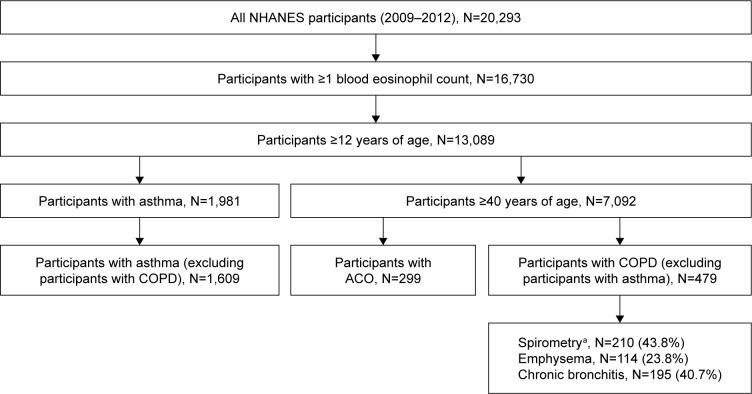
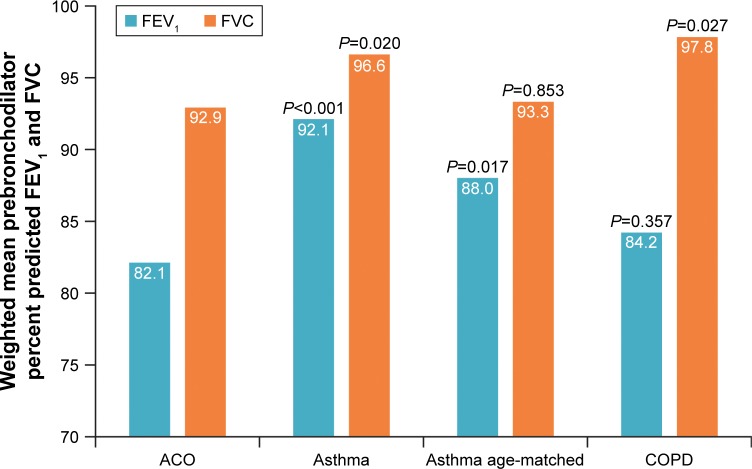
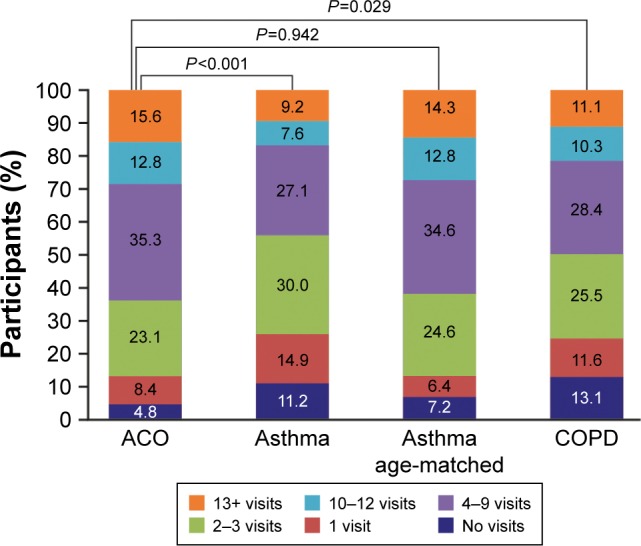
A total of 1,609, 479, and 299 participants with asthma, COPD, and ACO, respectively, were included. An age-matched asthma subgroup included 299 participants from the asthma group. Compared with asthma and COPD, participants with ACO had worse health status, increased disease burden, and more comorbid conditions. The ACO, vs age-matched asthma subgroup, had lower percent predicted prebronchodilator forced expiratory volume in 1 second (82.1% vs 88.0%; =0.017). The ACO group had significantly more asthma attacks in the past year than the age-matched asthma subgroup (49.8% vs 38.4%; <0.001). The ACO group had more participants with postbronchodilator forced expiratory volume in 1 second <80% predicted (52.1%) vs COPD (30.8%; =0.003) and more participants with blood eosinophil counts ≥400 cells/µL (16.9%) vs COPD (9.5%; =0.007) and the asthma subgroup (6.7%; =0.014).
The ACO group represents an important subset of patients with chronic respiratory disease with an increased burden of disease over asthma and COPD individually. Early identification of this population will enable appropriate therapeutic interventions in a timely manner.
哮喘和慢性阻塞性肺疾病(COPD)具有重叠的特征。由于关于哮喘-COPD重叠综合征(ACO)是否代表一种独特疾病的数据有限,本研究旨在确定ACO与哮喘和COPD的异同。
基于美国人群的横断面研究,使用国家健康和营养检查调查数据(2009 - 2012年),将ACO患者与哮喘或COPD患者进行比较,每种疾病状态相互排斥。分析了人口统计学、健康状况、残疾/功能受限、医疗资源利用、临床特征和外周血嗜酸性粒细胞计数。
分别纳入了1609例、479例和299例哮喘、COPD和ACO患者。一个年龄匹配的哮喘亚组包括来自哮喘组的299例患者。与哮喘和COPD相比,ACO患者的健康状况更差,疾病负担增加,合并症更多。与年龄匹配的哮喘亚组相比,ACO患者支气管扩张剂使用前1秒用力呼气容积预测值百分比更低(82.1%对88.0%;P = 0.017)。ACO组在过去一年中哮喘发作次数明显多于年龄匹配的哮喘亚组(49.8%对38.4%;P < 0.001)。ACO组支气管扩张剂使用后1秒用力呼气容积<预测值80%的患者比例高于COPD组(52.1%对30.8%;P = 0.003),外周血嗜酸性粒细胞计数≥400个/微升的患者比例高于COPD组(16.9%对9.5%;P = 0.007)和哮喘亚组(6.7%;P = 0.014)。
ACO组代表慢性呼吸系统疾病患者中的一个重要亚组,其疾病负担比单独的哮喘和COPD更重。早期识别该人群将有助于及时进行适当的治疗干预。