Li Qin, Deng Cunliang, Zhang Ting, Li Xiang
Department of Infectious Diseases, The Affiliated Hospital of Southwest Medical University, Luzhou, Sichuan Province, People's Republic of China.
School of Pharmacy, The Southwest Medical University, Luzhou, Sichuan Province, People's Republic of China,
Onco Targets Ther. 2018 Sep 12;11:5789-5796. doi: 10.2147/OTT.S168444. eCollection 2018.
Study on the relationship between glutathione-S-transferase Pi 1 (GSTP1) and P16 promoter region methylation and the risk of hepatitis B virus-related hepatocellular carcinoma (HBV-related HCC) has produced inconsistent results.
To assess the correlation between GSTP1 and P16 promoter methylation frequency and HBV-related HCC susceptibility.
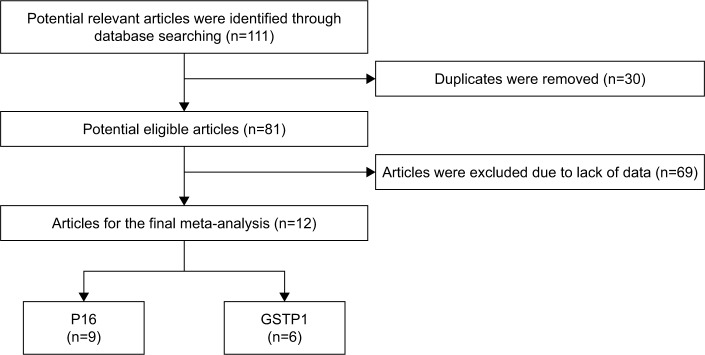
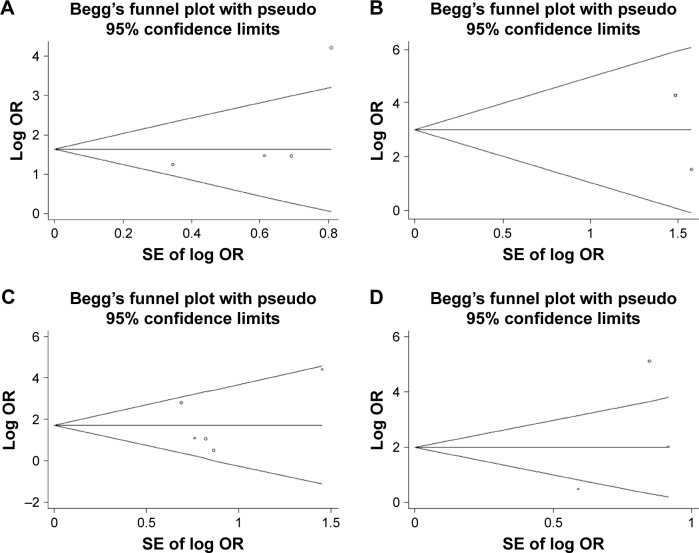
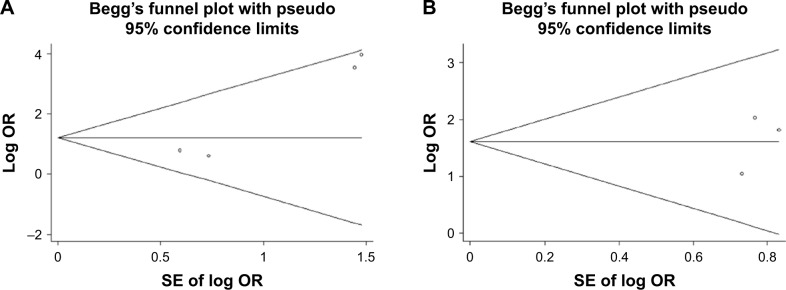
All relevant studies were identified by searching PubMed, Embase, Web of Science, and China National Knowledge Infrastructure literature databases before December, 2017. The OR and the corresponding 95% CI were calculated to investigate the risk of GSTP1 and P16 promoter methylation rate and HBV-related HCC. Sensitivity analysis was performed and publication bias was estimated using the Begg's and Egger's test.
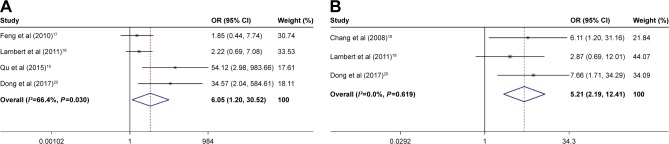
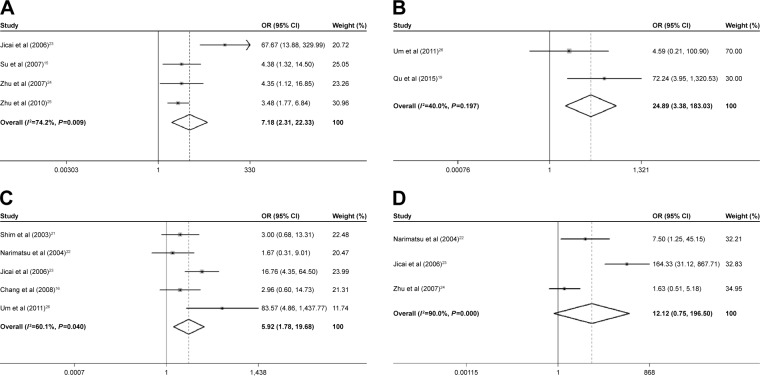
Our meta-analysis identified the relationships of GSTP1 (six studies including 213 HBV-related HCC tumor tissues) and P16 (nine studies with 287 HBV-related HCC tumor tissue) promoter methylation with HCC risk. Compared with normal liver tissue and cirrhosis, the pooled ORs of GSTP1 promoter region methylation in HBV-related HCC cancer tissues were 6.05 (95% CI =1.20-30.52) and 5.21 (95% CI =2.19-12.41), respectively. Compared with paracancerous tissue, normal liver tissue, cirrhosis, and chronic hepatitis B as controls, the pooled ORs of P16 promoter region methylation in HBV-related HCC cancer tissues were 7.18 (95% CI =2.31-22.33), 24.89 (95% CI =3.38-183.03), 5.92 (95% CI =1.78-19.68), and 12.12 (95% CI =0.75-196.50).
In summary, our meta-analysis found strong associations between GSTP1 and P16 gene promoter methylation and an increased HBV-related HCC susceptibility. Moreover, GSTP1 and P16 methylation in promoter region could obviously increase the risk of HBV-related HCC in patients with cirrhosis, indicating that these would be promising biomarkers for early clinical diagnosis of HBV-related HCC.
谷胱甘肽 - S - 转移酶Pi 1(GSTP1)与P16启动子区域甲基化和乙型肝炎病毒相关肝细胞癌(HBV相关HCC)风险之间关系的研究结果并不一致。
评估GSTP1和P16启动子甲基化频率与HBV相关HCC易感性之间的相关性。
通过检索2017年12月之前的PubMed、Embase、Web of Science和中国知网文献数据库来确定所有相关研究。计算比值比(OR)及相应的95%可信区间(CI),以研究GSTP1和P16启动子甲基化率与HBV相关HCC的风险。进行敏感性分析,并使用Begg检验和Egger检验评估发表偏倚。
我们的荟萃分析确定了GSTP1(六项研究,包括213个HBV相关HCC肿瘤组织)和P16(九项研究,有287个HBV相关HCC肿瘤组织)启动子甲基化与HCC风险之间的关系。与正常肝组织和肝硬化相比,HBV相关HCC癌组织中GSTP1启动子区域甲基化的合并OR分别为6.05(95%CI = 1.20 - 30.52)和5.21(95%CI = 2.19 - 12.41)。与癌旁组织、正常肝组织、肝硬化和慢性乙型肝炎作为对照相比,HBV相关HCC癌组织中P16启动子区域甲基化的合并OR分别为7.18(95%CI = 2.31 - 22.33)、24.89(95%CI = 3.38 - 183.03)、5.92(95%CI = 1.78 - 19.68)和12.12(95%CI = 0.75 - 196.50)。
总之,我们的荟萃分析发现GSTP1和P16基因启动子甲基化与HBV相关HCC易感性增加之间存在密切关联。此外,启动子区域的GSTP1和P16甲基化可明显增加肝硬化患者发生HBV相关HCC的风险,表明这些可能是HBV相关HCC早期临床诊断的有前景的生物标志物。