Faes Yannik, Banz Nora, Buscher Nathalie, Blasimann Angela, Radlinger Lorenz, Eichelberger Patric, Elfering Achim
Department of Work and Organizational Psychology, University of Bern, Bern 3012, Switzerland.
Department of Health Professions, Bern University of Applied Sciences, Bern 3008, Switzerland.
World J Orthop. 2018 Sep 18;9(9):156-164. doi: 10.5312/wjo.v9.i9.156.
To investigate the acute effects of sinusoidal and stochastic resonance partial-body vibration in sitting position, including muscle activity, heart rate variability, balance and flexibility.
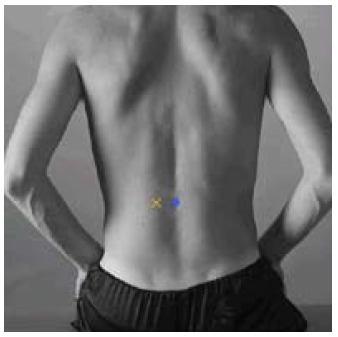
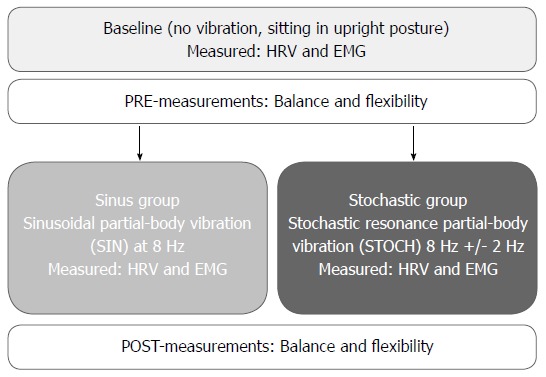
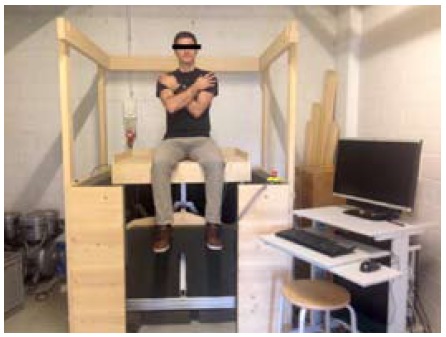
Fifty healthy participants were assigned randomly to two training conditions: A sinusoidal partial-body vibration (SIN, 8 Hz) or a stochastic resonance partial-body vibration (STOCH, 8 ± 2 Hz). For baseline assessment participants sat on the vibration platform without vibration. Both training conditions consisted of five series of a one-minute vibration training and a one-minute break between them. In this experimental study surface electromyography (EMG) of the erector spinae (ES), one of the back muscles, and heart rate variability (HRV) was measured at baseline and during training. Balance and flexibility were assessed at baseline and immediately after training. Balance was measured with the modified star excursion balance test (mSEBT) and flexibility was assessed through the modified fingertip-to-floor method (mFTF).
Paired sample -test showed a significant increase in balance that was restricted to STOCH ( = -2.22, = 0.018; SIN: = -0.09, = 0.466). An increase in flexibility was also restricted to STOCH ( = 2.65, = 0.007; SIN: = 1.41, = 0.086). There was no significant change of muscle activity in the ES-EMG in STOCH or SIN conditions. In both training conditions, HRV decreased significantly, but remained in a low-load range (STOCH: = 2.89, = 0.004; SIN: = 2.55, = 0.009).
In sitting position, stochastic resonance partial-body vibration can improve balance and flexibility while cardiovascular load is low. STOCH can be a valuable training option to people who are unable to stand (., people, who are temporarily wheelchair-bound).
研究坐姿下正弦和随机共振局部身体振动的急性效应,包括肌肉活动、心率变异性、平衡和灵活性。
50名健康参与者被随机分配到两种训练条件下:正弦局部身体振动(SIN,8赫兹)或随机共振局部身体振动(STOCH,8±2赫兹)。在基线评估时,参与者坐在振动平台上但不振动。两种训练条件均包括五组一分钟的振动训练,每组之间休息一分钟。在这项实验研究中,在基线和训练期间测量了背部肌肉之一竖脊肌(ES)的表面肌电图(EMG)和心率变异性(HRV)。在基线和训练后立即评估平衡和灵活性。使用改良的星形偏移平衡测试(mSEBT)测量平衡,通过改良的指尖触地法(mFTF)评估灵活性。
配对样本检验显示,平衡的显著增加仅限于STOCH组(t=-2.22,p=0.018;SIN组:t=-0.09,p=0.466)。灵活性的增加也仅限于STOCH组(t=2.65,p=0.007;SIN组:t=1.41,p=0.086)。在STOCH或SIN条件下,ES-EMG中的肌肉活动没有显著变化。在两种训练条件下,HRV均显著下降,但仍处于低负荷范围内(STOCH组:t=2.89,p=0.004;SIN组:t=2.55,p=0.009)。
在坐姿下,随机共振局部身体振动可在心血管负荷较低时改善平衡和灵活性。STOCH对于无法站立的人(例如暂时使用轮椅的人)可能是一种有价值的训练选择。