Mattes Benjamin, Scholpp Steffen
Living Systems Institute, School of Biosciences, College of Life and Environmental Science, University of Exeter, Exeter, EX4 4QD, UK.
Histochem Cell Biol. 2018 Nov;150(5):431-442. doi: 10.1007/s00418-018-1732-3. Epub 2018 Sep 25.
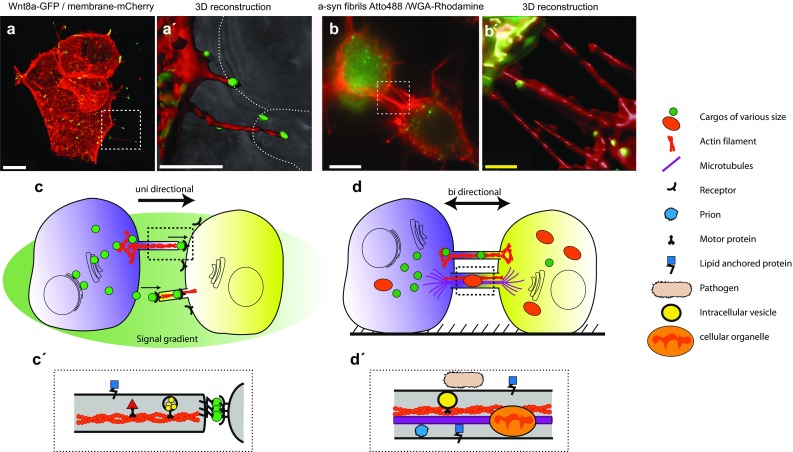
Cells of multicellular organisms are in continuous conversation with the neighbouring cells. The sender cells signal the receiver cells to influence their behaviour in transport, metabolism, motility, division, and growth. How cells communicate with each other can be categorized by biochemical signalling processes, which can be characterised by the distance between the sender cell and the receiver cell. Existing classifications describe autocrine signals as those where the sender cell is identical to the receiver cell. Complementary to this scenario, paracrine signalling describes signalling between a sender cell and a different receiver cell. Finally, juxtacrine signalling describes the exchange of information between adjacent cells by direct cell contact, whereas endocrine signalling describes the exchange of information, e.g., by hormones between distant cells or even organs through the bloodstream. In the last two decades, however, an unexpected communication mechanism has been identified which uses cell protrusions to exchange chemical signals by direct contact over long distances. These signalling protrusions can deliver signals in both ways, from sender to receiver and vice versa. We are starting to understand the morphology and function of these signalling protrusions in many tissues and this accumulation of findings forces us to revise our view of contact-dependent cell communication. In this review, we will focus on the two main categories of signalling protrusions, cytonemes and tunnelling nanotubes. These signalling protrusions emerge as essential structural components of a vibrant communication network in the development and tissue homeostasis of any multicellular organism.
多细胞生物的细胞与相邻细胞持续进行交流。发送信号的细胞向接收信号的细胞发出信号,以影响其在运输、代谢、运动、分裂和生长方面的行为。细胞间如何相互交流可根据生化信号传导过程进行分类,这可由发送信号的细胞与接收信号的细胞之间的距离来表征。现有的分类将自分泌信号描述为发送信号的细胞与接收信号的细胞相同的情况。与这种情况互补的是,旁分泌信号传导描述的是发送信号的细胞与不同的接收信号的细胞之间的信号传导。最后,近分泌信号传导描述的是相邻细胞通过直接细胞接触进行信息交换,而内分泌信号传导描述的是信息交换,例如通过激素在远距离的细胞甚至器官之间通过血液循环进行交换。然而,在过去二十年中,已经发现了一种意想不到的通讯机制,该机制利用细胞突起通过直接接触在远距离交换化学信号。这些信号突起可以双向传递信号,从发送者到接收者,反之亦然。我们开始了解这些信号突起在许多组织中的形态和功能,这些研究结果的积累迫使我们修正对依赖接触的细胞通讯的看法。在这篇综述中,我们将重点关注信号突起的两个主要类别,即丝状伪足和隧道纳米管。这些信号突起在任何多细胞生物的发育和组织稳态中作为一个活跃的通讯网络的重要结构组成部分而出现。