P Shenbagavalli, R Thangarajan
Department of Computer Science and Engineering, M.P.Nachimuthu M.Jaganathan Engineering College, Chennimalai, Erode-638 112, Tamilnadu, India. Email:
Asian Pac J Cancer Prev. 2018 Sep 26;19(9):2665-2671. doi: 10.22034/APJCP.2018.19.9.2665.
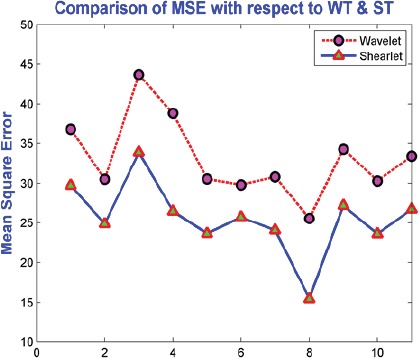
Objective: Breast Cancer is the most invasive disease and fatal disease next to lung cancer in human. Early detection of breast cancer is accomplished by X-ray mammography. Mammography is the most effective and efficient technique used for detection of breast cancer in women and also to improve the breast cancer prognosis. The numbers of images need to be examined by the radiologists, the resulting may be misdiagnosis due to human errors by visual Fatigue. In order to avoid human errors, Computer Aided Diagnosis is implemented. In Computer Aided Diagnosis system, number of processing and analysis of an image is done by the suitable algorithm. Methods: This paper proposed a technique to aid radiologist to diagnosis breast cancer using Shearlet transform image enhancement method. Similar to wavelet filter, Shearlet coefficients are more directional sensitive than wavelet filters which helps detecting the cancer cells particularly for small contours. After enhancement of an image, segmentation algorithm is applied to identify the suspicious region. Result: Many features are extracted and utilized to classify the mammographic images into harmful or harmless tissues using neural network classifier. Conclusions: Multi-scale Shearlet transform because more details on data phase, directionality and shift invariance than wavelet based transforms. The proposed Shearlet transform gives multi resolution result and generate malign and benign classification more accurate up to 93.45% utilizing DDSM database.
乳腺癌是人类中仅次于肺癌的最具侵袭性和致命性的疾病。乳腺癌的早期检测通过X线乳腺摄影来完成。乳腺摄影是用于检测女性乳腺癌以及改善乳腺癌预后的最有效和高效的技术。放射科医生需要检查的图像数量众多,由于视觉疲劳导致的人为错误,结果可能会出现误诊。为了避免人为错误,实施了计算机辅助诊断。在计算机辅助诊断系统中,通过合适的算法对图像进行大量的处理和分析。方法:本文提出了一种使用剪切波变换图像增强方法辅助放射科医生诊断乳腺癌的技术。与小波滤波器类似,剪切波系数比小波滤波器对方向更敏感,这有助于检测癌细胞,特别是对于小轮廓。在图像增强后,应用分割算法来识别可疑区域。结果:提取了许多特征,并利用神经网络分类器将乳腺图像分类为有害或无害组织。结论:多尺度剪切波变换在数据相位、方向性和位移不变性方面比基于小波的变换具有更多细节。所提出的剪切波变换给出了多分辨率结果,并利用DDSM数据库生成恶性和良性分类,准确率高达93.45%。