Bello-Bello Jericó Jabín, Spinoso-Castillo José Luis, Arano-Avalos Samantha, Martínez-Estrada Eduardo, Arellano-García María Evarista, Pestryakov Alexey, Toledano-Magaña Yanis, García-Ramos Juan Carlos, Bogdanchikova Nina
Conacyt-Colegio de Postgraduados Campus Córdoba, Carretera Córdoba Veracruz, Amatlán de los Reyes Km 348, Veracruz 94946, Mexico.
Colegio de Postgraduados Campus Córdoba, Carretera Córdoba Veracruz, Amatlán de los Reyes Km 348, Veracruz 94946, Mexico.
Nanomaterials (Basel). 2018 Sep 25;8(10):754. doi: 10.3390/nano8100754.
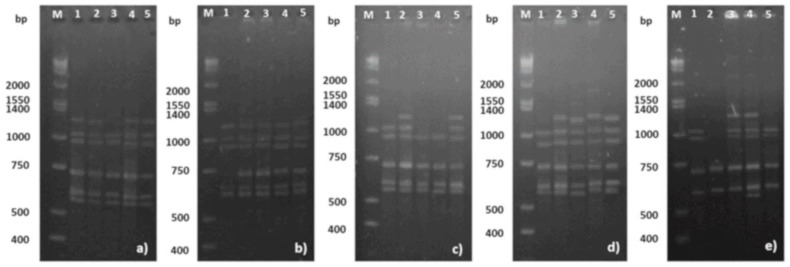
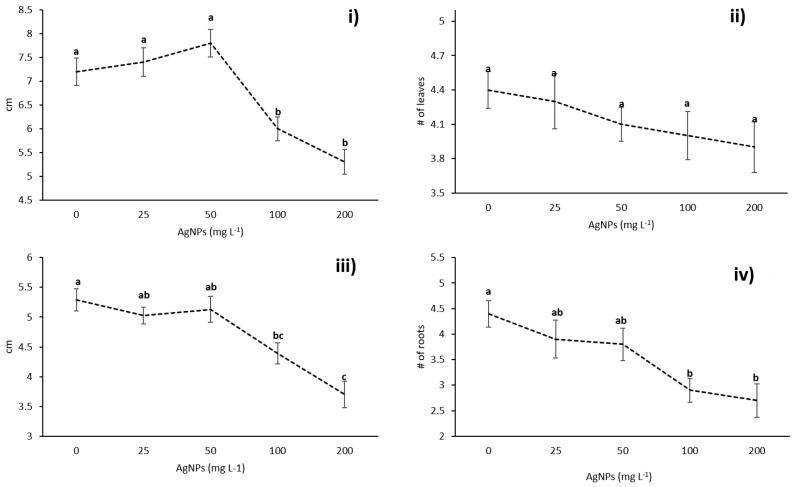
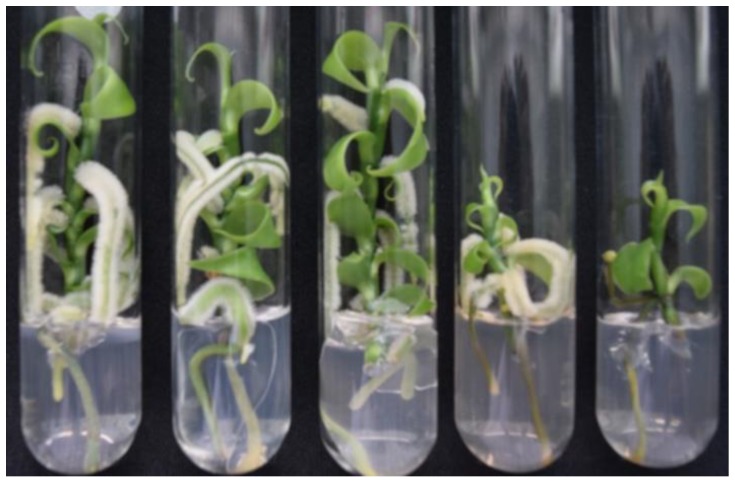
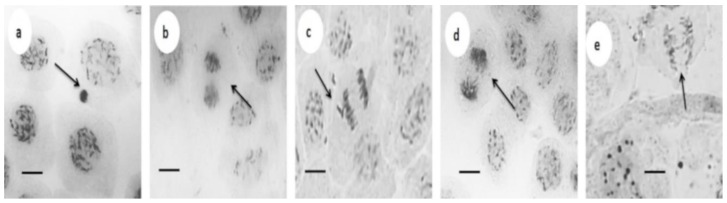
Worldwide demands of lead to finding new options to produce large-scale and contaminant-free crops. Particularly, the Mexican Government has classified at risk and it subject to protection programs since wild species are in danger of extinction and no more than 30 clones have been found. Nanotechnology could help to solve both demands and genetic variability, but toxicological concerns must be solved. In this work, we present the first study of the cytotoxic and genotoxic effects promoted by AgNPs in plantlets after a very long exposure time of six weeks. Our results show that plantlets growth with doses of 25 and 50 mg/L is favored with a small decrease in the mitotic index. A dose-dependency in the frequency of cells with chromosomal aberrations and micronuclei was found. However, genotoxic effects could be considered as minimum due to with the highest concentration employed (200 mg/L), the total percentage of chromatic aberrations is lower than 5% with only three micronuclei in 3000 cells, despite the long-time exposure to AgNP. Therefore, 25 and 50 mg/L (1.5 and 3 mg/L of metallic silver) were identified as safe concentrations for growth on in vitro conditions. Exposure of plantlets to AgNPs increase the polymorphism registered by inter-simple sequence repeat method (ISSR), which could be useful to promote the genetic variability of this species.
全球对[具体内容缺失]的需求促使人们寻找新的方法来大规模生产无污染作物。特别是,墨西哥政府已将[具体内容缺失]列为濒危物种并实施保护计划,因为野生种群面临灭绝危险,且发现的克隆体不超过30个。纳米技术有助于满足这两方面需求并解决遗传变异性问题,但毒理学方面的担忧必须得到解决。在这项工作中,我们首次研究了银纳米颗粒(AgNPs)在经过六周的长时间暴露后对[具体植物缺失]幼苗产生的细胞毒性和遗传毒性作用。我们的结果表明,25和50 mg/L剂量的AgNPs有利于[具体植物缺失]幼苗生长,同时有丝分裂指数略有下降。在具有染色体畸变和微核的细胞频率上发现了剂量依赖性。然而,由于即使在最高使用浓度(200 mg/L)下,尽管长时间暴露于AgNP,但在3000个细胞中染色畸变的总百分比低于5%且仅有三个微核,因此遗传毒性作用可被视为最小。所以,25和50 mg/L(1.5和3 mg/L金属银)被确定为[具体植物缺失]在体外条件下生长的安全浓度。将幼苗暴露于AgNPs会增加通过简单序列重复区间法(ISSR)记录的多态性,这可能有助于促进该物种的遗传变异性。