Department of Psychiatry and Seaver Autism Center for Research and Treatment, Icahn School of Medicine at Mount Sinai, New York, USA.
Center for Neural Science, New York University, New York, NY, 10003, USA.
Transl Psychiatry. 2018 Sep 26;8(1):204. doi: 10.1038/s41398-018-0229-0.
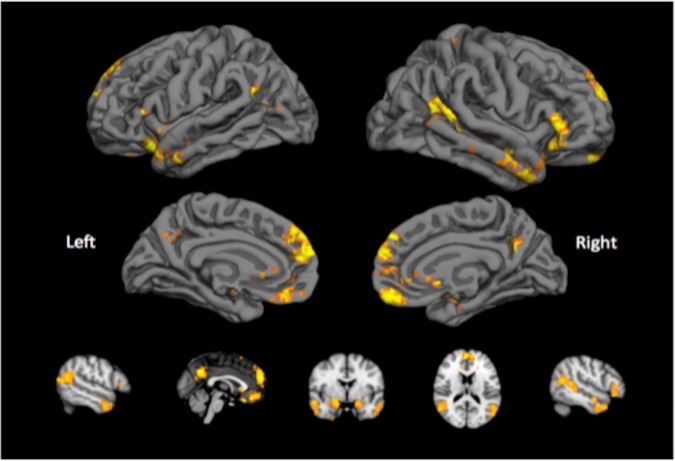
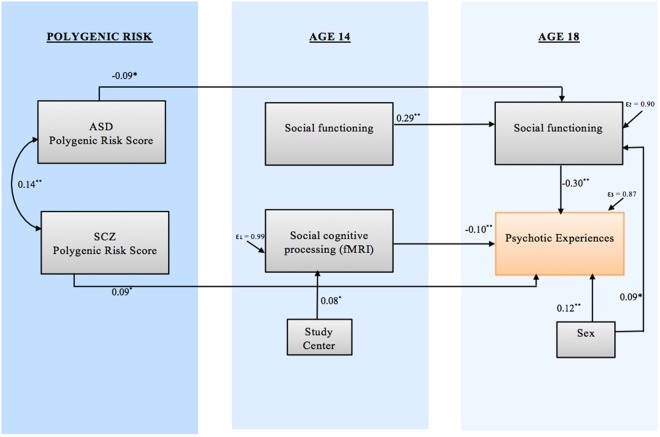
While psychotic experiences (PEs) are assumed to represent psychosis liability, general population studies have not been able to establish significant associations between polygenic risk scores (PRS) and PEs. Previous work suggests that PEs may only represent significant risk when accompanied by social impairment. Leveraging data from the large longitudinal IMAGEN cohort, including 2096 14-year old adolescents that were followed-up to age 18, we tested whether the association between polygenic risk and PEs is mediated by (increasing) impairments in social functioning and social cognitive processes. Using structural equation modeling (SEM) for the subset of participants (n = 643) with complete baseline and follow-up data, we examined pathways to PEs. We found that high polygenic risk for schizophrenia (p = 0.014), reduced brain activity to emotional stimuli (p = 0.009) and social impairments in late adolescence (p < 0.001; controlling for functioning in early adolescence) each independently contributed to the severity of PEs at age 18. The pathway between polygenic risk for autism spectrum disorder and PEs was mediated by social impairments in late adolescence (indirect pathway; p = 0.025). These findings point to multiple direct and indirect pathways to PEs, suggesting that different processes are in play, depending on genetic loading, and environment. Our results suggest that treatments targeting prevention of social impairment may be particularly promising for individuals at genetic risk for autism in order to minimize risk for psychosis.
虽然精神病体验(PE)被认为代表了精神病的易感性,但一般人群研究未能在多基因风险评分(PRS)和 PE 之间建立显著关联。之前的工作表明,只有当 PE 伴有社会功能障碍时,才可能代表显著风险。利用来自大型纵向 IMAGEN 队列的数据,包括 2096 名 14 岁的青少年,随访至 18 岁,我们测试了多基因风险与 PE 之间的关联是否通过(增加)社会功能和社会认知过程的损害来介导。对于具有完整基线和随访数据的参与者子集(n=643),我们使用结构方程模型(SEM)来检验通向 PE 的途径。我们发现,精神分裂症的高多基因风险(p=0.014)、对情绪刺激的大脑活动减少(p=0.009)和青少年晚期的社会功能障碍(p<0.001;控制了青少年早期的功能),每个因素都独立导致 18 岁时 PE 的严重程度增加。自闭症谱系障碍的多基因风险与 PE 之间的途径是由青少年晚期的社会功能障碍介导的(间接途径;p=0.025)。这些发现指向通向 PE 的多种直接和间接途径,表明不同的过程在起作用,这取决于遗传负荷和环境。我们的研究结果表明,针对预防社会功能障碍的治疗方法可能对处于自闭症遗传风险的个体特别有希望,以最大限度地降低精神病的风险。