Department of Psychiatry, Amsterdam UMC, University of Amsterdam, Amsterdam, The Netherlands.
Department of Psychology, University of Amsterdam, Amsterdam, The Netherlands.
Psychol Med. 2021 Jul;51(10):1704-1713. doi: 10.1017/S0033291720000458. Epub 2020 Mar 10.
Prevalence estimates of autistic traits in individuals with psychotic disorders (PD) vary greatly and it is unclear whether individuals with a familial risk (FR) for psychosis have an increased propensity to display autistic traits. Furthermore, it is unknown whether the presence of comorbid autism traits disproportionally affects the cognitive and behavioral aspects of social functioning in PD.
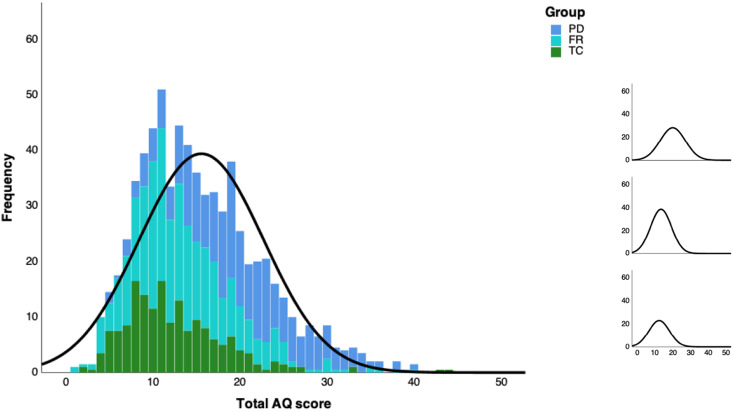
In total, 504 individuals with PD, 587 unaffected siblings with FR, and 337 typical comparison (TC) individuals (16-50 years) were included. Autistic and psychotic traits were measured with the Autism Spectrum Quotient (AQ) and the Community Assessment of Psychic Experiences (CAPE). Social cognition was assessed with the Picture Sequencing Task (PST) and social behavior with the Social Functioning Scale (SFS).
For PD 6.5% scored above AQ clinical cut-off (⩾32), 1.0% for FR, and 1.2% for TC. After accounting for age, sex, and IQ, the PD group showed significantly more autistic traits and alterations in social behavior and cognition, while FR and TC only displayed marginal differences. Within the PD group autistic traits were a robust predictor of social behavior and there were no interactions with positive psychotic symptoms.
Levels of autistic traits are substantially elevated in PD and have a profoundly negative association with social functioning. In contrast, autistic traits above the clinical cut-off are not elevated in those with FR, and only marginally on a dimensional level. These findings warrant specific clinical guidelines for psychotic patients who present themselves with autistic comorbidity to help address their social needs.
精神分裂症患者(PD)自闭症特征的流行率估计差异很大,目前尚不清楚是否有精神分裂症家族风险(FR)的个体更倾向于表现出自闭症特征。此外,尚不清楚合并自闭症特征是否会不成比例地影响 PD 患者的认知和行为方面的社会功能。
共纳入 504 名 PD 患者、587 名无 FR 的未受影响的兄弟姐妹和 337 名典型对照组(TC)个体(16-50 岁)。自闭症和精神病特征采用自闭症谱系商数(AQ)和社区心理体验评估(CAPE)进行测量。社会认知采用图片序列任务(PST)评估,社会行为采用社会功能量表(SFS)评估。
PD 组有 6.5%的人 AQ 得分高于临床截断值(≥32),FR 组有 1.0%,TC 组有 1.2%。在考虑年龄、性别和智商后,PD 组表现出明显更多的自闭症特征以及社会行为和认知的改变,而 FR 和 TC 仅显示出边缘差异。在 PD 组中,自闭症特征是社会行为的一个强有力的预测因素,与阳性精神病症状没有相互作用。
PD 患者的自闭症特征显著升高,与社会功能呈显著负相关。相比之下,FR 组的自闭症特征未高于临床截断值,仅在维度水平上略有升高。这些发现需要为出现自闭症共病的精神病患者制定特定的临床指南,以帮助满足他们的社会需求。