Kasaragod Vikram B, Schindelin Hermann
Institute of Structural Biology, Rudolf Virchow Center for Experimental Biomedicine, University of Würzburg, Würzburg, Germany.
Front Mol Neurosci. 2018 Sep 12;11:317. doi: 10.3389/fnmol.2018.00317. eCollection 2018.
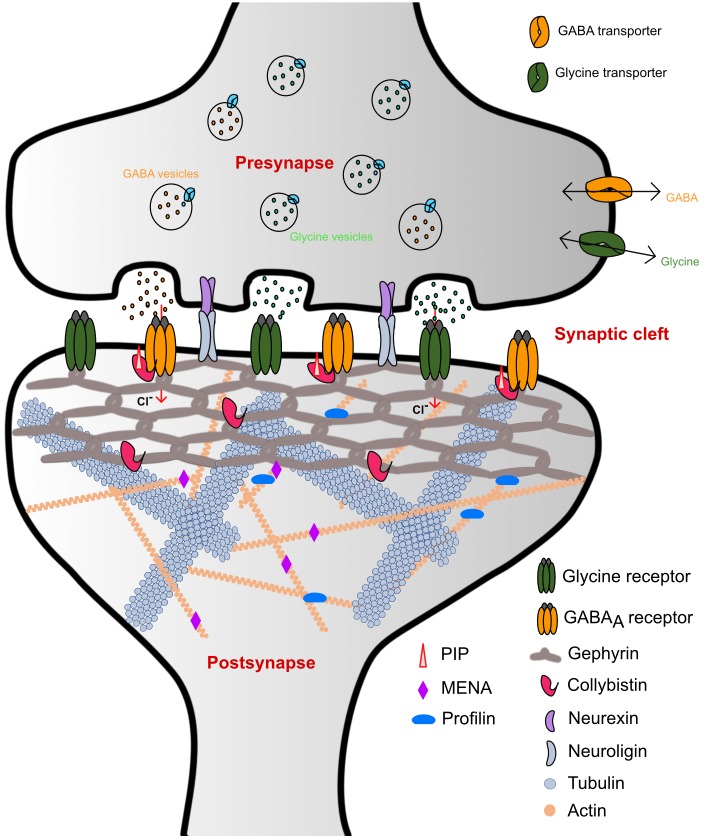
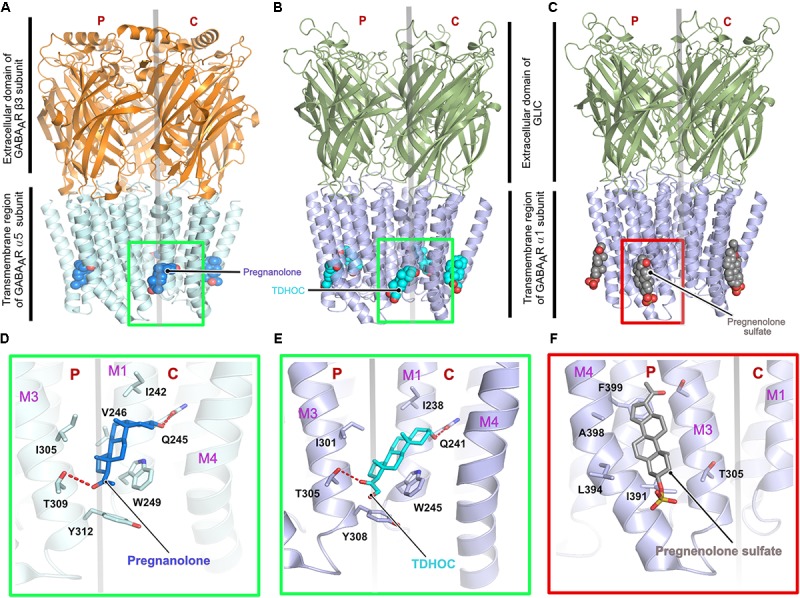
Glycine and γ-aminobutyric acid (GABA) are the major determinants of inhibition in the central nervous system (CNS). These neurotransmitters target glycine and GABA receptors, respectively, which both belong to the Cys-loop superfamily of pentameric ligand-gated ion channels (pLGICs). Interactions of the neurotransmitters with the cognate receptors result in receptor opening and a subsequent influx of chloride ions, which, in turn, leads to hyperpolarization of the membrane potential, thus counteracting excitatory stimuli. The majority of glycine receptors and a significant fraction of GABA receptors (GABARs) are recruited and anchored to the post-synaptic membrane by the central scaffolding protein gephyrin. This ∼93 kDa moonlighting protein is structurally organized into an N-terminal G-domain (GephG) connected to a C-terminal E-domain (GephE) via a long unstructured linker. Both inhibitory neurotransmitter receptors interact via a short peptide motif located in the large cytoplasmic loop located in between transmembrane helices 3 and 4 (TM3-TM4) of the receptors with a universal receptor-binding epitope residing in GephE. Gephyrin engages in nearly identical interactions with the receptors at the N-terminal end of the peptide motif, and receptor-specific interaction toward the C-terminal region of the peptide. In addition to its receptor-anchoring function, gephyrin also interacts with a rather large collection of macromolecules including different cytoskeletal elements, thus acting as central scaffold at inhibitory post-synaptic specializations. Dysfunctions in receptor-mediated or gephyrin-mediated neurotransmission have been identified in various severe neurodevelopmental disorders. Although biochemical, cellular and electrophysiological studies have helped to understand the physiological and pharmacological roles of the receptors, recent high resolution structures of the receptors have strengthened our understanding of the receptors and their gating mechanisms. Besides that, multiple crystal structures of GephE in complex with receptor-derived peptides have shed light into receptor clustering by gephyrin at inhibitory post-synapses. This review will highlight recent biochemical and structural insights into gephyrin and the GlyRs as well as GABA receptors, which provide a deeper understanding of the molecular machinery mediating inhibitory neurotransmission.
甘氨酸和γ-氨基丁酸(GABA)是中枢神经系统(CNS)中抑制作用的主要决定因素。这些神经递质分别作用于甘氨酸受体和GABA受体,它们都属于五聚体配体门控离子通道(pLGICs)的半胱氨酸环超家族。神经递质与同源受体的相互作用导致受体开放,随后氯离子内流,进而导致膜电位超极化,从而抵消兴奋性刺激。大多数甘氨酸受体和相当一部分GABA受体(GABARs)通过中央支架蛋白gephyrin募集并锚定在突触后膜上。这种约93 kDa的兼职蛋白在结构上被组织成一个通过长的无结构连接子连接到C端E结构域(GephE)的N端G结构域(GephG)。两种抑制性神经递质受体都通过位于受体跨膜螺旋3和4(TM3-TM4)之间的大细胞质环中的短肽基序与位于GephE中的通用受体结合表位相互作用。Gephyrin在肽基序的N端与受体进行几乎相同的相互作用,并对肽的C端区域进行受体特异性相互作用。除了其受体锚定功能外,gephyrin还与包括不同细胞骨架成分在内的相当多的大分子相互作用,因此在抑制性突触后特化中充当中央支架。在各种严重的神经发育障碍中已发现受体介导或gephyrin介导的神经传递功能障碍。尽管生化、细胞和电生理研究有助于理解受体的生理和药理作用,但最近受体的高分辨率结构加强了我们对受体及其门控机制的理解。除此之外,GephE与受体衍生肽复合物的多个晶体结构揭示了gephyrin在抑制性突触后使受体聚集的情况。本综述将重点介绍最近关于gephyrin以及甘氨酸受体和GABA受体的生化和结构见解,这些见解有助于更深入地理解介导抑制性神经传递的分子机制。