Boardman James P, Ireland Graeme, Sullivan Gemma, Pataky Rozalia, Fleiss Bobbi, Gressens Pierre, Miron Veronique
MRC Centre for Reproductive Health, The Queen's Medical Research Institute, The University of Edinburgh, Edinburgh, United Kingdom.
Centre for Clinical Brain Sciences, Chancellor's Building, The University of Edinburgh, Edinburgh, United Kingdom.
Front Physiol. 2018 Sep 12;9:1299. doi: 10.3389/fphys.2018.01299. eCollection 2018.
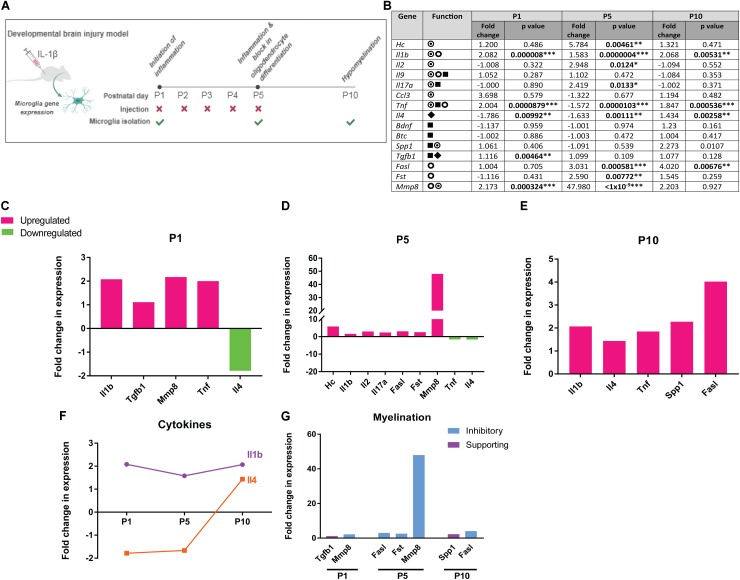
Preterm birth is the leading risk factor for perinatal white matter injury, which can lead to motor and neuropsychiatric impairment across the life course. There is an unmet clinical need for therapeutics. White matter injury is associated with an altered inflammatory response in the brain, primarily led by microglia, and subsequent hypomyelination. However, microglia can release both damaging and trophic factors in response to injury, and a comprehensive assessment of these factors in the preterm central nervous system (CNS) has not been carried out. A custom antibody array was used to assess relative levels of 50 inflammation- and myelination-associated proteins in the cerebrospinal fluid (CSF) of preterm infants in comparison to term controls. Fifteen proteins differed between the groups: BDNF, BTC, C5a, FasL, Follistatin, IL-1β, IL-2, IL-4, IL-9, IL-17A, MIP-1α, MMP8, SPP1, TGFβ, and TNFβ ( < 0.05). To investigate the temporal regulation of these proteins after injury, we mined a gene expression dataset of microglia isolated from a mouse model of developmental white matter injury. Microglia in the experimental model showed dynamic temporal expression of genes encoding these proteins, with an initial and sustained pro-inflammatory response followed by a delayed anti-inflammatory response, and a continuous expression of genes predicted to inhibit healthy myelination. Preterm CSF shows a distinct neuroinflammatory profile compared to term controls, suggestive of a complex neural environment with concurrent damaging and reparative signals. We propose that limitation of pro-inflammatory responses, which occur early after perinatal insult, may prevent expression of myelination-suppressive genes and support healthy white matter development.
早产是围产期白质损伤的主要危险因素,可导致一生的运动和神经精神障碍。临床上对治疗方法存在未满足的需求。白质损伤与大脑中炎症反应改变有关,主要由小胶质细胞引起,随后是髓鞘形成减少。然而,小胶质细胞在损伤后可释放损伤性和营养性因子,尚未对早产中枢神经系统(CNS)中的这些因子进行全面评估。使用定制抗体阵列评估早产儿脑脊液(CSF)中50种炎症和髓鞘形成相关蛋白的相对水平,并与足月儿对照进行比较。两组之间有15种蛋白存在差异:脑源性神经营养因子(BDNF)、双向调节蛋白(BTC)、C5a、Fas配体(FasL)、卵泡抑素、白细胞介素-1β(IL-1β)、白细胞介素-2(IL-2)、白细胞介素-4(IL-4)、白细胞介素-9(IL-9)、白细胞介素-17A(IL-17A)、巨噬细胞炎性蛋白-1α(MIP-1α)、基质金属蛋白酶8(MMP8)、分泌性磷蛋白1(SPP1)、转化生长因子β(TGFβ)和肿瘤坏死因子β(TNFβ)(P<0.05)。为了研究损伤后这些蛋白的时间调控,我们挖掘了从发育性白质损伤小鼠模型中分离的小胶质细胞的基因表达数据集。实验模型中的小胶质细胞显示出编码这些蛋白的基因的动态时间表达,最初是持续的促炎反应,随后是延迟的抗炎反应,以及预测会抑制健康髓鞘形成的基因的持续表达。与足月儿对照相比,早产脑脊液显示出独特 的神经炎症特征,提示存在具有同时损伤性和修复性信号的复杂神经环境。我们提出,限制围产期损伤后早期发生的促炎反应,可能会阻止髓鞘形成抑制基因的表达,并支持健康的白质发育。