De Silva A N L M, Dawson Andrew H, Gawarammana Indika B, Tennakoon Sampath, Rajapakse Thilini
1South Asian Clinical Toxicology Research Collaboration, Faculty of Medicine, University of Peradeniya, Peradeniya, Sri Lanka.
2Central Clinical School, University of Sydney, Sydney, Australia.
Pilot Feasibility Stud. 2018 Sep 24;4:150. doi: 10.1186/s40814-018-0341-1. eCollection 2018.
Deliberate self-harm in the form of non-fatal self-poisoning is a major public health problem in Sri Lanka. Previous work suggests that many nurses in Sri Lanka-particularly those who work in primary care in the medical treatment of persons who attempt self-poisoning-already approach their role in a holistic fashion and consider "advising" or "counseling" patients after self-poisoning to be a part of their nursing role. But there is no formal training given to such nurses at present nor has the efficacy or feasibility of such an intervention been assessed in Sri Lanka. The aims of this pilot study are to explore the potential efficacy, acceptability, and feasibility of carrying out a counseling intervention that could be delivered by nurses for persons who present to hospital for medical management of non-fatal self-poisoning.
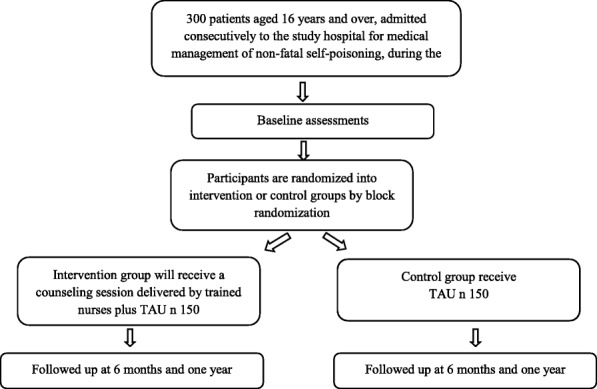
METHODS/DESIGN: The study will be carried out at the Toxicology Unit of Teaching Hospital Peradeniya, Sri Lanka. A pilot randomized controlled trial will be carried out among participants admitted to Teaching Hospital Peradeniya for medical management of non-fatal self-poisoning. The primary objective of this study is to explore the acceptability and feasibility of a counseling intervention being delivered by nurses. The secondary objectives are to explore the efficacy of the intervention for the improvement of skills to cope with situations of acute emotional distress, and to reduce rates of anxiety, depression, and future repetition and suicidal ideation. A nurse's experiences and attitudes regarding the acceptability and feasibility of implementing this intervention and participant experiences of the intervention and its effects will be explored via qualitative interviews and focus group discussions.
It is anticipated that the findings of this pilot study will help determine and assess the acceptability and feasibility of this counseling intervention, as well as indicate the more useful aspects of this intervention in order to develop it for further exploration in a larger trial.
SLCTR/2017/008 Registered on 21st March 2017.
非致命性自我中毒形式的蓄意自我伤害是斯里兰卡的一个主要公共卫生问题。先前的研究表明,斯里兰卡的许多护士——尤其是那些在初级保健机构工作、负责治疗自我中毒者的护士——已经以整体的方式履行职责,并将自我中毒后“建议”或“辅导”患者视为其护理职责的一部分。但目前尚未对这类护士进行正规培训,在斯里兰卡也未评估这种干预措施的有效性或可行性。这项试点研究的目的是探讨由护士为因非致命性自我中毒而前来医院接受治疗的患者实施辅导干预的潜在效果、可接受性和可行性。
方法/设计:该研究将在斯里兰卡佩拉德尼亚教学医院的毒理学科进行。将对因非致命性自我中毒而入住佩拉德尼亚教学医院接受治疗的参与者开展一项试点随机对照试验。本研究的主要目的是探讨由护士实施辅导干预的可接受性和可行性。次要目的是探讨该干预措施在提高应对急性情绪困扰情况的技能、降低焦虑和抑郁发生率以及减少未来重复自我中毒和自杀意念方面的效果。将通过定性访谈和焦点小组讨论来探究护士对实施该干预措施的可接受性和可行性的经验及态度,以及参与者对该干预措施及其效果的体验。
预计这项试点研究的结果将有助于确定和评估这种辅导干预的可接受性和可行性,并指出该干预措施更有用的方面,以便在更大规模的试验中进一步探索。
SLCTR/2017/008,于2017年3月21日注册。