Department of Surgery and Cancer, Imperial College London, Hammersmith Hospital, Du Cane Rd, London, W120NN, UK.
Department of Radiology, Imperial College Healthcare NHS Trust, London, UK.
Eur J Nucl Med Mol Imaging. 2018 Dec;45(13):2285-2299. doi: 10.1007/s00259-018-4098-9. Epub 2018 Sep 27.
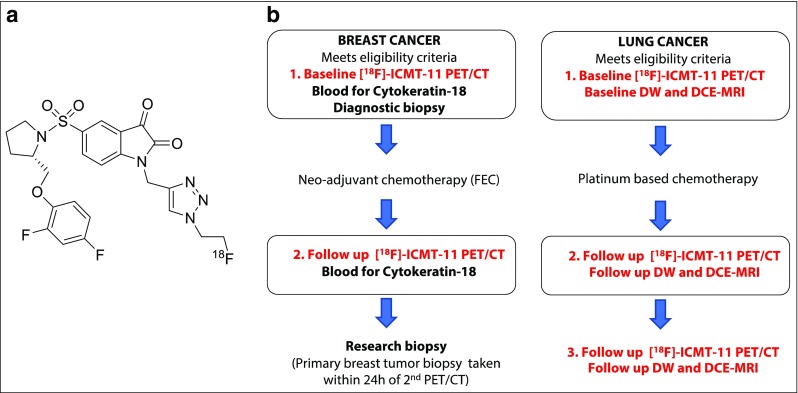
Effective anticancer therapy is thought to involve induction of tumour cell death through apoptosis and/or necrosis. [F]ICMT-11, an isatin sulfonamide caspase-3/7-specific radiotracer, has been developed for PET imaging and shown to have favourable dosimetry, safety, and biodistribution. We report the translation of [F]ICMT-11 PET to measure chemotherapy-induced caspase-3/7 activation in breast and lung cancer patients receiving first-line therapy.
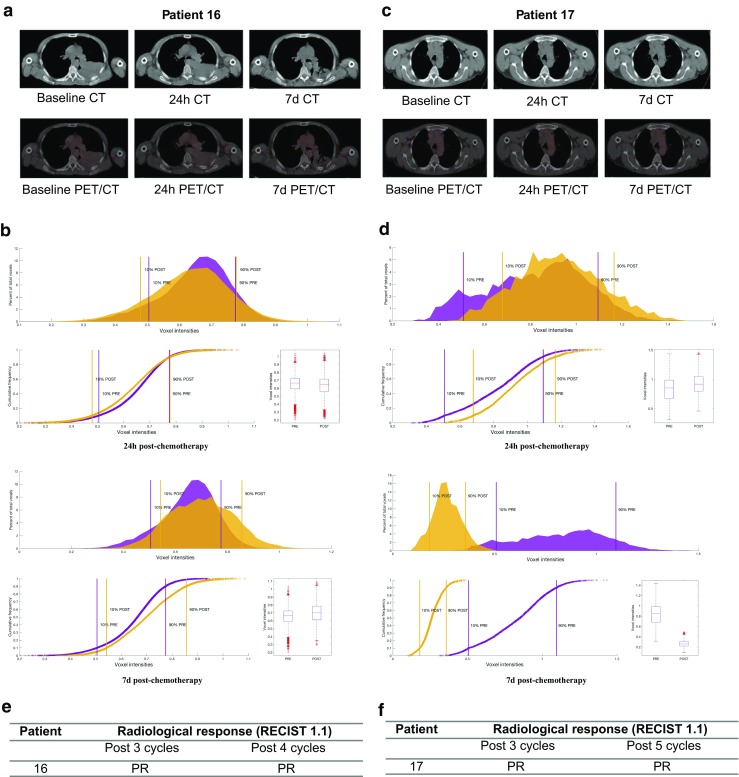
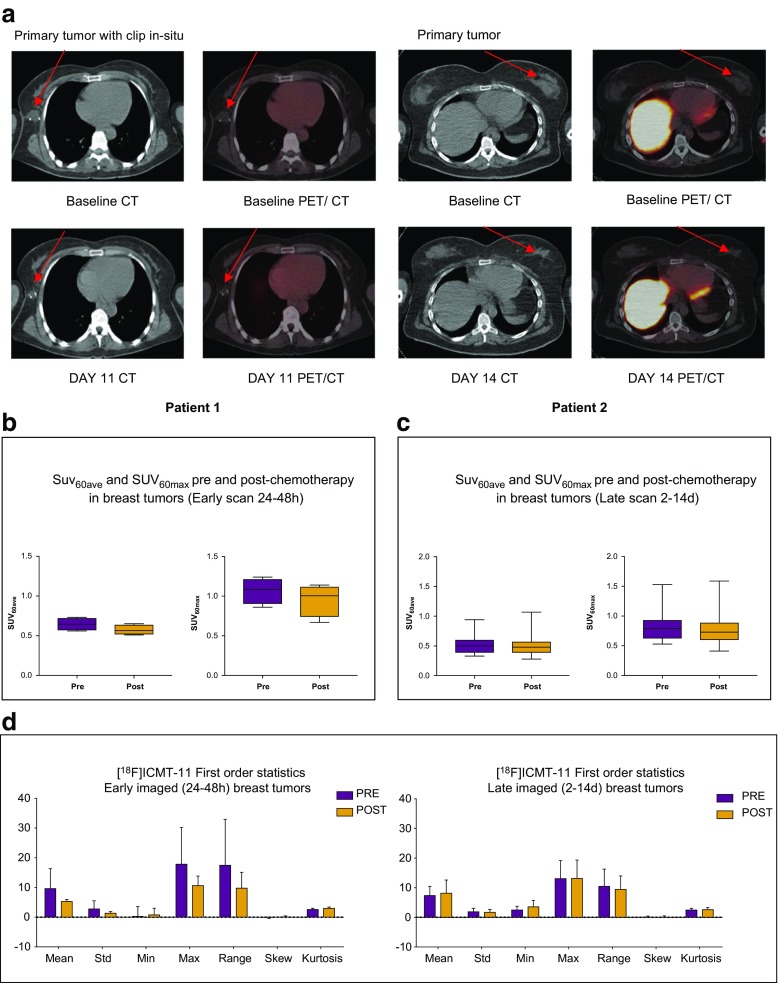
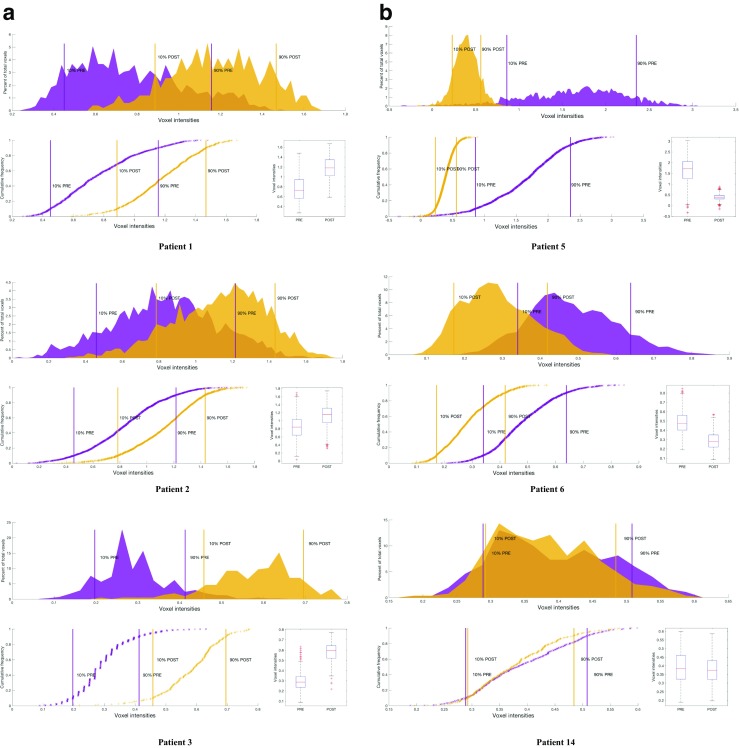
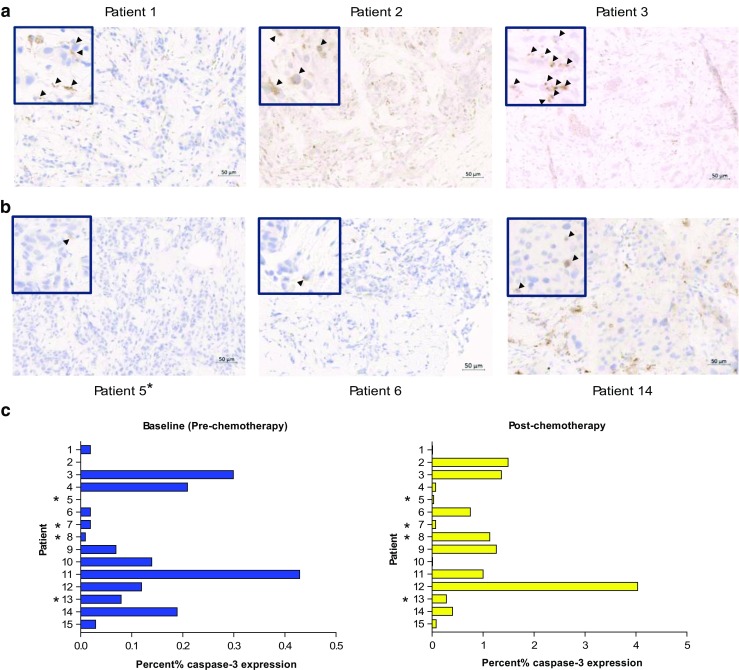
Breast tumour SUV of [F]ICMT-11 was low at baseline and unchanged following therapy. Measurement of M30/M60 cytokeratin-18 cleavage products showed that therapy was predominantly not apoptosis in nature. While increases in caspase-3 staining on breast histology were seen, post-treatment caspase-3 positivity values were only approximately 1%; this low level of caspase-3 could have limited sensitive detection by [F]ICMT-11-PET. Fourteen out of 15 breast cancer patients responded to first-line chemotherapy (complete or partial response); one patient had stable disease. Four patients showed increases in regions of high tumour [F]ICMT-11 intensity on voxel-wise analysis of tumour data (classed as PADS); response was not exclusive to patients with this phenotype. In patients with lung cancer, multi-parametric [F]ICMT-11 PET and MRI (diffusion-weighted- and dynamic contrast enhanced-MRI) showed that PET changes were concordant with cell death in the absence of significant perfusion changes.
This study highlights the potential use of [F]ICMT-11 PET as a promising candidate for non-invasive imaging of caspase3/7 activation, and the difficulties encountered in assessing early-treatment responses. We summarize that tumour response could occur in the absence of predominant chemotherapy-induced caspase-3/7 activation measured non-invasively across entire tumour lesions in patients with breast and lung cancer.
有效的抗癌疗法被认为涉及通过细胞凋亡和/或坏死诱导肿瘤细胞死亡。[F]ICMT-11 是一种色氨酸磺酰胺半胱天冬酶-3/7 特异性放射性示踪剂,已被开发用于 PET 成像,并显示出良好的剂量学、安全性和生物分布。我们报告了[F]ICMT-11 PET 的转化,以测量接受一线治疗的乳腺癌和肺癌患者化疗诱导的半胱天冬酶-3/7 激活。
乳腺癌肿瘤 SUV 在基线时较低,治疗后不变。M30/M60 角蛋白-18 切割产物的测量表明,治疗主要不是凋亡。虽然在乳腺癌组织学上观察到半胱天冬酶-3 染色增加,但治疗后半胱天冬酶-3 阳性值仅约为 1%;这种低水平的半胱天冬酶可能通过[F]ICMT-11-PET 进行敏感检测有限。15 名乳腺癌患者中有 14 名对一线化疗有反应(完全或部分缓解);一名患者病情稳定。4 名患者在肿瘤数据的体素分析中显示出高肿瘤[F]ICMT-11 强度区域增加(归类为 PADS);这种表型的患者并非唯一有反应。在肺癌患者中,多参数[F]ICMT-11 PET 和 MRI(扩散加权和动态对比增强 MRI)显示,在没有明显灌注变化的情况下,PET 变化与细胞死亡一致。
本研究强调了[F]ICMT-11 PET 作为一种有前途的候选物,用于非侵入性成像半胱天冬酶-3/7 激活的潜在用途,以及在评估早期治疗反应时遇到的困难。我们总结说,在接受乳腺癌和肺癌治疗的患者中,整个肿瘤病变的非侵入性测量未显示出主要的化疗诱导的半胱天冬酶-3/7 激活,肿瘤反应也可能发生。