Heart Failure Research Center, Division of Cardiology, Department of Internal Medicine, Chang Gung Memorial Hospital, 222 Mai Chin Road, Keelung, Taiwan, ROC.
Chang Gung University College of Medicine, Taoyuan, Taiwan, ROC.
Aging Clin Exp Res. 2019 Jul;31(7):1001-1009. doi: 10.1007/s40520-018-1044-4. Epub 2018 Sep 27.
There is an increased need for permanent pacemaker (PPM) implantation for older patients with multiple comorbidities. The current guidelines recommend that, before implanting PPM, clinicians should discuss life expectancy with patients and their families as part of the decision-making process. However, estimating individual life expectancy is always a challenge.
We investigated predictors of long-term survival prior to PPM implantation in patients aged 80 or older.
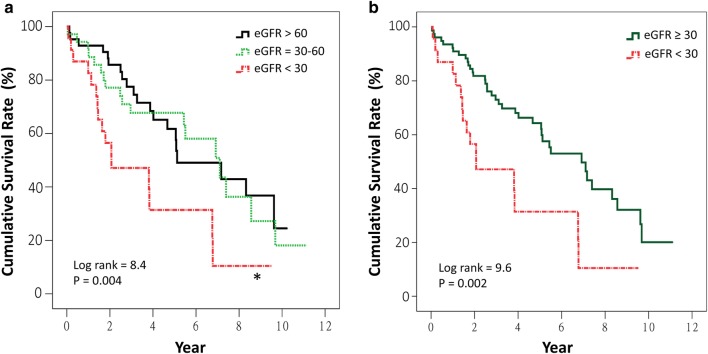
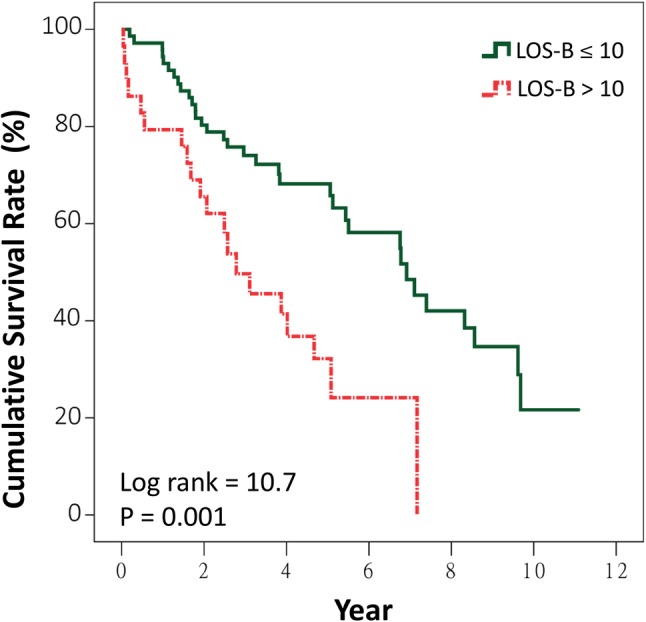
From September 2004 to September 2015, 100 patients aged ≥ 80 years who received PPM implantation were included for retrospective survival analysis. The end point was all-cause mortality. Follow-up duration was 4.0 ± 2.7 years. By the end of the study, 54 patients (54%) had died. Of the 54 who died, 40 patients (74.1%) died of non-cardiac causes. Their survival rates at 1, 2, 3, 5, and 7 years were 90%, 76%, 54%, 32%, and 16%, respectively. Patients with a longer length of hospital stay before PPM implantation (LOS-B) [hazard ratio (HR) 1.03, 95% confidence interval (CI) 1.02-1.05, p < 0.001], estimated glomerular filtration rate (eGFR) < 30 ml/min/1.73 m (HR 4.07, 95% CI 1.95-8.52, p < 0.001), body mass index (BMI) < 21 kg/m (HR 2.50, 95% CI 1.16-5.39, p = 0.02), and dyspnea as the major presenting symptom (HR 2.88, 95% CI 1.27-6.55, p = 0.01) were associated with lower cumulative survival.
Longer LOS-B, lower eGFR and BMI, and dyspnea as the major presenting symptom are pre-PPM implantation predictors of long-term survival in patients aged 80 or older.
患有多种合并症的老年患者对永久性起搏器 (PPM) 植入的需求不断增加。目前的指南建议,在植入 PPM 之前,临床医生应与患者及其家属讨论预期寿命,作为决策过程的一部分。然而,估计个体预期寿命始终是一个挑战。
我们研究了 80 岁或以上接受 PPM 植入的患者在植入 PPM 之前长期生存的预测因素。
从 2004 年 9 月至 2015 年 9 月,纳入了 100 名年龄≥80 岁接受 PPM 植入的患者进行回顾性生存分析。终点为全因死亡率。随访时间为 4.0±2.7 年。研究结束时,54 名患者(54%)死亡。在 54 名死亡患者中,40 名(74.1%)患者死于非心脏原因。他们的 1、2、3、5 和 7 年生存率分别为 90%、76%、54%、32%和 16%。PPM 植入前住院时间较长的患者(LOS-B)[风险比(HR)1.03,95%置信区间(CI)1.02-1.05,p<0.001]、估算肾小球滤过率(eGFR)<30ml/min/1.73m(HR 4.07,95%CI 1.95-8.52,p<0.001)、体重指数(BMI)<21kg/m(HR 2.50,95%CI 1.16-5.39,p=0.02)和呼吸困难为主要表现症状(HR 2.88,95%CI 1.27-6.55,p=0.01)与累积生存率降低相关。
PPM 植入前 LOS-B 较长、eGFR 和 BMI 较低以及呼吸困难为主要表现症状是 80 岁或以上患者长期生存的预测因素。