Center for Genome Regulation, Facultad de Ciencias, Universidad de Chile, Santiago 8370415, Chile.
Broad Institute of MIT and Harvard, Cambridge, MA 02142, USA.
Dis Model Mech. 2018 Nov 5;11(11):dmm034876. doi: 10.1242/dmm.034876.
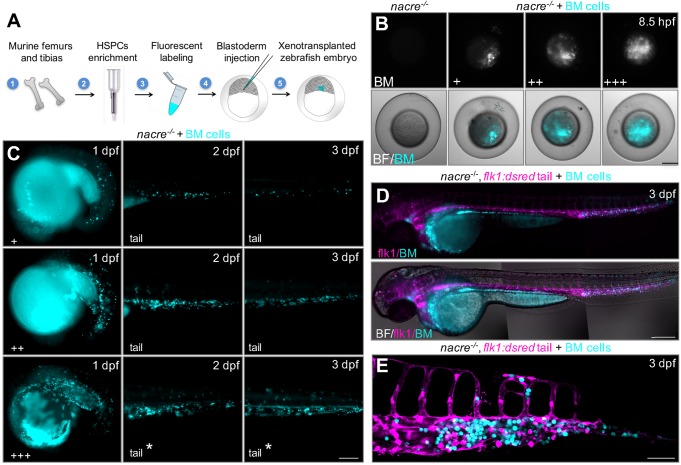
Xenografts of the hematopoietic system are extremely useful as disease models and for translational research. Zebrafish xenografts have been widely used to monitor blood cancer cell dissemination and homing due to the optical clarity of embryos and larvae, which allow unrestricted visualization of migratory events. Here, we have developed a xenotransplantation technique that transiently generates hundreds of hematopoietic tissue chimeric embryos by transplanting murine bone marrow cells into zebrafish blastulae. In contrast to previous methods, this procedure allows mammalian cell integration into the fish developmental hematopoietic program, which results in chimeric animals containing distinct phenotypes of murine blood cells in both circulation and the hematopoietic niche. Murine cells in chimeric animals express antigens related to (i) hematopoietic stem and progenitor cells, (ii) active cell proliferation and (iii) myeloid cell lineages. We verified the utility of this method by monitoring zebrafish chimeras during development using non-invasive imaging to show novel murine cell behaviors, such as homing to primitive and definitive hematopoietic tissues, dynamic hematopoietic cell and hematopoietic niche interactions, and response to bacterial infection. Overall, transplantation into the zebrafish blastula provides a useful method that simplifies the generation of numerous chimeric animals and expands the range of murine cell behaviors that can be studied in zebrafish chimeras. In addition, integration of murine cells into the host hematopoietic system during development suggests highly conserved molecular mechanisms of hematopoiesis between zebrafish and mammals.This article has an associated First Person interview with the first author of the paper.
造血系统的异种移植物作为疾病模型和转化研究极具应用价值。由于胚胎和幼虫的光学透明度,斑马鱼异种移植物已被广泛用于监测血液癌细胞的扩散和归巢,因为这使得迁移事件可以不受限制地可视化。在这里,我们开发了一种异种移植技术,通过将鼠骨髓细胞移植到斑马鱼囊胚中,可暂时产生数百个造血组织嵌合胚胎。与以前的方法相比,该程序允许哺乳动物细胞整合到鱼类发育性造血程序中,从而产生嵌合动物,其在循环和造血龛位中都具有明显的鼠血细胞表型。嵌合动物中的鼠细胞表达与(i)造血干细胞和祖细胞、(ii)活跃的细胞增殖和(iii)髓系细胞谱系相关的抗原。我们通过使用非侵入性成像在发育过程中监测斑马鱼嵌合体来验证该方法的实用性,以显示新的鼠细胞行为,例如归巢到原始和定型造血组织、造血细胞和造血龛位的动态相互作用以及对细菌感染的反应。总体而言,将其移植到斑马鱼囊胚中提供了一种有用的方法,可简化大量嵌合动物的生成,并扩展可在斑马鱼嵌合体中研究的鼠细胞行为范围。此外,鼠细胞在发育过程中整合到宿主造血系统中表明,鱼类和哺乳动物的造血具有高度保守的分子机制。本文附有该论文第一作者的相关第一人称采访。