Texas State University, 601 University Dr, Encino 250, San Marcos, TX, 78666, USA.
J Med Syst. 2018 Sep 29;42(11):214. doi: 10.1007/s10916-018-1075-6.
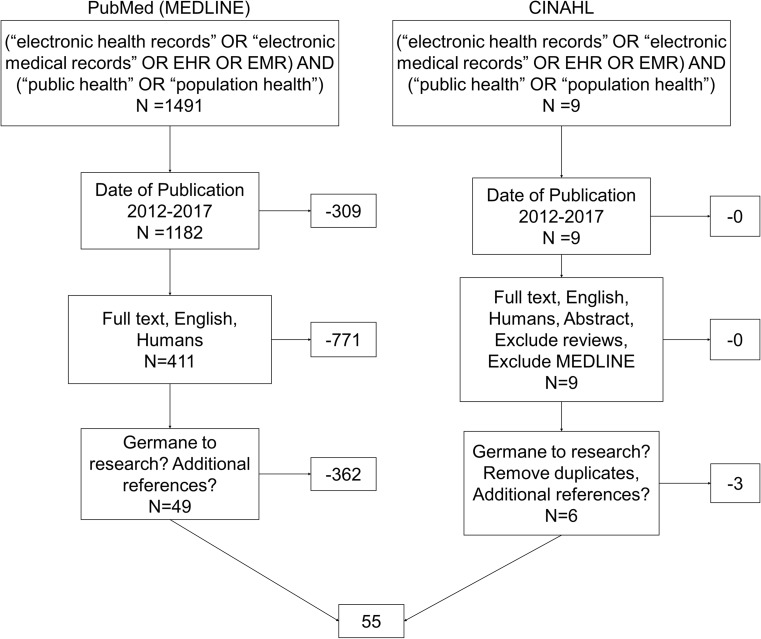
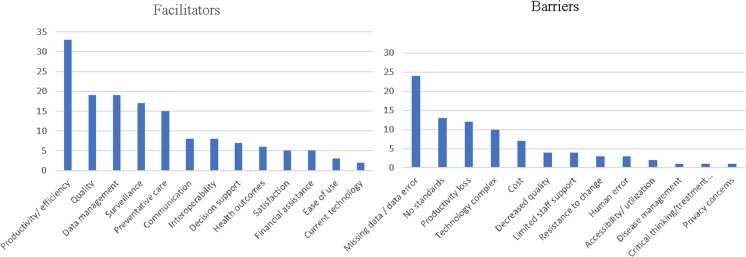
Electronic health records (EHRs) have emerged among health information technology as "meaningful use" to improve the quality and efficiency of healthcare, and health disparities in population health. In other instances, they have also shown lack of interoperability, functionality and many medical errors. With proper implementation and training, are electronic health records a viable source in managing population health? The primary objective of this systematic review is to assess the relationship of electronic health records' use on population health through the identification and analysis of facilitators and barriers to its adoption for this purpose. Authors searched Cumulative Index of Nursing and Allied Health Literature (CINAHL) and MEDLINE (PubMed), 10/02/2012-10/02/2017, core clinical/academic journals, MEDLINE full text, English only, human species and evaluated the articles that were germane to our research objective. Each article was analyzed by multiple reviewers. Group members recognized common facilitators and barriers associated with EHRs effect on population health. A final list of articles was selected by the group after three consensus meetings (n = 55). Among a total of 26 factors identified, 63% (147/232) of those were facilitators and 37% (85/232) barriers. About 70% of the facilitators consisted of productivity/efficiency in EHRs occurring 33 times, increased quality and data management each occurring 19 times, surveillance occurring 17 times, and preventative care occurring 15 times. About 70% of the barriers consisted of missing data occurring 24 times, no standards (interoperability) occurring 13 times, productivity loss occurring 12 times, and technology too complex occurring 10 times. The analysis identified more facilitators than barriers to the use of the EHR to support public health. Wider adoption of the EHR and more comprehensive standards for interoperability will only enhance the ability for the EHR to support this important area of surveillance and disease prevention. This review identifies more facilitators than barriers to using the EHR to support public health, which implies a certain level of usability and acceptance to use the EHR in this manner. The public-health industry should combine their efforts with the interoperability projects to make the EHR both fully adopted and fully interoperable. This will greatly increase the availability, accuracy, and comprehensiveness of data across the country, which will enhance benchmarking and disease surveillance/prevention capabilities.
电子健康记录 (EHR) 在健康信息技术中作为“有意义的使用”出现,以提高医疗保健的质量和效率,并减少人口健康中的差异。在其他情况下,它们也显示出缺乏互操作性、功能和许多医疗错误。通过适当的实施和培训,电子健康记录是否是管理人口健康的可行资源?本系统评价的主要目的是通过识别和分析采用电子健康记录的促进因素和障碍因素,评估其在人口健康方面的应用关系。作者搜索了 Cumulative Index of Nursing and Allied Health Literature (CINAHL) 和 MEDLINE (PubMed),时间为 2012 年 10 月 2 日至 2017 年 10 月 2 日,核心临床/学术期刊,MEDLINE 全文,仅英语,人类物种,并评估了与我们研究目标相关的文章。每篇文章都由多名评审员进行分析。小组成员认识到与电子健康记录对人口健康的影响相关的共同促进因素和障碍因素。经过三次共识会议(n=55)后,小组选择了最终的文章列表。在总共确定的 26 个因素中,有 63%(147/232)是促进因素,37%(85/232)是障碍因素。大约 70%的促进因素是电子健康记录中的生产力/效率发生了 33 次,提高质量和数据管理各发生了 19 次,监测发生了 17 次,预防保健发生了 15 次。大约 70%的障碍因素是数据缺失发生了 24 次,没有标准(互操作性)发生了 13 次,生产力损失发生了 12 次,技术过于复杂发生了 10 次。分析发现,使用电子健康记录支持公共卫生的促进因素多于障碍因素。更广泛地采用电子健康记录和更全面的互操作性标准将只会增强电子健康记录支持这一重要监测和疾病预防领域的能力。本审查确定了使用电子健康记录支持公共卫生的促进因素多于障碍因素,这意味着以这种方式使用电子健康记录具有一定程度的可用性和可接受性。公共卫生行业应与互操作性项目合作,使电子健康记录得到全面采用和充分互操作。这将极大地提高全国范围内数据的可用性、准确性和全面性,从而增强基准测试和疾病监测/预防能力。