Dick Cynthia, Hinh Jasmine, Hayashi Cheryl Y, Reznick David N
Department of Evolution, Ecology and Organismal Biology University of California-Riverside Riverside California.
Division of Invertebrate Zoology and Sackler Institute for Comparative Genomics American Museum of Natural History New York New York.
Ecol Evol. 2018 Aug 15;8(17):8999-9006. doi: 10.1002/ece3.4418. eCollection 2018 Sep.
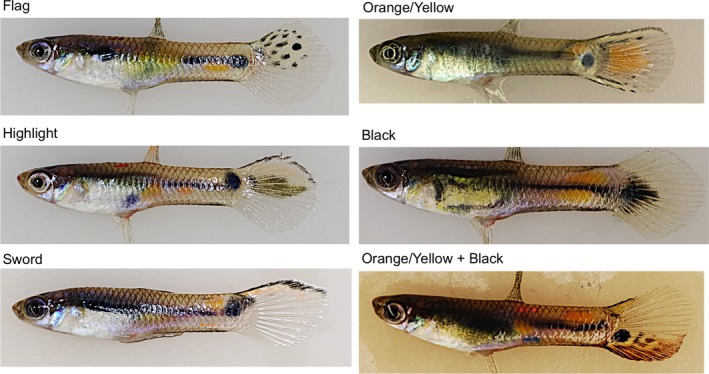
Despite the multitude of examples of evolution in action, relatively fewer studies have taken a replicated approach to understand the repeatability of evolution. Here, we examine the convergent evolution of adaptive coloration in experimental introductions of guppies from a high-predation (HP) environment into four low-predation (LP) environments. LP introductions were replicated across 2 years and in two different forest canopy cover types. We take a complementary approach by examining both phenotypes and genetics. For phenotypes, we categorize the whole color pattern on the tail fin of male guppies and analyze evolution using a correspondence analysis. We find that coloration in the introduction sites diverged from the founding Guanapo HP site. Sites group together based on canopy cover, indicating convergence in response to light environment. However, the axis that explains the most variation indicates a lack of convergence. Therefore, evolution may proceed along similar phenotypic trajectories, but still maintain unique variation within sites. For the genetics underlying the divergent phenotypes, we examine expression levels of color genes. We find no evidence for differential expression, indicating that the genetic basis for the color changes remains undetermined.
尽管有大量正在发生进化的实例,但采用重复实验方法来理解进化的可重复性的研究相对较少。在这里,我们研究了将孔雀鱼从高捕食(HP)环境引入四个低捕食(LP)环境的实验中,适应性体色的趋同进化。LP环境的引入在两年内进行了重复,并且涉及两种不同的森林冠层覆盖类型。我们通过研究表型和遗传学采用了一种互补的方法。对于表型,我们对雄性孔雀鱼尾鳍上的整体颜色模式进行分类,并使用对应分析来分析进化。我们发现引入地点的体色与原始的瓜纳波HP地点有所不同。地点根据冠层覆盖聚集在一起,表明对光照环境的趋同响应。然而,解释最大变异的轴表明缺乏趋同。因此,进化可能沿着相似的表型轨迹进行,但各地点内仍保持独特的变异。对于不同表型背后的遗传学,我们研究了颜色基因的表达水平。我们没有发现差异表达的证据,这表明颜色变化的遗传基础仍未确定。