Biological Systems and Engineering Division, Lawrence Berkeley National Laboratory, Berkeley, CA, United States of America.
Department of Population Sciences, Beckman Research Institute, City of Hope, Duarte, CA, United States of America.
PLoS One. 2018 Oct 1;13(10):e0204645. doi: 10.1371/journal.pone.0204645. eCollection 2018.
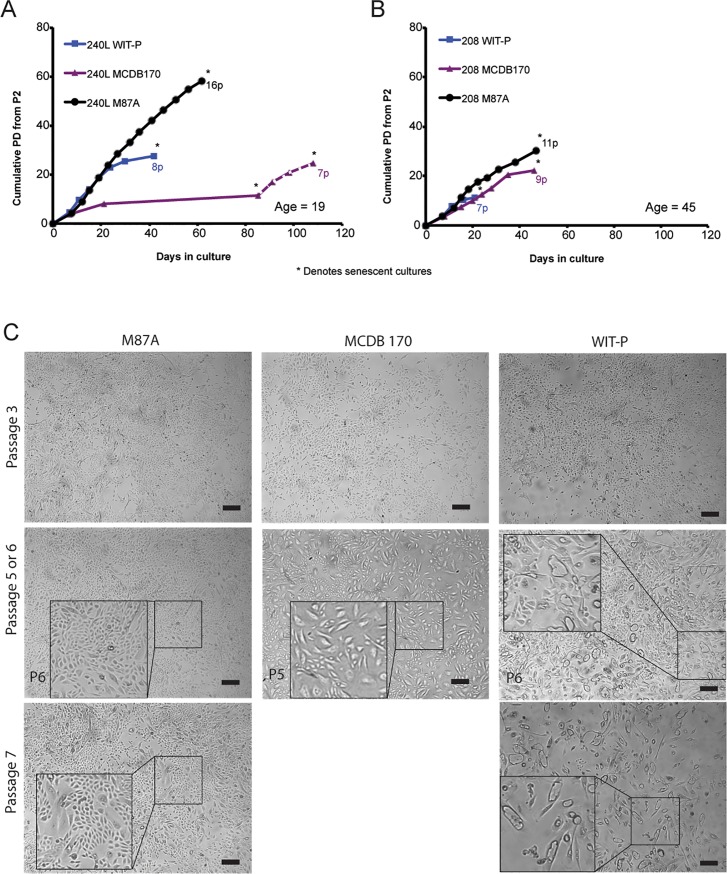
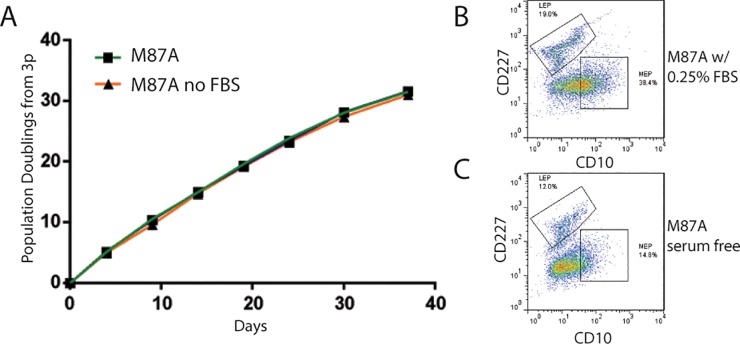
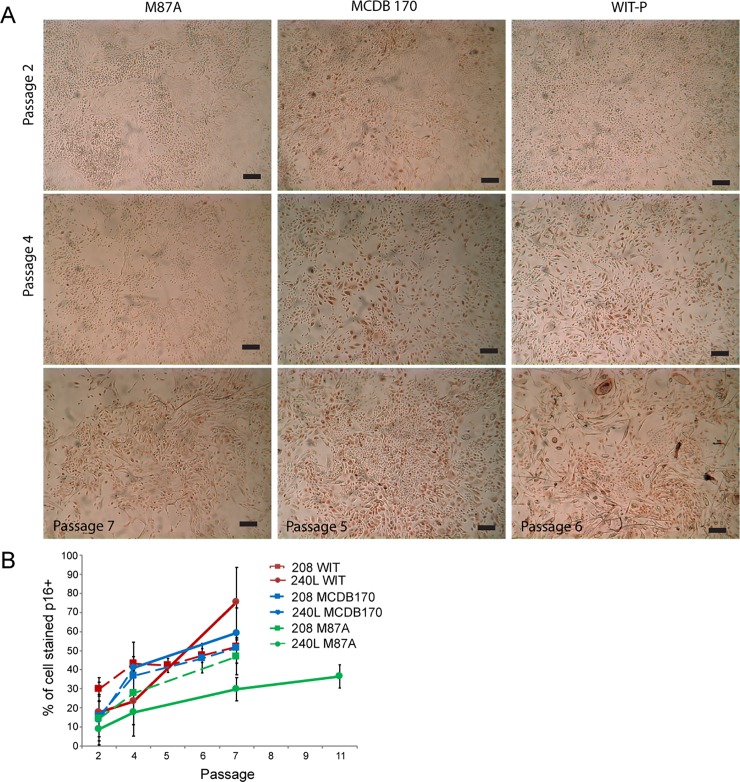
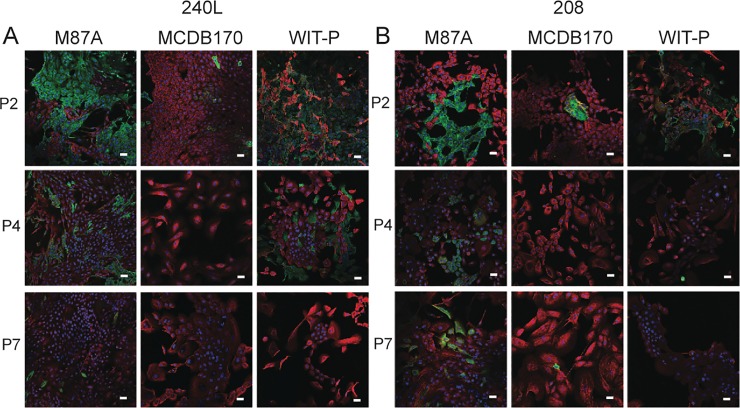
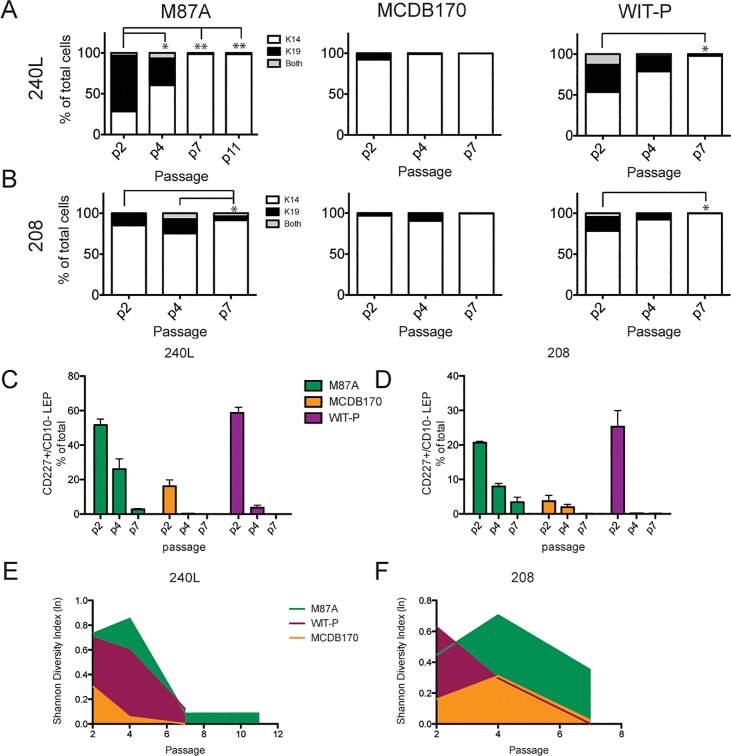
The ability to culture normal human mammary epithelial cells (HMEC) greatly facilitates experiments that seek to understand both normal mammary cell biology and the many differences between normal and abnormal human mammary epithelia. To maximize in vivo relevance, the primary cell culture conditions should maintain cells in states that resemble in vivo as much as possible. Towards this goal, we compared the properties of HMEC strains from two different reduction mammoplasty tissues that were grown in parallel using different media and culture conditions. Epithelial organoids were initiated into three different media: two commonly used serum-free-media, MCDB 170-type (e.g. MEGM) and WIT-P, and a low stress media, M87A. Growth, lineage heterogeneity, p16 protein expression, and population doublings to senescence were measured for each culture condition. MCDB 170 caused rapid senescence and loss of heterogeneity within 2 to 3 passages, but some cultures went through the 1 to 2 month process of selection to generate clonal finite post-selection post-stasis cells. WIT-P caused impressive expansion of luminal cells in 2nd passage followed by their near complete disappearance by passage 4 and senescence shortly thereafter. M87A supported as much as twice the number of population doublings compared to either serum-free medium, and luminal and myoepithelial cells were present for as many as 8 passages. Thus, of the three media compared, WIT-P and MCDB 170 imposed rapid senescence and loss of lineage heterogeneity, phenotypes consistent with cells maintained in high-stress conditions, while M87A supported cultures that maintained multiple lineages and robust growth for up to 60 population doublings. In conjunction with previous studies examining the molecular properties of cultures grown in these media, we conclude that M87A medium is most able to support long-term culture of multiple lineages similar to in vivo conditions, thereby facilitating investigations of normal HMEC biology relevant to the mammary gland in situ.
培养正常人类乳腺上皮细胞(HMEC)的能力极大地促进了实验,这些实验旨在了解正常乳腺细胞生物学以及正常和异常人类乳腺上皮之间的许多差异。为了最大限度地提高体内相关性,主要的细胞培养条件应使细胞尽可能地保持体内状态。为了实现这一目标,我们比较了来自两个不同乳房缩小术组织的 HMEC 菌株的特性,这些菌株平行生长,使用不同的培养基和培养条件。上皮类器官被引入三种不同的培养基中:两种常用的无血清培养基,MCDB 170 型(例如 MEGM)和 WIT-P,以及一种低应激培养基,M87A。每种培养条件都测量了细胞的生长、谱系异质性、p16 蛋白表达和衰老的倍增次数。MCDB 170 在 2 到 3 个传代中迅速衰老并失去异质性,但一些培养物经历了 1 到 2 个月的选择过程,以产生克隆有限的后期选择静止细胞。WIT-P 在第 2 个传代中令人印象深刻地扩增了腔细胞,然后在第 4 个传代中几乎完全消失,并在不久后衰老。与无血清培养基相比,M87A 支持多达两倍的倍增次数,并且多达 8 个传代中存在腔细胞和肌上皮细胞。因此,在所比较的三种培养基中,WIT-P 和 MCDB 170 导致快速衰老和谱系异质性丧失,这些表型与在高应激条件下维持的细胞一致,而 M87A 支持的培养物能够维持多种谱系并进行多达 60 次的倍增。结合之前研究检查在这些培养基中生长的培养物的分子特性,我们得出结论,M87A 培养基最能够支持类似于体内条件的多个谱系的长期培养,从而促进与原位乳腺相关的正常 HMEC 生物学的研究。