San Francisco Veterans Affairs Health Care System, San Francisco, CA.
Division of General Internal Medicine, Department of Medicine, University of California, San Francisco, San Francisco, CA.
Am J Obstet Gynecol. 2019 Jan;220(1):94.e1-94.e7. doi: 10.1016/j.ajog.2018.09.026. Epub 2018 Sep 28.
Among reproductive-aged women, exposure to interpersonal trauma is associated with genitourinary symptoms. Little is known about the relationship between these exposures and the genitourinary health of older women, who tend to experience different and more prevalent genitourinary symptoms because of menopause and aging.
In this study, we examined relationships between common types of interpersonal trauma and aging-related genitourinary dysfunction among older women.
We analyzed data from the National Social Life, Health, and Aging Project, a national area probability sample of older community-dwelling adults born between 1920 and 1947. We used cross-sectional data from home-based study visits conducted in 2005-2006 to examine interpersonal violence exposures (any lifetime sexual assault, past-year emotional and physical abuse), and past-year genitourinary symptoms (urinary incontinence, other urinary problems, and vaginal pain/lubrication problems with sexual intercourse) among women participants. Multivariable logistic regression models were used to relate interpersonal violence and genitourinary symptoms, adjusting for age, race/ethnicity, body mass index, education, marital status, parity, hormone therapy, depressive and anxiety symptoms, and self-reported health. In exploratory models, we further adjusted for vaginal maturation, a tissue-specific marker of aging-related urogenital atrophy obtained from vaginal self-swabs.
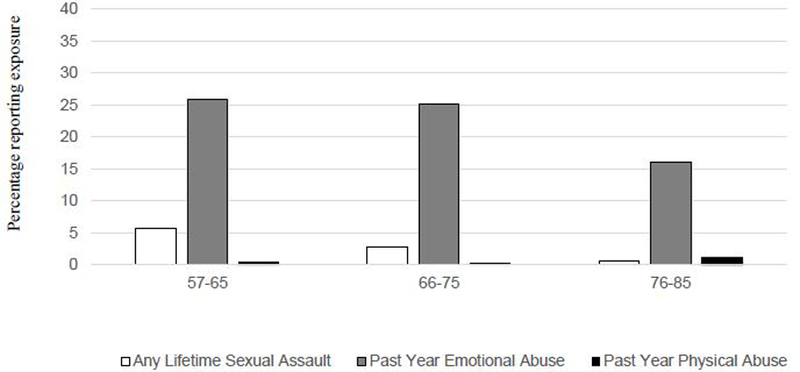
In this national sample of 1551 older women (mean age 69 ± 2 years), 9% reported sexual assault, 23% reported emotional abuse, and <1% reported physical abuse. Urinary incontinence and other urinary problems were reported by 42% and 17%, respectively, and 42% of sexually active women (n = 527) reported vaginal symptoms with intercourse. In multivariable regression analyses adjusted for age, race/ethnicity, education, marital status, parity, hormone therapy, anxiety, depressive symptoms, and self-reported health, women with any lifetime history of sexual assault had 2.5 times the odds (95% confidence interval, 1.0-6.3) of vaginal symptoms, while women who reported past-year emotional abuse had higher odds of urinary incontinence (odds ratio, 1.7, 95% confidence interval, 1.2-2.4) and other urinary problems (odds ratio, 1.8, 95% confidence interval, 1.2-2.8). Among women who provided vaginal self-swabs (n = 869), adjustment for vaginal maturation-attenuated associations with other urinary problems (odds ratio, 1.6, 95% confidence interval, .9-2.6) and vaginal symptoms (odds ratio, 2.2, 95% confidence interval, 0.8-5.8).
Sexual assault and emotional abuse may play a role in the development or experience of aging-related genitourinary dysfunction in older women. Clinicians caring for older women should recognize the prevalence and importance of traumatic exposures in health related to menopause and aging.
在生殖年龄段的女性中,暴露于人际创伤与下尿路症状有关。对于这些暴露与老年女性下尿路健康之间的关系,人们知之甚少,因为老年女性由于绝经和衰老,往往会经历不同且更常见的下尿路症状。
本研究旨在探讨常见类型的人际创伤与老年女性与衰老相关的下尿路功能障碍之间的关系。
我们分析了来自全国社会生活、健康和老龄化项目的数据,该项目是一项针对出生于 1920 年至 1947 年的年龄较大的社区居住成年人的全国性区域概率抽样。我们使用 2005-2006 年基于家庭的研究访问中的横断面数据,检查了女性参与者中的人际暴力暴露(任何终生性侵犯、过去一年的情感和身体虐待)和过去一年的下尿路症状(尿失禁、其他尿路问题和阴道疼痛/性交时润滑问题)。多变量逻辑回归模型用于将人际暴力与下尿路症状相关联,调整了年龄、种族/民族、体重指数、教育、婚姻状况、产次、激素治疗、抑郁和焦虑症状以及自我报告的健康状况。在探索性模型中,我们进一步根据阴道成熟度进行了调整,阴道成熟度是从阴道自我拭子中获得的与衰老相关的女性生殖道萎缩的组织特异性标志物。
在这个由 1551 名老年女性(平均年龄 69±2 岁)组成的全国性样本中,9%的女性报告了性侵犯,23%的女性报告了情感虐待,不到 1%的女性报告了身体虐待。尿失禁和其他尿路问题的发生率分别为 42%和 17%,527 名有性生活的女性中有 42%报告了阴道症状与性交有关。在调整了年龄、种族/民族、教育、婚姻状况、产次、激素治疗、焦虑、抑郁症状和自我报告健康状况的多变量回归分析中,有任何终生性侵犯史的女性发生阴道症状的可能性是 2.5 倍(95%置信区间,1.0-6.3),而报告过去一年情感虐待的女性发生尿失禁(优势比,1.7,95%置信区间,1.2-2.4)和其他尿路问题(优势比,1.8,95%置信区间,1.2-2.8)的可能性更高。在提供阴道自我拭子的女性(n=869)中,阴道成熟度调整减弱了与其他尿路问题(优势比,1.6,95%置信区间,.9-2.6)和阴道症状(优势比,2.2,95%置信区间,0.8-5.8)之间的关联。
性侵犯和情感虐待可能在老年女性与衰老相关的下尿路功能障碍的发展或经历中起作用。照顾老年女性的临床医生应认识到创伤暴露在与绝经和衰老相关的健康问题中的普遍性和重要性。
