Seetahal Janine F R, Vokaty Alexandra, Vigilato Marco A N, Carrington Christine V F, Pradel Jennifer, Louison Bowen, Sauers Astrid Van, Roopnarine Rohini, Arrebato Jusayma C González, Millien Max F, James Colin, Rupprecht Charles E
Department of Preclinical Sciences, Faculty of Medical Sciences, The University of the West Indies, St. Augustine, Trinidad and Tobago.
Pan American Health Organization (PAHO/WHO), Trinidad and Tobago Country Office, St. Clair, Trinidad and Tobago.
Trop Med Infect Dis. 2018 Aug 20;3(3):89. doi: 10.3390/tropicalmed3030089.
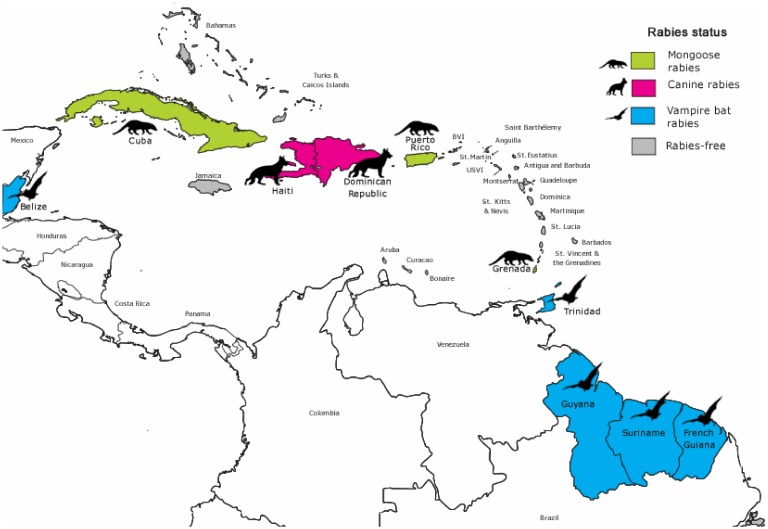
Rabies virus is the only Lyssavirus species found in the Americas. In discussions about rabies, Latin America and the Caribbean are often grouped together. Our study aimed to independently analyse the rabies situation in the Caribbean and examine changes in rabies spatiotemporal epidemiology. A questionnaire was administered to the 33 member countries and territories of the Caribbean Animal Health Network (CaribVET) to collect current data, which was collated with a literature review. Rabies was endemic in ten Caribbean localities, with the dog, mongoose, and vampire bat identified as enzootic reservoirs. The majority of animal cases occurred in Puerto Rico, the Dominican Republic, and Haiti, while human cases only consistently occurred in the latter two areas. Rabies vaccination was conducted for high-risk animal populations with variable coverage, and rabies diagnostic capacities varied widely throughout the region. Illegal importation and natural migration of animals may facilitate the introduction of rabies virus variants into virus-naïve areas. Passive surveillance, together with enhanced methods and serological screening techniques, can therefore be of value. The insularity of the Caribbean makes it ideal for conducting pilot studies on reservoir host population management. Best practice guidelines developed for these reservoir hosts can be individually modified to the epidemiological status and available resources within each locality.
狂犬病病毒是在美洲发现的唯一一种狂犬病毒属病毒。在关于狂犬病的讨论中,拉丁美洲和加勒比地区常常被归为一类。我们的研究旨在独立分析加勒比地区的狂犬病情况,并研究狂犬病时空流行病学的变化。我们向加勒比动物卫生网络(CaribVET)的33个成员国和地区发放了调查问卷,以收集当前数据,并将其与文献综述进行整理。狂犬病在加勒比地区的10个地方流行,狗、獴和吸血蝙蝠被确定为动物疫源地宿主。大多数动物病例发生在波多黎各、多米尼加共和国和海地,而人类病例仅在后两个地区持续出现。对高危动物群体进行了狂犬病疫苗接种,覆盖率各不相同,整个地区的狂犬病诊断能力差异很大。动物的非法进口和自然迁移可能会促使狂犬病病毒变种传入未感染病毒的地区。因此,被动监测以及改进的方法和血清学筛查技术可能会有帮助。加勒比地区的岛屿性质使其成为开展宿主种群管理试点研究的理想之地。为这些宿主制定的最佳实践指南可根据每个地方的流行病学状况和可用资源进行个别调整。