Leeuwis Anna E, Smith Lorna A, Melbourne Andrew, Hughes Alun D, Richards Marcus, Prins Niels D, Sokolska Magdalena, Atkinson David, Tillin Therese, Jäger Hans R, Chaturvedi Nish, van der Flier Wiesje M, Barkhof Frederik
Department of Neurology, Amsterdam Neuroscience, Alzheimer Center Amsterdam, Vrije Universiteit Amsterdam Amsterdam UMC, Amsterdam, Netherlands.
Department of Population Science and Experimental Medicine, Institute of Cardiovascular Science University College London, London, United Kingdom.
Front Aging Neurosci. 2018 Sep 18;10:279. doi: 10.3389/fnagi.2018.00279. eCollection 2018.
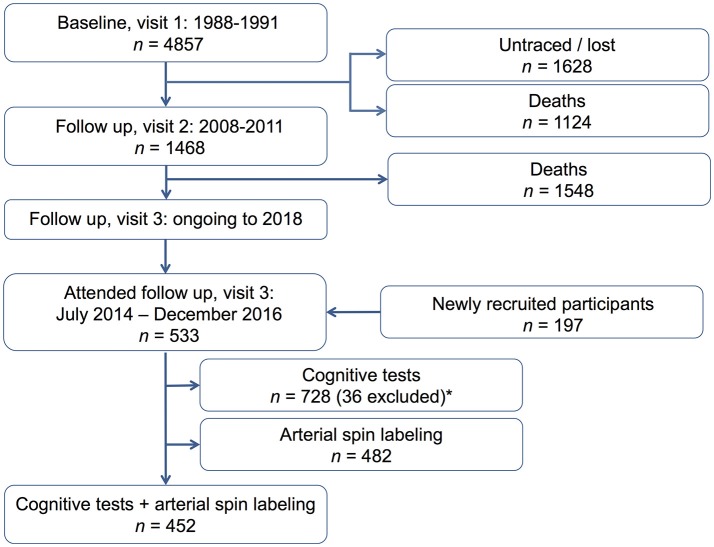
Lower cerebral blood flow (CBF) is associated with cardiovascular disease and vascular risk factors, and is increasingly acknowledged as an important contributor to cognitive decline and dementia. In this cross-sectional study, we examined the association between CBF and cognitive functioning in a community-based, multi-ethnic cohort. From the SABRE (Southall and Brent Revisited) study, we included 214 European, 151 South Asian and 87 African Caribbean participants (71 ± 5 years; 39%F). We used 3T pseudo-continuous arterial spin labeling to estimate whole-brain, hematocrit corrected CBF. We measured global cognition and three cognitive domains (memory, executive functioning/attention and language) with a neuropsychological test battery. Associations were investigated using linear regression analyses, adjusted for demographic variables, vascular risk factors and MRI measures. Across groups, we found an association between higher CBF and better performance on executive functioning/attention (standardized ß [stß] = 0.11, < 0.05). Stratification for ethnicity showed associations between higher CBF and better performance on memory and executive functioning/attention in the white European group (stß = 0.14; < 0.05 and stß = 0.18; < 0.01 respectively), associations were weaker in the South Asian and African Caribbean groups. In a multi-ethnic community-based cohort we showed modest associations between CBF and cognitive functioning. In particular, we found an association between higher CBF and better performance on executive functioning/attention and memory in the white European group. The observations are consistent with the proposed role of cerebral hemodynamics in cognitive decline.
较低的脑血流量(CBF)与心血管疾病和血管危险因素相关,并且越来越被认为是认知衰退和痴呆的重要促成因素。在这项横断面研究中,我们在一个基于社区的多民族队列中研究了CBF与认知功能之间的关联。从SABRE(索撒尔和布伦特再研究)研究中,我们纳入了214名欧洲人、151名南亚人和87名非洲加勒比参与者(71±5岁;39%为女性)。我们使用3T伪连续动脉自旋标记来估计全脑、校正血细胞比容后的CBF。我们用一套神经心理测试测量了整体认知和三个认知领域(记忆、执行功能/注意力和语言)。使用线性回归分析研究关联,并对人口统计学变量、血管危险因素和MRI测量进行了调整。在所有组中,我们发现较高的CBF与执行功能/注意力方面更好的表现之间存在关联(标准化β[stβ]=0.11,P<0.05)。按种族分层显示,在欧洲白人组中,较高的CBF与记忆和执行功能/注意力方面更好的表现之间存在关联(stβ分别为0.14;P<0.05和stβ为0.18;P<0.01),在南亚和非洲加勒比组中关联较弱。在一个基于社区的多民族队列中,我们显示CBF与认知功能之间存在适度关联。特别是,我们发现欧洲白人组中较高的CBF与执行功能/注意力和记忆方面更好的表现之间存在关联。这些观察结果与脑血流动力学在认知衰退中所提出的作用一致。