Sugiyama Hiromi, Omonishi Kunihiro, Yonehara Shuji, Ozasa Kotaro, Kajihara Hiroki, Tsuya Takafumi, Takeshima Yukio
Department of Epidemiology, Radiation Effects Research Foundation, Hiroshima, Hiroshima, Japan.
Department of Pathology, Fukuyama City Hospital, Fukuyama, Hiroshima, Japan.
JB JS Open Access. 2018 May 29;3(2):e0064. doi: 10.2106/JBJS.OA.17.00064. eCollection 2018 Jun 28.
Reported information on the characteristics of benign bone tumors is disjointed, and the long-term trends in the occurrence of malignant bone tumors by histological type have not been reported in Japan. Our aim was to describe the characteristics of both benign and malignant bone tumors as described in cases registered in the Hiroshima Tumor Tissue Registry from 1973 to 2012.
Cases were identified with the International Classification of Diseases for Oncology (ICD-O-3) topography code C40-C41 (bones, joints, and articular cartilage), and histological types were classified according to the World Health Organization 2013 system. We described the distribution of the cases by behavior, sex, skeletal site of tumor occurrence, histological type, period at diagnosis (in 10-year groups), and age at diagnosis (in 10-year groups).
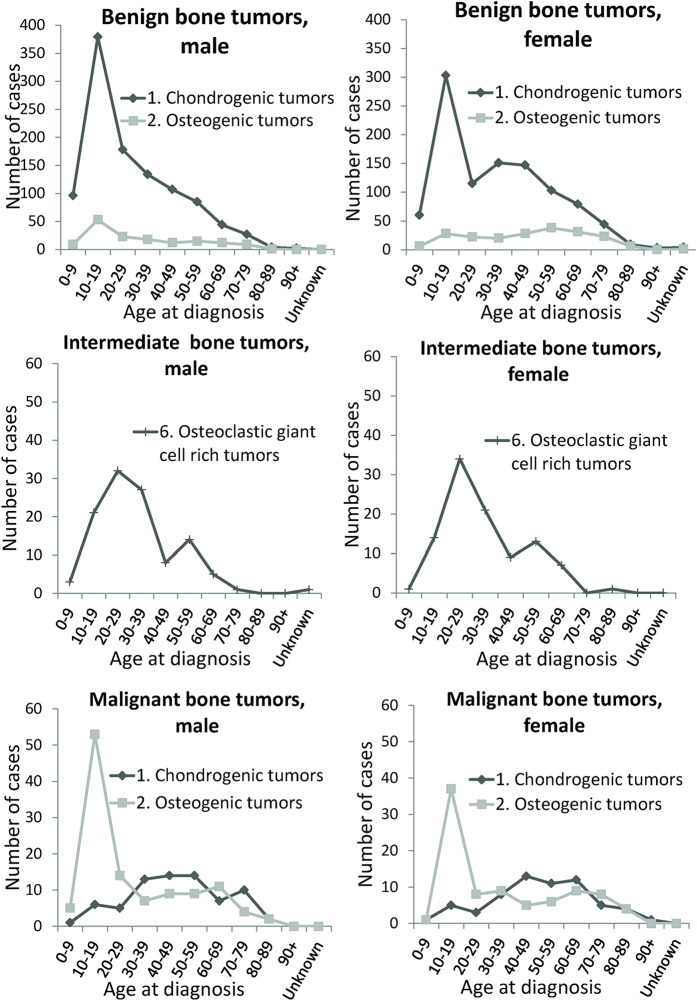
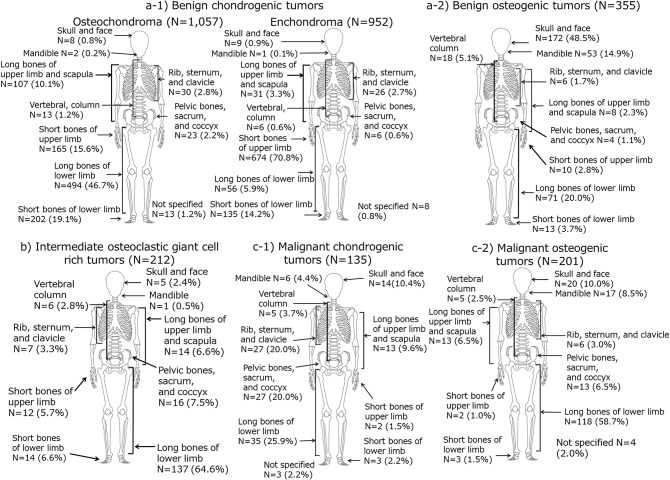
We observed 2,542 benign bone tumors, 272 intermediate bone tumors, and 506 malignant bone tumors. We confirmed that 81.6% of benign bone tumors were chondrogenic, consisting primarily of osteochondromas and enchondromas. Giant cell tumor of bone was the most dominant type of intermediate tumor, whereas osteogenic tumors and chondrogenic tumors were the most dominant types of malignant tumors. Among malignant bone tumors, 41.7% of tumors occurred in the long bones of the lower limb, and there were different peaks of age at the time of diagnosis for osteogenic tumors and chondrogenic tumors. A similar distribution of histological types was seen throughout the 40-year observation period.
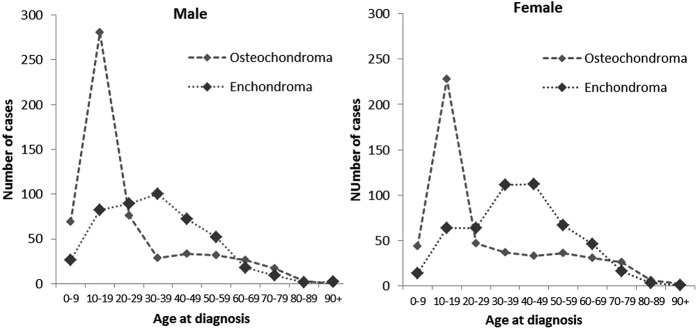
Osteochondroma and enchondroma differed in terms of the age of the patient at the time of diagnosis and the skeletal sites where the tumors most frequently occurred. Giant cell tumor had a large impact on occurrence as a common type of intermediate bone tumor.
The results of the present study, based on pathological tissue registry data, provide knowledge about the epidemiological and pathological features of bone tumors in Japan.
关于良性骨肿瘤特征的报告信息不连贯,日本尚未报道恶性骨肿瘤按组织学类型划分的长期发病趋势。我们的目的是描述1973年至2012年广岛肿瘤组织登记处登记病例中良性和恶性骨肿瘤的特征。
根据国际肿瘤疾病分类(ICD - O - 3)地形编码C40 - C41(骨骼、关节和关节软骨)确定病例,并根据世界卫生组织2013年系统对组织学类型进行分类。我们按行为、性别、肿瘤发生的骨骼部位、组织学类型、诊断时期(按10年分组)和诊断年龄(按10年分组)描述病例分布。
我们观察到2542例良性骨肿瘤、272例中间型骨肿瘤和506例恶性骨肿瘤。我们证实81.6%的良性骨肿瘤为软骨源性,主要由骨软骨瘤和内生软骨瘤组成。骨巨细胞瘤是最主要的中间型肿瘤类型,而成骨性肿瘤和软骨源性肿瘤是最主要的恶性肿瘤类型。在恶性骨肿瘤中,41.7%的肿瘤发生在下肢长骨,成骨性肿瘤和软骨源性肿瘤在诊断时具有不同的年龄高峰。在整个40年的观察期内,组织学类型分布相似。
骨软骨瘤和内生软骨瘤在诊断时患者年龄以及肿瘤最常发生的骨骼部位方面存在差异。骨巨细胞瘤作为常见的中间型骨肿瘤类型,对发病率有很大影响。
本研究基于病理组织登记数据的结果,提供了关于日本骨肿瘤流行病学和病理特征的知识。