Kaur Manbir, Kaur Rupinder, Kaur Sarvjeet, Baghla Naresh, Bansal Aradhna, Kalia Akshay, Kumar Saravana, Lall Amit
Department of Anaesthesia, GGS Medical College, Faridkot, Punjab, India.
Anesth Essays Res. 2018 Jul-Sep;12(3):669-673. doi: 10.4103/aer.AER_64_18.
Supraclavicular brachial plexus provides complete and reliable anesthesia for upper limb surgeries. Adjuvants are added to local anesthetists to improve various block characteristics. There are limited studies comparing the efficacy of dexmedetomidine and fentanyl as an adjuvant to levobupivacaine.
The aim of the study was to evaluate and compare the effect of dexmedetomidine versus fentanyl as an adjuvant with levobupivacaine in ultrasound-guided supraclavicular brachial plexus block.
This study design was a prospective, randomized, double-blind controlled study.
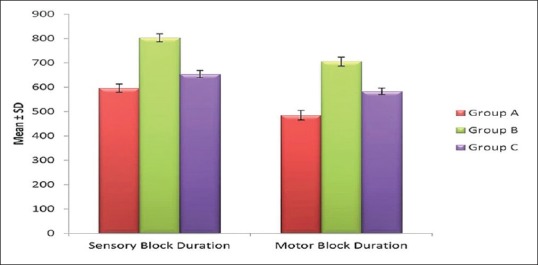
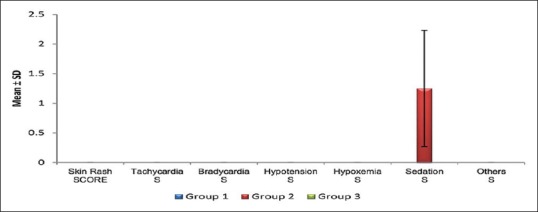
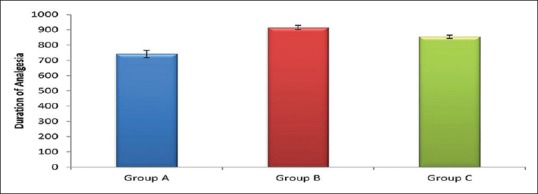
A total of 120 patients in the age group of 30-55 years with physical status American Society of Anesthesiologists Classes I and II undergoing elective upper limb surgeries under ultrasound-guided supraclavicular brachial plexus block were randomly divided into three groups of forty each after taking informed consent and approval from Hospital Ethics Committee: Group A received 25 ml of 0.5% levobupivacaine with 5 ml normal saline (NS). Group B received 25 ml of 0.5% levobupivacaine with 1 μg/kg dexmedetomidine diluted to the volume of 5 ml NS. Group C received 25 ml of 0.5% levobupivacaine with 1 μg/kg fentanyl diluted to the volume of 5 ml NS. Onset and duration of sensory and motor block and duration of analgesia were noted and any side effects were observed.
The distribution of variables tested with Shapiro-Wilk test. Group comparison of values was made by Kruskal-Wallis test followed by Mann-Whitney test.
There was fastest onset time as well as longer duration of sensory and motor block in dexmedetomidine group, intermediate in fentanyl group as compared to levobupivacaine group.
This study concludes that addition of dexmedetomidine to levobupivacaine for supraclavicular brachial plexus block shortens the onset time and prolongs the duration of sensory and motor blockade as compared to the addition of fentanyl.
锁骨上臂丛神经阻滞可为上肢手术提供完善且可靠的麻醉。在局部麻醉药中添加佐剂可改善各种阻滞特性。比较右美托咪定和芬太尼作为左旋布比卡因佐剂疗效的研究有限。
本研究旨在评估和比较右美托咪定与芬太尼作为佐剂与左旋布比卡因用于超声引导下锁骨上臂丛神经阻滞的效果。
本研究设计为前瞻性、随机、双盲对照研究。
共有120例年龄在30 - 55岁、美国麻醉医师协会身体状况分级为I级和II级、接受超声引导下锁骨上臂丛神经阻滞的择期上肢手术患者,在获得医院伦理委员会的知情同意和批准后,随机分为三组,每组40例:A组接受25毫升0.5%左旋布比卡因加5毫升生理盐水(NS)。B组接受25毫升0.5%左旋布比卡因加1微克/千克右美托咪定,稀释至5毫升NS的体积。C组接受25毫升0.5%左旋布比卡因加1微克/千克芬太尼稀释至5毫升NS的体积。记录感觉和运动阻滞的起效时间、持续时间以及镇痛持续时间,并观察任何副作用。
用Shapiro-Wilk检验测试变量的分布。通过Kruskal-Wallis检验进行组间值比较,随后进行Mann-Whitney检验。
与左旋布比卡因组相比,右美托咪定组的起效时间最快,感觉和运动阻滞持续时间更长,芬太尼组居中。
本研究得出结论,与添加芬太尼相比,在左旋布比卡因中添加右美托咪定用于锁骨上臂丛神经阻滞可缩短起效时间并延长感觉和运动阻滞的持续时间。