Das Anjan, Majumdar Saikat, Halder Susanta, Chattopadhyay Surajit, Pal Saswati, Kundu Ratul, Mandal Subrata Kumar, Chattopadhyay Sandip
Department of Anaesthesiology, College of Medicine & Sagore Dutta Hospital, Kolkata, West Bengal, India.
Department of Anaesthesiology, NRS Medical College, Kolkata, West Bengal, India.
Saudi J Anaesth. 2014 Nov;8(Suppl 1):S72-7. doi: 10.4103/1658-354X.144082.
Different additives have been used to prolong brachial plexus block. We evaluated the effect of adding dexmedetomidine to ropivacaine for supraclavicular brachial plexus blockade. The primary endpoints were the onset and duration of sensory and motor block and duration of analgesia.
A total of 84 patients (20-50 years) posted for elective forearm and hand surgery under supraclavicular brachial plexus block were divided into two equal groups (Group R and RD) in a randomized, double-blind fashion. In group RD (n = 42) 30 ml 0.5% ropivacaine +1 ml (100 μg) of dexmedetomidine and group R (n = 42) 30 ml 0.5% ropivacaine +1 ml normal saline were administered in supraclavicular block. Sensory and motor block onset times and block durations, time to first analgesic use, total analgesic need, postoperative visual analog scale (VAS), hemodynamics and side-effects were recorded for each patient.
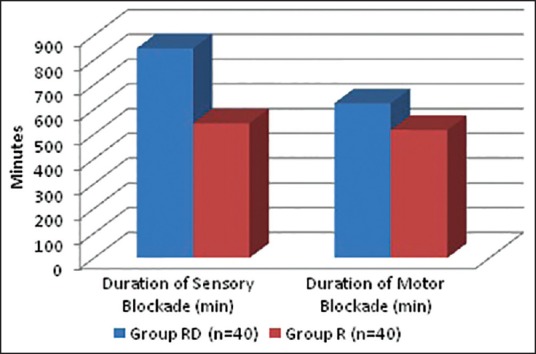
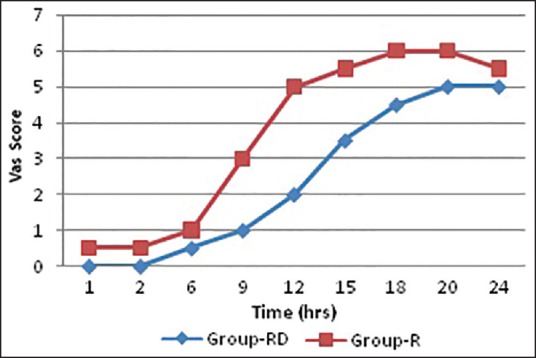
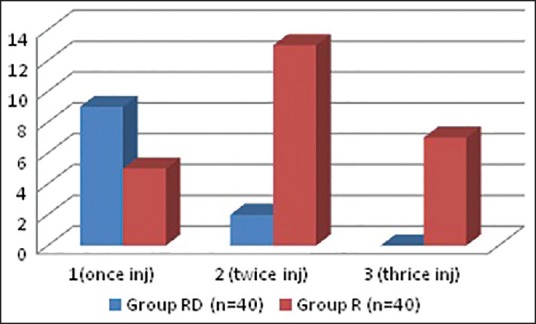
Though with similar demographic profile in both groups, sensory and motor block in group RD (P < 0.05) was earlier than group R. Sensory and motor block duration and time to first analgesic use were significantly longer and the total need for rescue analgesics was lower in group RD (P < 0.05) than group R. Post-operative VAS value at 12 h were significantly lower in group RD (P < 0.05). Intra-operative hemodynamics were significantly lower in group RD (P < 0.05) without any appreciable side-effects.
It can be concluded that adding dexmedetomidine to supraclavicular brachial plexus block increases the sensory and motor block duration and time to first analgesic use, and decreases total analgesic use with no side-effects.
已使用不同添加剂来延长臂丛神经阻滞时间。我们评估了在罗哌卡因中添加右美托咪定用于锁骨上臂丛神经阻滞的效果。主要终点为感觉和运动阻滞的起效时间及持续时间以及镇痛持续时间。
总共84例计划在锁骨上臂丛神经阻滞下进行择期前臂和手部手术的患者(20至50岁),以随机、双盲方式分为两组(R组和RD组),每组42例。在RD组(n = 42)中,于锁骨上阻滞时给予30 ml 0.5%罗哌卡因 + 1 ml(100 μg)右美托咪定,而在R组(n = 42)中给予30 ml 0.5%罗哌卡因 + 1 ml生理盐水。记录每位患者的感觉和运动阻滞起效时间、阻滞持续时间、首次使用镇痛药的时间、总镇痛药需求量、术后视觉模拟评分(VAS)、血流动力学及副作用。
尽管两组患者的人口统计学特征相似,但RD组的感觉和运动阻滞(P < 0.05)早于R组。RD组的感觉和运动阻滞持续时间及首次使用镇痛药的时间显著更长,且挽救性镇痛药的总需求量低于R组(P < 0.05)。RD组术后12小时的VAS值显著更低(P < 0.05)。RD组术中血流动力学显著更低(P < 0.05),且无明显副作用。
可以得出结论,在锁骨上臂丛神经阻滞中添加右美托咪定可延长感觉和运动阻滞持续时间及首次使用镇痛药的时间,并减少总镇痛药用量,且无副作用。