Plaikner Michaela, Kremser Christian, Zoller Heinz, Jaschke Werner, Henninger Benjamin
Department of Radiology, Medical University of Innsbruck, 6020 Innsbruck, Austria.
Department of Internal Medicine, Medical University of Innsbruck, 6020 Innsbruck, Austria.
J Clin Imaging Sci. 2018 Sep 18;8:40. doi: 10.4103/jcis.JCIS_30_18. eCollection 2018.
The objective of this study was to evaluate the relationship between hepatic magnetic resonance imaging (MRI) with R2* relaxometry and serum ferritin in therapy monitoring of patients with iron overload. Further, a possible influence of the chosen therapy (phlebotomy or chelation) was assessed.
We retrospectively evaluated 42 patients with baseline and follow-up R2* relaxometry and determination of serum ferritin before and during therapeutic phlebotomy or iron chelation therapy or watchful waiting, respectively. Linear regression analysis was used to analyze the correlation between changes of R2* and serum ferritin. Regression lines for different groups were compared with analysis of covariance.
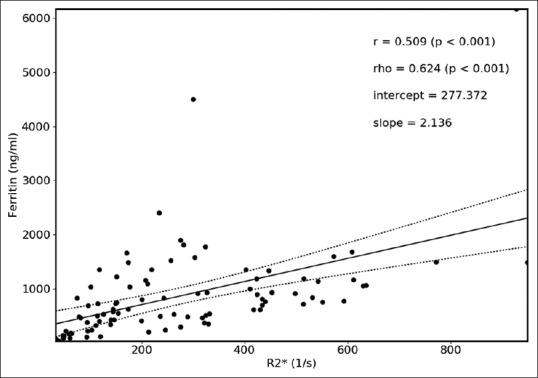
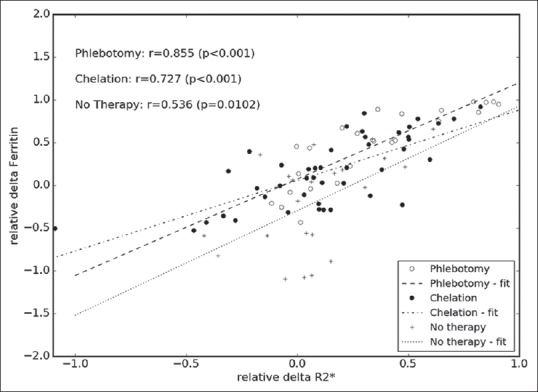
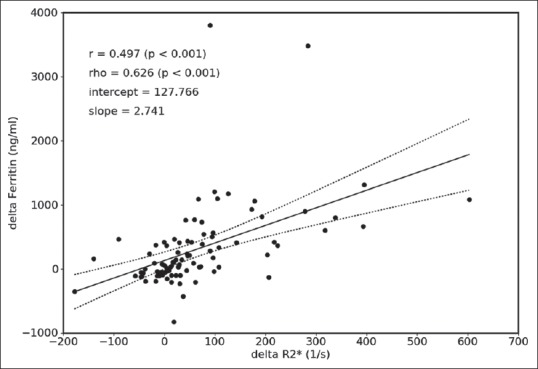
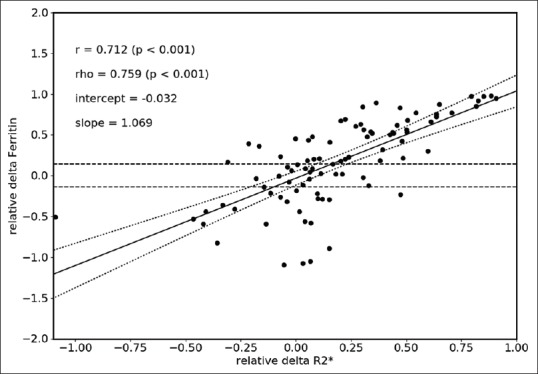
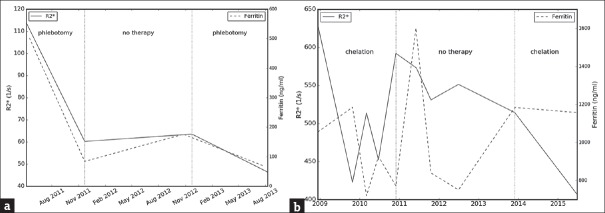
We found a moderate positive statistical correlation ( = 0.509) between serum ferritin and R2*, a moderate positive correlation between absolute R2* changes and serum ferritin changes ( = 0.497), and a strong correlation for percentage changes ( = 0.712). The correlation analysis between relative changes of R2* and serum ferritin for the different therapies resulted in a strong correlation between phlebotomy and chelation ( = 0.855/0.727) and a moderate for no applied therapy ( = 0.536). In 22/92 paired examinations, a discordance of R2* and ferritin was found, particularly involving patients under chelation.
Despite the good correlation between serum ferritin and R2* relaxometry in monitoring iron overload, treatment response may be misinterpreted when only serum ferritin is considered. Although ferritin is an acceptable and far cheaper tool for monitoring, MRI should be performed for confirmation, especially in case of unexpected ferritin changes, particularly under chelation therapy.
本研究的目的是评估肝脏磁共振成像(MRI)的R2*弛豫测量与血清铁蛋白在铁过载患者治疗监测中的关系。此外,还评估了所选治疗方法(放血或螯合疗法)可能产生的影响。
我们回顾性评估了42例患者,分别在治疗性放血、铁螯合治疗或观察等待之前及期间进行了基线和随访R2弛豫测量,并测定了血清铁蛋白。采用线性回归分析来分析R2变化与血清铁蛋白之间的相关性。通过协方差分析比较不同组的回归线。
我们发现血清铁蛋白与R2之间存在中度正相关(r = 0.509),绝对R2变化与血清铁蛋白变化之间存在中度正相关(r = 0.497),百分比变化之间存在强相关(r = 0.712)。不同治疗方法的R2与血清铁蛋白相对变化之间的相关性分析显示,放血与螯合疗法之间存在强相关(r = 0.855/0.727),未进行治疗的患者之间存在中度相关(r = 0.536)。在92次配对检查中的22次检查中,发现R2与铁蛋白存在不一致,特别是在接受螯合治疗的患者中。
尽管血清铁蛋白与R2*弛豫测量在监测铁过载方面具有良好的相关性,但仅考虑血清铁蛋白时可能会误解治疗反应。虽然铁蛋白是一种可接受且成本低得多的监测工具,但对于确认情况应进行MRI检查,特别是在铁蛋白出现意外变化时,尤其是在螯合治疗的情况下。