Taouk Laura H, Fialkow Michael F, Schulkin Jay A
Research Department, The American College of Obstetricians and Gynecologists (ACOG), Washington, District of Columbia.
Department of Psychology, American University, Washington, District of Columbia.
Health Equity. 2018 Aug 1;2(1):207-215. doi: 10.1089/heq.2018.0014. eCollection 2018.
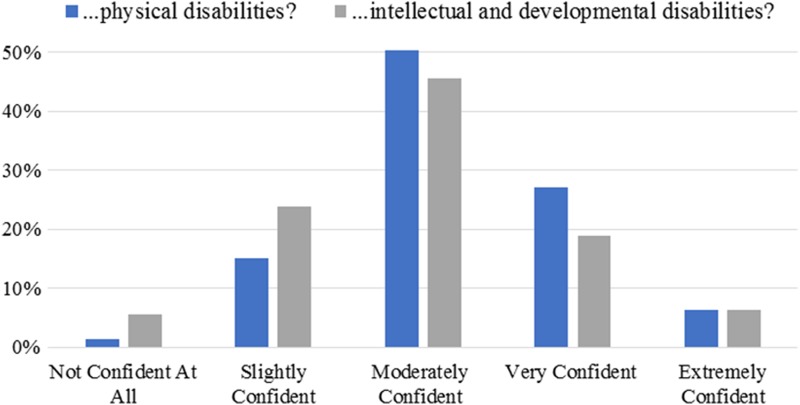
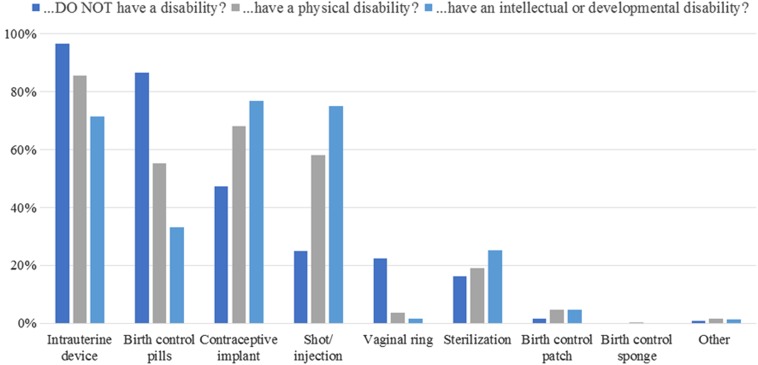
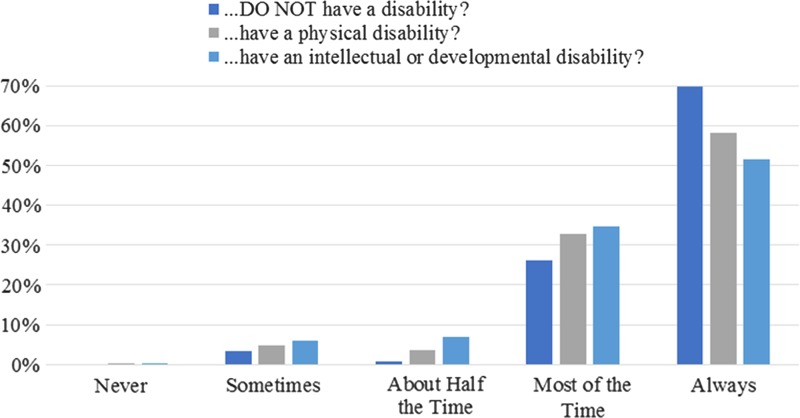
The purpose of this study was to document current awareness, attitudes, and training regarding the care of women with disabilities by obstetrician-gynecologists (ob-gyns) and explore barriers that may explain observed discrepancies in care. One thousand ob-gyns, including 500 members of the Collaborative Ambulatory Research Network (CARN), were surveyed on practice accessibility, training, awareness, barriers, beliefs, comfort, challenges, practices, contraceptive counseling, and preconception/pregnancy counseling. CARN, 49.0%, and non-CARN, 19.4%, members completed the survey for an overall response rate of 33.9%. Most respondents indicated feeling "somewhat" (57.5%) or "very" (21.9%) aware of the special healthcare needs of women with disabilities. Only 17.2%, however, received any information or training on the provision of healthcare to women with disabilities. Eighty-one percent agreed somewhat or strongly that women with disabilities are less likely to receive comprehensive reproductive healthcare. Respondents who provided contraceptive counseling (94.3%) initiated it with women of reproductive age who did not have a disability more frequently than those who had a disability. Finally, only 19.3% felt "definitely" adequately equipped to manage the pregnancies of women with disabilities. Women with disabilities require reproductive healthcare no less than women without disabilities; however, the evidence consistently identifies disparities. This study suggests that while ob-gyn providers are aware of these issues, they lack adequate training and resources to provide equal care.
本研究的目的是记录妇产科医生目前对残疾妇女护理的认知、态度和培训情况,并探讨可能解释所观察到的护理差异的障碍。对1000名妇产科医生进行了调查,其中包括500名协作门诊研究网络(CARN)的成员,调查内容涉及实践可及性、培训、认知、障碍、信念、舒适度、挑战、实践、避孕咨询以及孕前/孕期咨询。CARN成员的完成率为49.0%,非CARN成员的完成率为19.4%,总体回复率为33.9%。大多数受访者表示“有点”(57.5%)或“非常”(21.9%)了解残疾妇女的特殊医疗需求。然而,只有17.2%的人接受过任何关于为残疾妇女提供医疗保健的信息或培训。81%的人在一定程度上或强烈同意残疾妇女获得全面生殖保健的可能性较小。提供避孕咨询的受访者(94.3%)对非残疾育龄妇女进行避孕咨询的频率高于残疾妇女。最后,只有19.3%的人认为自己“绝对”有足够的能力管理残疾妇女的妊娠。残疾妇女对生殖保健的需求并不低于非残疾妇女;然而,证据始终表明存在差异。这项研究表明,虽然妇产科医生了解这些问题,但他们缺乏提供平等护理的充分培训和资源。