Sabath Bruce, Muhammad Hasan A, Balagani Amulya, Ost David E, Vakil Erik, Ahmed Tahreem, Vial Macarena R, Grosu Horiana B
Department of Pulmonary Medicine, Unit 1462, The University of Texas MD Anderson Cancer Center, 1515 Holcombe Blvd, Houston, TX, 77030, USA.
Thoracic Surgery, The University of Texas MD Anderson Cancer Center, Houston, TX, USA.
BMC Cancer. 2018 Oct 1;18(1):937. doi: 10.1186/s12885-018-4858-8.
The tyrosine kinase inhibitor pazopanib is used for treatment of sarcoma. Recent studies have suggested that the use of pazopanib may lead to the development of pneumothorax, an unexpected adverse effect in patients with sarcoma metastatic to the chest.
We conducted a retrospective case control study of patients with sarcoma with metastases to the chest with pneumothorax (cases) and without pneumothorax (controls). The control population was selected from tumor registry in a 1:4 (cases to controls) ratio. The primary outcome of interest was the association between pazopanib and pneumothorax risk in patients with sarcoma metastatic to the chest. Secondary objective was to evaluate risk factors for pneumothorax.
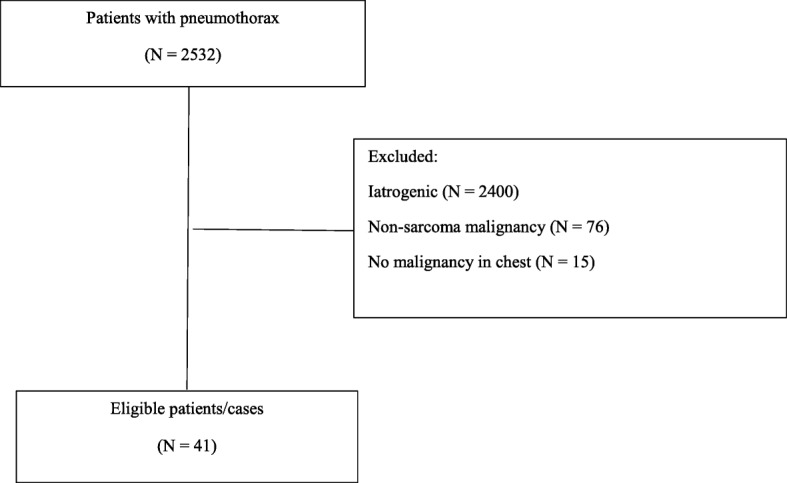
We identified 41 cases and 164 controls. Using purposeful selection method the odds of developing pneumothorax while being on pazopanib was not significant in univariate (p = .06) and multivariable analysis (p = .342). On univariate analysis risk factors of pneumothorax in patients with sarcoma were age, male sex, African American race, the presence of cavitary lung nodules/masses, and the presence of pleural-based nodules/masses. On multivariate analysis, only the presence of cavitary lung nodules/masses (P < .001) and the presence of pleural-based nodules/masses (P < .001) remained as risk factors for developing pneumothorax.
Pazopanib does not increase the risk of pneumothorax in patients with sarcoma and evidence of metastatic disease to the chest. Presence of cavitary lung nodules/masses and the presence of pleural-based nodules/masses were found to be risk factors for pneumothorax.
酪氨酸激酶抑制剂帕唑帕尼用于治疗肉瘤。最近的研究表明,使用帕唑帕尼可能导致气胸的发生,这对于肉瘤转移至胸部的患者来说是一种意想不到的不良反应。
我们对肉瘤转移至胸部且发生气胸的患者(病例组)和未发生气胸的患者(对照组)进行了一项回顾性病例对照研究。对照组人群从肿瘤登记处按1:4(病例组与对照组)的比例选取。主要关注的结局是帕唑帕尼与肉瘤转移至胸部患者气胸风险之间的关联。次要目标是评估气胸的危险因素。
我们确定了41例病例和164例对照。采用有目的的选择方法,在单变量分析(p = 0.06)和多变量分析(p = 0.342)中,使用帕唑帕尼时发生气胸的几率均无统计学意义。在单变量分析中,肉瘤患者气胸的危险因素包括年龄、男性、非裔美国人种族、存在空洞性肺结节/肿块以及存在胸膜下结节/肿块。在多变量分析中,只有存在空洞性肺结节/肿块(P < 0.001)和存在胸膜下结节/肿块(P < 0.001)仍然是发生气胸的危险因素。
帕唑帕尼不会增加肉瘤且有胸部转移证据患者发生气胸的风险。发现存在空洞性肺结节/肿块和存在胸膜下结节/肿块是气胸的危险因素。