Ragon Institute of MGH, MIT and Harvard, Cambridge, MA, 02139, USA.
Department of Systems Biology, Harvard University, Boston, MA, 02115, USA.
Retrovirology. 2018 Oct 1;15(1):66. doi: 10.1186/s12977-018-0449-7.
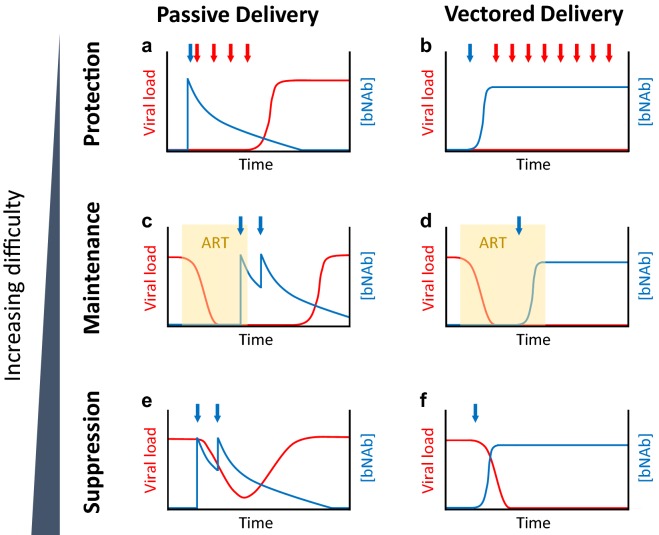
Vectored gene delivery of HIV-1 broadly neutralizing antibodies (bNAbs) using recombinant adeno-associated virus (rAAV) is a promising alternative to conventional vaccines for preventing new HIV-1 infections and for therapeutically suppressing established HIV-1 infections. Passive infusion of single bNAbs has already shown promise in initial clinical trials to temporarily decrease HIV-1 load in viremic patients, and to delay viral rebound from latent reservoirs in suppressed patients during analytical treatment interruptions of antiretroviral therapy. Long-term, continuous, systemic expression of such bNAbs could be achieved with a single injection of rAAV encoding antibody genes into muscle tissue, which would bypass the challenges of eliciting such bNAbs through traditional vaccination in naïve patients, and of life-long repeated passive transfers of such biologics for therapy. rAAV delivery of single bNAbs has already demonstrated protection from repeated HIV-1 vaginal challenge in humanized mouse models, and phase I clinical trials of this approach are underway. Selection of which individual, or combination of, bNAbs to deliver to counter pre-existing resistance and the rise of escape mutations in the virus remains a challenge, and such choices may differ depending on use of this technology for prevention versus therapy.
利用重组腺相关病毒(rAAV)进行 HIV-1 广谱中和抗体(bNAbs)的载体基因传递,是预防新的 HIV-1 感染和治疗性抑制已建立的 HIV-1 感染的一种很有前途的替代传统疫苗的方法。在初步的临床试验中,被动输注单一 bNAbs 已经显示出有希望的结果,可以暂时降低病毒血症患者的 HIV-1 载量,并在抗逆转录病毒治疗的分析性治疗中断期间,延迟潜伏储库中病毒的反弹。通过将编码抗体基因的 rAAV 单次注射到肌肉组织中,可以实现这种 bNAbs 的长期、持续、系统表达,从而绕过在未经免疫的患者中通过传统疫苗接种来引发这种 bNAbs 的挑战,以及为治疗而进行的这种生物制剂的终身重复被动转移的挑战。rAAV 递送单一 bNAbs 已经在人源化小鼠模型中证明可以防止重复的 HIV-1 阴道挑战,并且这种方法的 I 期临床试验正在进行中。选择要递送的个体或组合的 bNAbs 来对抗预先存在的耐药性和病毒逃避突变的出现仍然是一个挑战,并且这种选择可能因该技术用于预防还是治疗而有所不同。