Università Vita-Salute San Raffaele, IRCCS-San Raffaele Scientific Institute, Milan, Italy.
Unit of Immunology, Rheumatology, Allergy and Rare Diseases (UnIRAR), IRCCS-San Raffaele Scientific Institute, via Olgettina 60, 20132, Milan, Italy.
Arthritis Res Ther. 2018 Oct 3;20(1):222. doi: 10.1186/s13075-018-1718-5.
Immunoglobulin G4-related disease (IgG4-RD) promptly responds to glucocorticoids but relapses in a considerable fraction of patients. Reliable biomarkers of flare are currently lacking because the pathophysiology of IgG4-RD remains largely elusive. In the present work, we aimed to identify perturbations of B-cell subpopulations that might predict IgG4-RD relapse.
Thirty patients were treated with glucocorticoids according to international guidelines. Circulating CD19 and CD20 cells, naive B cells, memory B cells, plasmablasts, and plasma cells were measured by flow cytometry at baseline and every 6 months for 2 years after the initiation of corticosteroid therapy.
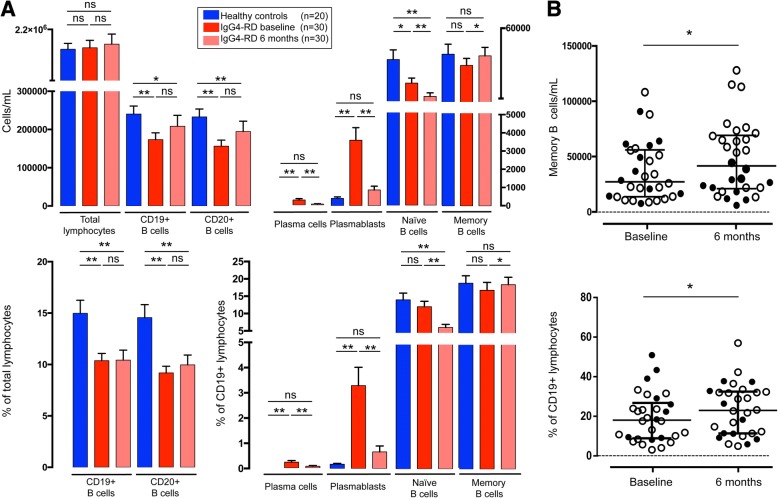
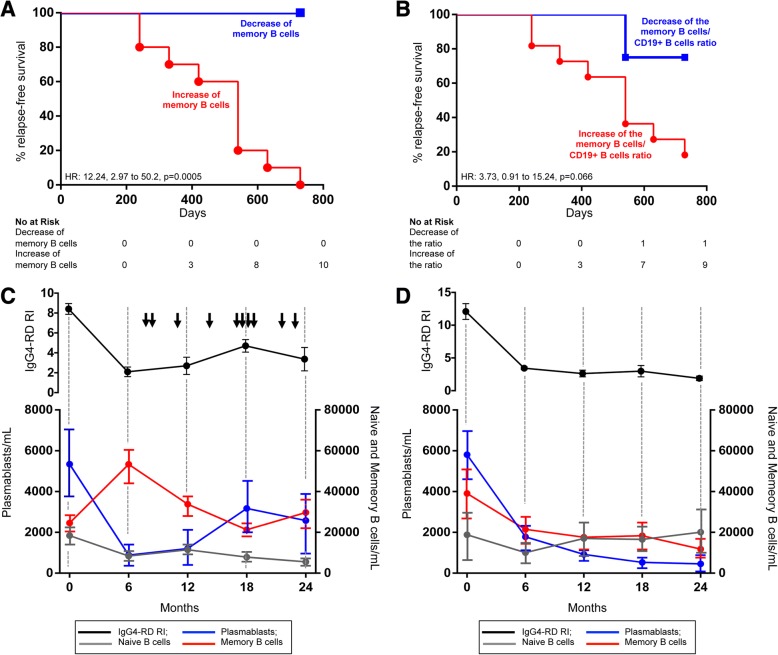
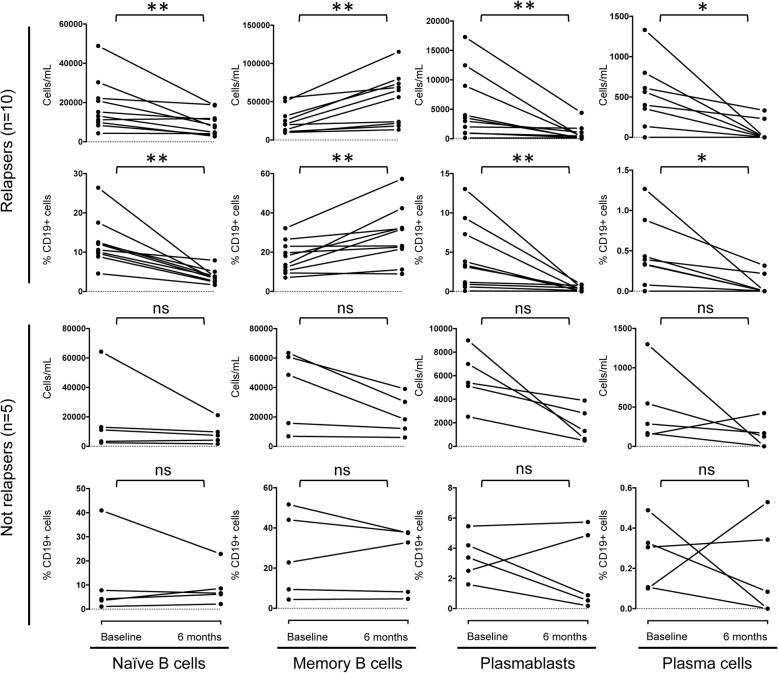
Patients with active untreated IgG4-RD showed significantly reduced CD19 B cells, CD20 B cells, and naive B cells compared with healthy subjects (p < 0.05), but significantly expanded plasmablasts and plasma cells (p < 0.01). After 6 months of corticosteroid treatment, all patients achieved clinical improvement. Naive B cells, plasmablasts, and plasma cells significantly decreased compared with disease onset, whereas memory B cells significantly increased compared with baseline (p < 0.01). Increase of memory B cells was observed only in patients who relapsed within 2 years of follow-up, however (HR, 12.24; 2.99 to 50.2; p = 0.0005). In these patients, the relapse rates at 12 and 24 months were 30% and 100%, respectively. No abnormalities of other B-cell subpopulations at disease onset or after 6 months of glucocorticoid treatment were found to predict IgG4-RD relapse at 2 years.
Increase of circulating memory B cells after 6 months of glucocorticoid treatment might predict IgG4-RD relapse.
免疫球蛋白 G4 相关疾病(IgG4-RD)对糖皮质激素治疗反应迅速,但相当一部分患者会复发。目前缺乏可靠的疾病活动标志物,因为 IgG4-RD 的病理生理学仍很大程度上难以捉摸。在本研究中,我们旨在确定可能预测 IgG4-RD 复发的 B 细胞亚群的变化。
30 例患者根据国际指南接受糖皮质激素治疗。在开始皮质类固醇治疗后 2 年内,每 6 个月通过流式细胞术测量基线和治疗后循环 CD19 和 CD20 细胞、幼稚 B 细胞、记忆 B 细胞、浆母细胞和浆细胞。
与健康受试者相比,未经治疗的活动期 IgG4-RD 患者的 CD19 B 细胞、CD20 B 细胞和幼稚 B 细胞明显减少(p<0.05),但浆母细胞和浆细胞明显增加(p<0.01)。经过 6 个月的皮质类固醇治疗,所有患者均获得临床改善。与疾病发作相比,幼稚 B 细胞、浆母细胞和浆细胞均显著下降,而记忆 B 细胞则显著增加(p<0.01)。然而,仅在 2 年内随访时复发的患者中观察到记忆 B 细胞增加(HR,12.24;2.99 至 50.2;p=0.0005)。这些患者在 12 个月和 24 个月的复发率分别为 30%和 100%。在疾病发作或接受糖皮质激素治疗 6 个月后,其他 B 细胞亚群无异常,无法预测 2 年内 IgG4-RD 的复发。
糖皮质激素治疗 6 个月后循环记忆 B 细胞的增加可能预测 IgG4-RD 的复发。