Dorothy P. and Richard P. Simmons Center for Interstitial Lung Disease and Division of Pulmonary, Allergy, and Critical Care Medicine, University of Pittsburgh, NW 628 UPMC Montefiore, 3459 Fifth Avenue Pittsburgh, Pittsburgh, PA, 15213, USA.
Interstitial Lung Diseases Program, Servei de Pneumologia, Institut Clinic Respiratori, Barcelona, Spain.
Respir Res. 2018 Oct 3;19(1):195. doi: 10.1186/s12931-018-0899-4.
Lung Cancer is occasionally observed in patients with Idiopathic Pulmonary Fibrosis (IPF). We sought to describe the epidemiologic and clinical characteristics of lung cancer for patients with IPF and other interstitial lung disease (ILD) using institutional and statewide data registries.
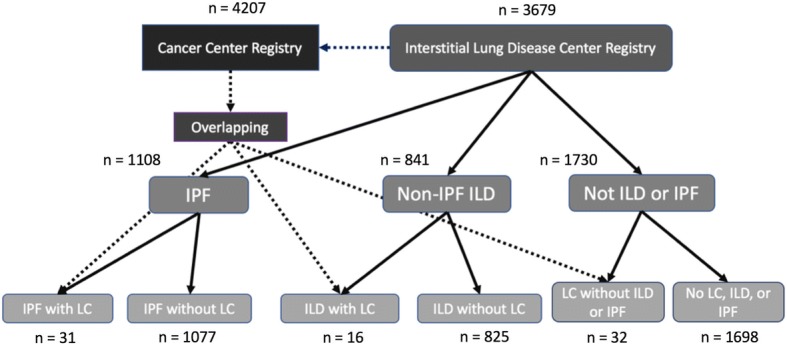
We conducted a retrospective analysis of IPF and non-IPF ILD patients from the ILD center registry, to compare with lung cancer registries at the University of Pittsburgh as well as with population data of lung cancer obtained from Pennsylvania Department of Health between 2000 and 2015.
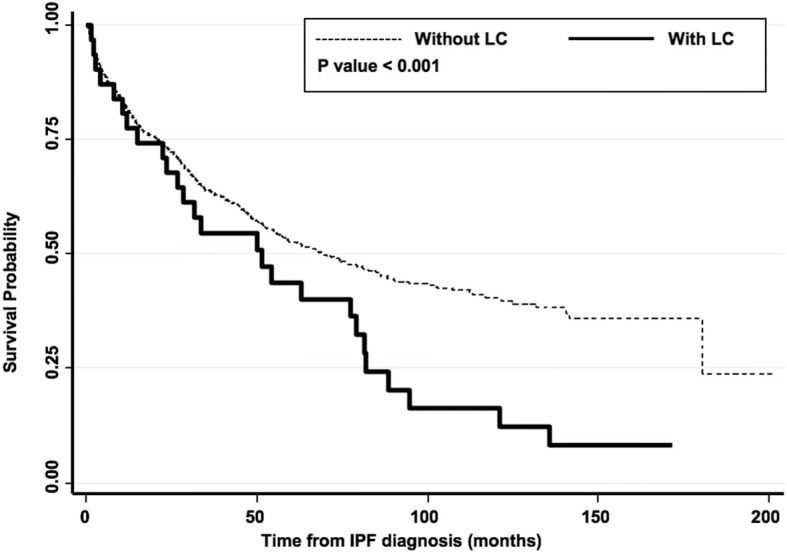
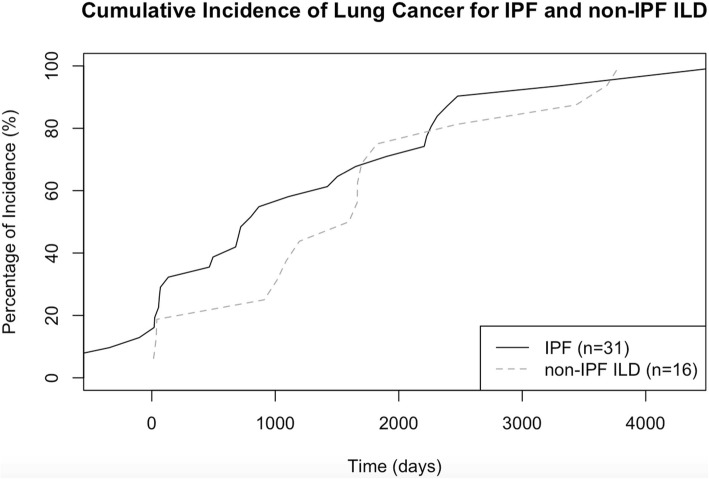
Among 1108 IPF patients, 31 patients were identified with IPF and lung cancer. The age-adjusted standard incidence ratio of lung cancer was 3.34 (with IPF) and 2.3 (with non-IPF ILD) (between-group Hazard ratio = 1.4, p = 0.3). Lung cancer worsened the mortality of IPF (p < 0.001). Lung cancer with IPF had higher mortality compared to lung cancer in non-IPF ILD (Hazard ratio = 6.2, p = 0.001). Lung cancer among IPF was characterized by a predilection for lower lobes (63% vs. 26% in non-IPF lung cancer, p < 0.001) and by squamous cell histology (41% vs. 29%, p = 0.07). Increased incidence of lung cancer was observed among single lung transplant (SLT) recipients for IPF (13 out of 97, 13.4%), with increased mortality compared to SLT for IPF without lung cancer (p = 0.028) during observational period.
Lung cancer is approximately 3.34 times more frequently diagnosed in IPF patients compared to general population, and associated with worse prognosis compared with IPF without lung cancer, with squamous cell carcinoma and lower lobe predilection. The causality between non-smoking IPF patients and lung cancer is to be determined.
特发性肺纤维化(IPF)患者偶尔会并发肺癌。我们利用机构和全州的登记数据,旨在描述 IPF 患者及其他间质性肺疾病(ILD)患者肺癌的流行病学和临床特征。
我们对ILD 中心登记处的 IPF 和非 IPFILD 患者进行了回顾性分析,同时与匹兹堡大学的肺癌登记处以及 2000 年至 2015 年宾夕法尼亚州卫生部获得的肺癌人群数据进行了比较。
在 1108 例 IPF 患者中,有 31 例被确诊为 IPF 合并肺癌。肺癌的年龄调整标准化发病率比为 3.34(有 IPF)和 2.3(无 IPFILD)(组间风险比=1.4,p=0.3)。肺癌使 IPF 的死亡率恶化(p<0.001)。与非 IPFILD 中的肺癌相比,IPF 合并肺癌的死亡率更高(风险比=6.2,p=0.001)。IPF 合并肺癌的特征为更易发生于下叶(63%比非 IPF 肺癌的 26%,p<0.001)和鳞状细胞组织学(41%比 29%,p=0.07)。在 IPF 患者中,单肺移植(SLT)后肺癌的发病率增加(97 例中有 13 例,13.4%),与 SLT 后无肺癌的 IPF 患者相比,死亡率增加(p=0.028)。
与一般人群相比,IPF 患者肺癌的诊断频率约高 3.34 倍,与无肺癌的 IPF 相比,预后更差,与鳞状细胞癌和下叶倾向有关。非吸烟 IPF 患者与肺癌之间的因果关系有待确定。