Department of Dermatology, Inselspital, Bern University Hospital, Bern, Switzerland.
Department for Biomedical Research, University of Bern, Bern, Switzerland.
PLoS One. 2018 Oct 4;13(10):e0205038. doi: 10.1371/journal.pone.0205038. eCollection 2018.
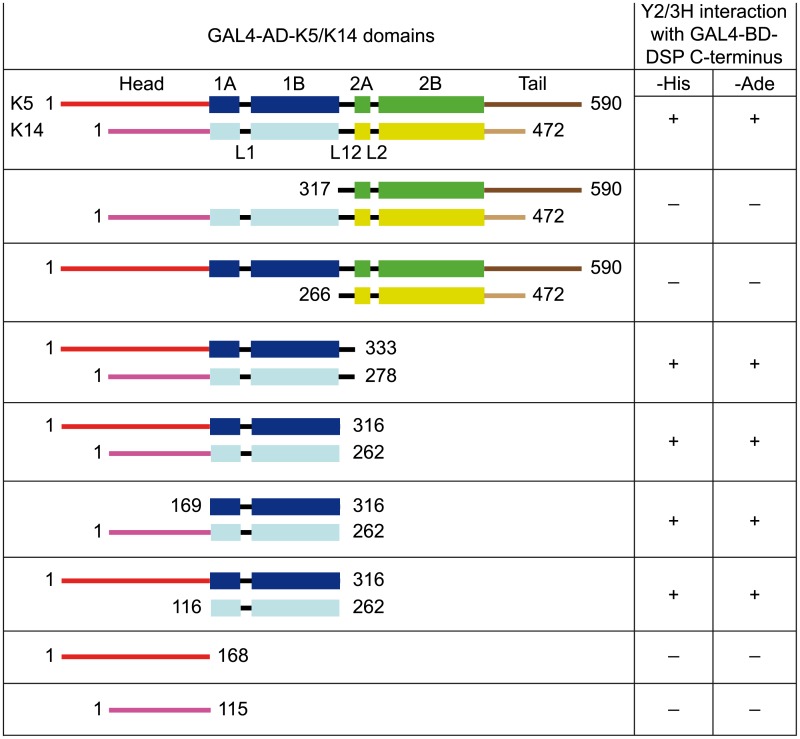
The interaction of intermediate filaments (IFs) with the cell-cell adhesion complexes desmosomes is crucial for cytoskeletal organization and cell resilience in the epidermis and heart. The intracellular desmosomal protein desmoplakin anchors IFs to the cell adhesion complexes predominantly via its four last carboxy-terminal domains (C-terminus). However, it remains unclear why the C-terminus of desmoplakin interacts with different IF types or if there are different binding affinities for each type of IFs that may influence the stability of cell-specific adhesion complexes. By yeast three-hybrid and fluorescence binding assays, we found that the coiled-coil 1 of the conserved central rod domain of the heterodimeric cytokeratins (Ks) 5 and 14 (K5/K14) was required for their interaction with the C-terminus of desmoplakin, while their unique amino head- and C-tail domains were dispensable. Similar findings were obtained in vitro with K1/K10, and the type III IF proteins desmin and vimentin. Binding assays testing the C-terminus of desmoplakin with assembled K5/K14 and desmin IFs yielded an apparent affinity in the nM range. Our findings reveal that the same conserved domain of IF proteins binds to the C-terminus of desmoplakin, which may help explain the previously reported broad binding IF-specificity to desmoplakin. Our data suggest that desmoplakin high-affinity binding to diverse IF proteins ensures robust linkages of IF cytoskeleton and desmosomes that maintain the structural integrity of cellular adhesion complexes. In summary, our results give new insights into the molecular basis of the IF-desmosome association.
中间丝(IFs)与细胞-细胞黏附复合物桥粒的相互作用对于表皮和心脏中的细胞骨架组织和细胞弹性至关重要。细胞内桥粒蛋白桥粒斑蛋白通过其四羧基末端结构域(C 末端)主要将 IF 锚定到细胞黏附复合物上。然而,目前尚不清楚桥粒斑蛋白的 C 末端为什么与不同的 IF 类型相互作用,或者每种 IF 类型是否存在不同的结合亲和力,这可能会影响细胞特异性黏附复合物的稳定性。通过酵母三杂交和荧光结合测定,我们发现异二聚体细胞角蛋白(Ks)5 和 14(K5/K14)的保守中心杆域的卷曲螺旋 1 对于其与桥粒斑蛋白 C 末端的相互作用是必需的,而其独特的氨基头和 C 尾结构域则是可有可无的。在体外与 K1/K10 以及 III 型 IF 蛋白结蛋白和波形蛋白的类似发现也得到了证实。用组装好的 K5/K14 和结蛋白 IF 进行的桥粒斑蛋白 C 末端结合测定表明,其表观亲和力在纳摩尔范围内。我们的研究结果揭示了 IF 蛋白的相同保守结构域与桥粒斑蛋白的 C 末端结合,这可能有助于解释先前报道的桥粒斑蛋白与 IF 具有广泛的结合特异性。我们的数据表明,桥粒斑蛋白与不同 IF 蛋白的高亲和力结合确保了 IF 细胞骨架和桥粒之间的牢固连接,从而维持了细胞黏附复合物的结构完整性。总之,我们的研究结果为 IF-桥粒关联的分子基础提供了新的见解。