Diana Tanja, Olivo Paul D, Kahaly George J
Molecular Thyroid Research Laboratory, Department of Medicine I, Johannes Gutenberg University (JGU) Medical Center, Mainz, Germany.
Department of Molecular Microbiology, Washington University Medical School, St. Louis, Missouri, USA.
Horm Metab Res. 2018 Dec;50(12):853-862. doi: 10.1055/a-0723-9023. Epub 2018 Oct 4.
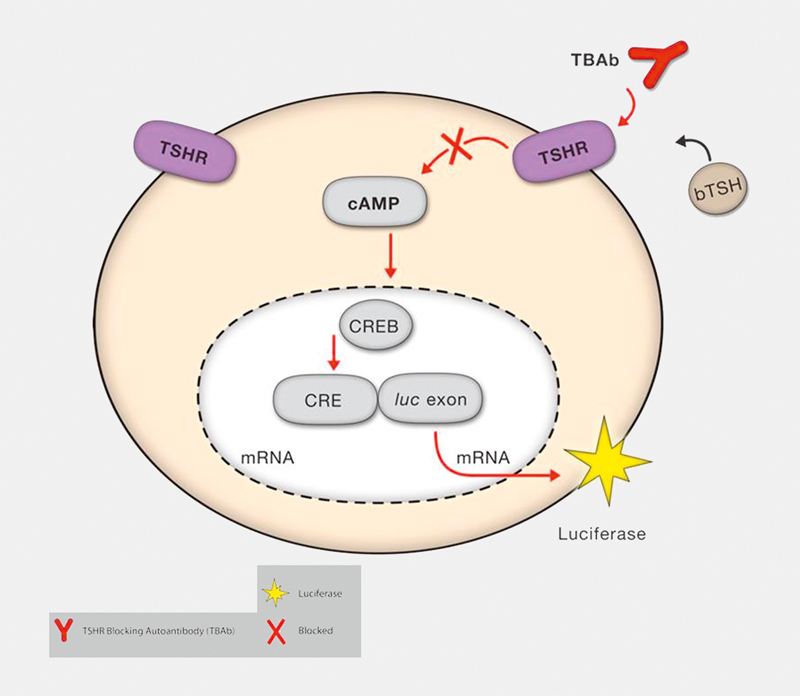
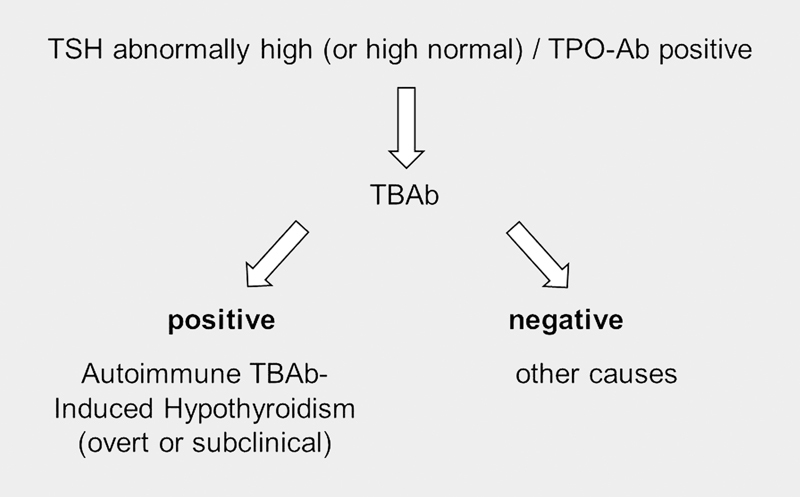
Autoantibodies (Ab) against the thyroid-stimulating hormone receptor (TSHR) are frequently found in autoimmune thyroid disease (AITD). Autoantibodies to the TSHR (anti-TSHR-Ab) may mimic or block the action of TSH or be functionally neutral. Measurement of anti-TSHR-Ab can be done either via competitive-binding immunoassays or with functional cell-based bioassays. Antibody-binding assays do not assess anti-TSHR-Ab functionality, but rather measure the concentration of total anti-TSHR binding activity. In contrast, functional cell-based bioassays indicate whether anti-TSHR-Ab have stimulatory or blocking activity. Historically bioassays for anti-TSHR-Ab were research tools and were used to study the pathophysiology of Graves' disease and Hashimoto's thyroiditis. In the past, bioassays for anti-TSHR-Abs were laborious and time-consuming and varied widely in performance from laboratory to laboratory. Recent advances in the development of cell-based assays, including the application of molecular engineering, have led to significant improvements that have enabled bioassays to be employed routinely in clinical laboratories. The prevalence and functional significance of TSHR blocking autoantibodies (TBAb) in autoimmune hypothyroidism has been less well investigated compared to TSHR stimulating Ab. There is an increasing body of data, however, that demonstrate the clinical utility and relevance of TBAb, and thus the importance of TBAb bioassays, in the diagnosis and management of patients with AITD. In the present review, we summarize the different methods used to measure TBAb, and discuss their prevalence and clinical relevance.
抗促甲状腺激素受体(TSHR)自身抗体(Ab)在自身免疫性甲状腺疾病(AITD)中经常被发现。TSHR自身抗体(抗TSHR-Ab)可能模拟或阻断促甲状腺激素(TSH)的作用,或在功能上呈中性。抗TSHR-Ab的检测可通过竞争性结合免疫测定法或基于功能性细胞的生物测定法进行。抗体结合测定法不评估抗TSHR-Ab的功能,而是测量总抗TSHR结合活性的浓度。相比之下,基于功能性细胞的生物测定法可表明抗TSHR-Ab是否具有刺激或阻断活性。历史上,抗TSHR-Ab的生物测定法是研究工具,用于研究格雷夫斯病和桥本甲状腺炎的病理生理学。过去,抗TSHR-Ab的生物测定法既费力又耗时,而且不同实验室的检测结果差异很大。基于细胞的检测方法的最新进展,包括分子工程的应用,已带来显著改进,使生物测定法能够在临床实验室中常规使用。与TSHR刺激抗体相比,自身免疫性甲状腺功能减退症中TSHR阻断自身抗体(TBAb)的患病率和功能意义的研究较少。然而,越来越多的数据表明TBAb在AITD患者的诊断和管理中的临床实用性和相关性,因此TBAb生物测定法也很重要。在本综述中,我们总结了用于测量TBAb的不同方法,并讨论了它们的患病率和临床相关性。