Department of Psychiatry, Hadassah Hebrew University Medical Center, Jerusalem, Israel.
Experimental Therapeutics and Pathophysiology Branch, National Institute of Mental Health, National Institutes of Health, Bethesda, MD, USA.
Transl Psychiatry. 2018 Oct 4;8(1):206. doi: 10.1038/s41398-018-0257-9.
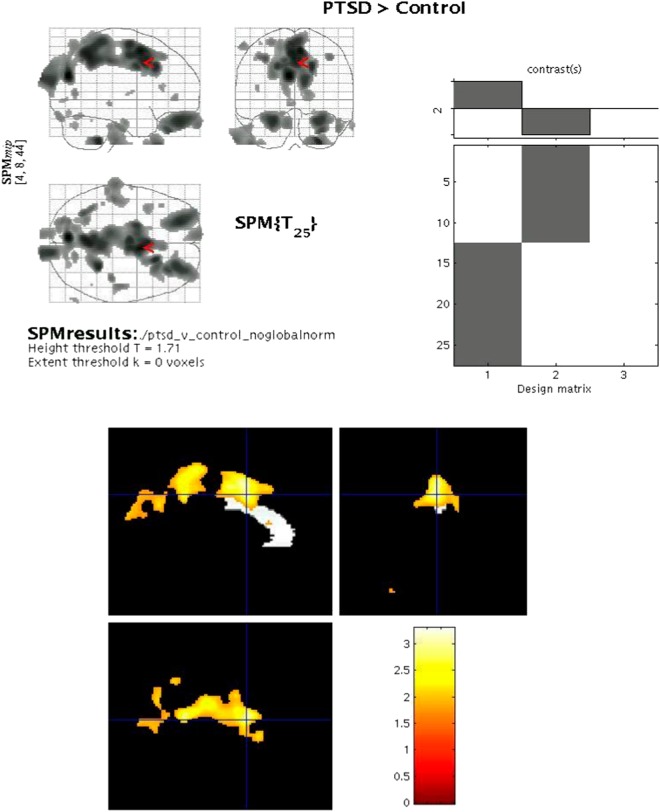
Agonists of the γ-aminobutyric acid (GABA) type A benzodiazepine (BZD) receptor exert anxiolytic effects in anxiety disorders, raising the possibility that altered GABA-ergic function may play a role in the pathophysiology of anxiety disorders, such as post-traumatic stress disorder (PTSD). However, few neuroimaging studies have assessed the function or binding potential of the central GABA BZD receptor system in PTSD. Therefore, our aim was to compare the BZD receptor binding potential between PTSD patients and healthy controls. Twelve medication-free participants with a current diagnosis of PTSD and 15 matched healthy controls underwent positron emission tomography (PET) imaging using [C] flumazenil. Structural magnetic resonance imaging (MRI) scans were obtained and co-registered to the PET images to permit co-location of neuroanatomical structures in the lower resolution PET image data. Compared to healthy controls, PTSD patients exhibited increased BZD binding in the caudal anterior cingulate cortex and precuneus (p's < 0.05). Severity of PTSD symptoms positively correlated with BZD binding in the left mid- and anterior insular cortices. This study extends previous findings by suggesting that central BZD receptor system involvement in PTSD includes portions of the default mode and salience networks, along with insular regions that support interoception and autonomic arousal.
γ-氨基丁酸(GABA)A型苯二氮䓬(BZD)受体激动剂在焦虑症中具有抗焦虑作用,这表明 GABA 能功能的改变可能在焦虑症的病理生理学中发挥作用,例如创伤后应激障碍(PTSD)。然而,很少有神经影像学研究评估 PTSD 中心 GABA BZD 受体系统的功能或结合潜能。因此,我们的目的是比较 PTSD 患者和健康对照组之间的 BZD 受体结合潜能。12 名未服用药物且目前诊断为 PTSD 的参与者和 15 名匹配的健康对照组接受了正电子发射断层扫描(PET)成像,使用 [C]氟马西尼。获得结构磁共振成像(MRI)扫描,并与 PET 图像配准,以允许在较低分辨率的 PET 图像数据中对神经解剖结构进行共定位。与健康对照组相比,PTSD 患者在尾状前扣带皮层和楔前叶表现出更高的 BZD 结合(p 值<0.05)。PTSD 症状的严重程度与左中前岛叶皮质的 BZD 结合呈正相关。这项研究通过表明 PTSD 中涉及中枢 BZD 受体系统的部分包括默认模式和显着性网络,以及支持内脏感知和自主唤醒的岛叶区域,扩展了先前的发现。