Ng Qin Xiang, Soh Alex Yu Sen, Loke Wayren, Lim Donovan Yutong, Yeo Wee-Song
National University Hospital, National University Health System, Singapore,
MOH Holdings Pte Ltd, Singapore,
J Inflamm Res. 2018 Sep 21;11:345-349. doi: 10.2147/JIR.S174982. eCollection 2018.
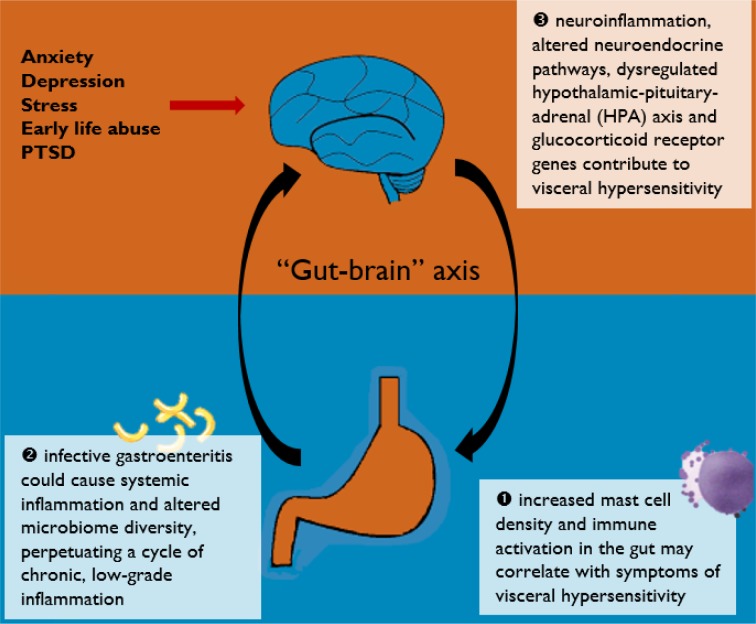
Irritable bowel syndrome (IBS) is a complex, functional gastrointestinal disorder characterized by chronic abdominal pain or discomfort and altered bowel habits. Despite the global prevalence and disease burden of IBS, its underlying pathophysiology remains unclear. Inflammation may play a pathogenic role in IBS. Studies have highlighted the persistence of mucosal inflammation at the microscopic and molecular level in IBS, with increased recruitment of enteroendocrine cells. Substantial overlaps between IBS and inflammatory bowel disease have also been reported. This review thus aimed to discuss the body of evidence pertaining to the presence of mucosal inflammation in IBS, its putative role in the disease process of IBS, and its clinical relevance. Increased mast cell density and activity in the gut may correlate with symptoms of visceral hypersensitivity. As evidenced by patients who develop postinfectious IBS, infective gastroenteritis could cause systemic inflammation and altered microbiome diversity, which in turn perpetuates a cycle of chronic, low-grade, subclinical inflammation. Apart from mucosal inflammation, neuroinflammation is probably involved in the pathophysiology of IBS via the "gut-brain" axis, resulting in altered neuroendocrine pathways and glucocorticoid receptor genes. This gives rise to an overall proinflammatory phenotype and dysregulated hypothalamic-pituitary-adrenal axis and serotonergic (5-HT) functioning, which could, at least in part, account for the symptoms of IBS. Although a definite and reproducible pattern of immune response has yet to be recognized, further research into anti-inflammatories may be of clinical value.
肠易激综合征(IBS)是一种复杂的功能性胃肠疾病,其特征为慢性腹痛或不适以及排便习惯改变。尽管IBS在全球范围内普遍存在且疾病负担较重,但其潜在的病理生理学仍不清楚。炎症可能在IBS中起致病作用。研究强调了IBS在微观和分子水平上黏膜炎症的持续性,同时肠内分泌细胞的募集增加。也有报道称IBS与炎症性肠病之间存在大量重叠。因此,本综述旨在讨论与IBS中黏膜炎症的存在、其在IBS疾病过程中的假定作用及其临床相关性相关的证据。肠道中肥大细胞密度和活性的增加可能与内脏超敏反应的症状相关。如感染后IBS患者所证实的,感染性肠胃炎可导致全身炎症和微生物群多样性改变,进而使慢性、低度、亚临床炎症循环持续存在。除了黏膜炎症外,神经炎症可能通过“肠-脑”轴参与IBS的病理生理学过程,导致神经内分泌途径和糖皮质激素受体基因改变。这会产生整体的促炎表型以及下丘脑-垂体-肾上腺轴和血清素能(5-HT)功能失调,这至少可以部分解释IBS的症状。尽管尚未识别出明确且可重复的免疫反应模式,但对抗炎药物的进一步研究可能具有临床价值。