Hutter Eline M, Gélvez-Rueda María C, Bartesaghi Davide, Grozema Ferdinand C, Savenije Tom J
Department of Chemistry, Stanford University, Stanford, California 94305, United States.
Department of Chemical Engineering, Delft University of Technology, Van der Maasweg 9, 2629 HZ Delft, The Netherlands.
ACS Omega. 2018 Sep 30;3(9):11655-11662. doi: 10.1021/acsomega.8b01705. Epub 2018 Sep 24.
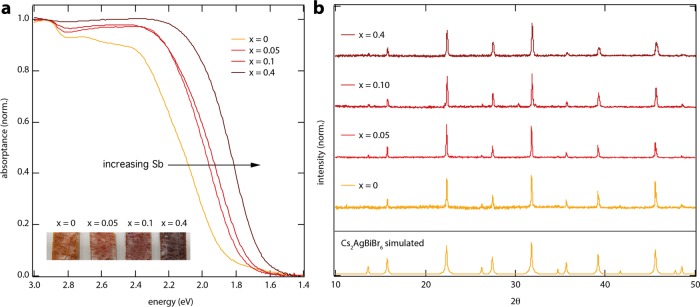
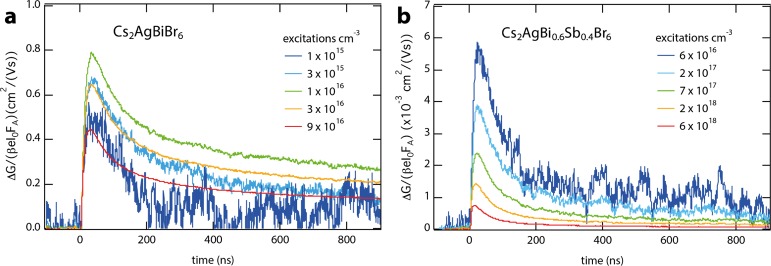
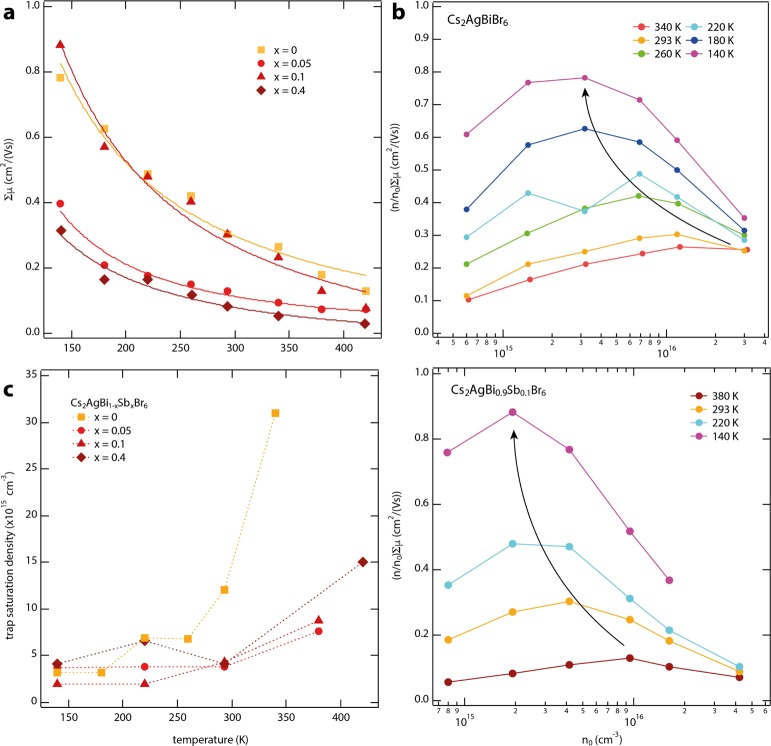
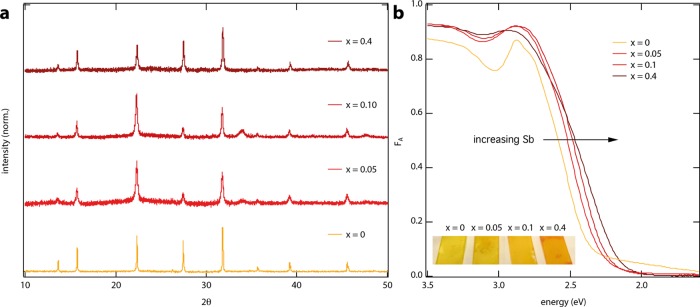
Recently, halide double perovskites (HDPs), such as CsAgBiBr, have been reported as promising nontoxic alternatives to lead halide perovskites. However, it remains unclear whether the charge-transport properties of these materials are as favorable as for lead-based perovskites. In this work, we study the mobilities of charges in CsAgBiBr and in mixed antimony-bismuth CsAgBi Sb Br, in which the band gap is tunable from 2.0 to 1.6 eV. Using temperature-dependent time-resolved microwave conductivity techniques, we find that the mobility is proportional to (with ≈ 1.5). Importantly, this indicates that phonon scattering is the dominant scattering mechanism determining the charge carrier mobility in these HDPs similar to the state-of-the-art lead-based perovskites. Finally, we show that wet chemical processing of CsAgBi Sb Br powders is a successful route to prepare thin films of these materials, which paves the way toward photovoltaic devices based on nontoxic HDPs with tunable band gaps.
最近,卤化物双钙钛矿(HDPs),如CsAgBiBr,已被报道为卤化铅钙钛矿有前景的无毒替代品。然而,这些材料的电荷传输特性是否与铅基钙钛矿一样有利仍不清楚。在这项工作中,我们研究了CsAgBiBr和混合锑铋CsAgBiSbBr中电荷的迁移率,其中带隙可在2.0至1.6 eV之间调节。使用温度相关的时间分辨微波电导率技术,我们发现迁移率与 成正比( ≈ 1.5)。重要的是,这表明声子散射是决定这些HDPs中电荷载流子迁移率的主要散射机制,类似于最先进的铅基钙钛矿。最后,我们表明CsAgBiSbBr粉末的湿化学处理是制备这些材料薄膜的成功途径,这为基于具有可调带隙的无毒HDPs的光伏器件铺平了道路。