Shahrokh Tehrani Nejad Ensieh, Bakhtiari Ghaleh Fatemeh, Eslami Bita, Haghollahi Fedyeh, Bagheri Maryam, Masoumi Masoumeh
Vali-Asr Reproductive Health Research Center, Tehran University of Medical Sciences, Tehran, Iran.
Breast Disease Research Center (BDRC), Tehran University of Medical Sciences, Tehran, Iran.
Int J Reprod Biomed. 2018 Aug;16(8):535-540.
Both oral contraceptive pills (OCPs) and estradiol valerate (E2) have been used to schedule a gonadotropin-releasing hormone antagonist in vitro fertilization (IVF) cycles. Since the suppression of follicle-stimulating hormone by OCPs can stay 5-7 days after stopping the pills, it seems that starting the gonadotropin-releasing hormone (GnRH) after 6 days of pre-treatment discontinuation may be important in IVF outcomes.
The aim of the present study was to determine the number of mature oocyte and pregnancy rate of three pretreatment methods for fresh embryo transfer cycles.
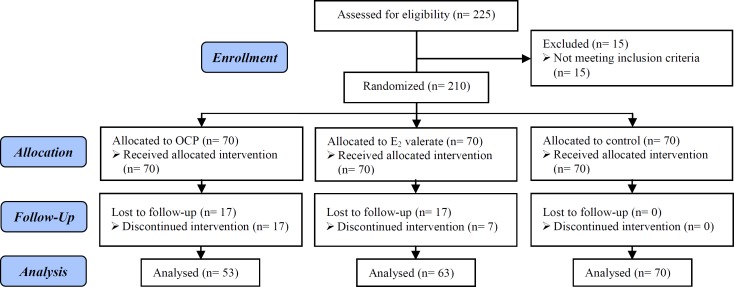
In this randomized controlled trial, two-hundred ten women (18-35 yr and less than 2 previous IVF attempts) undergoing IVF with the GnRH antagonist protocol were randomized to the OCP, E2, and no pretreatment arms. OCP group (n=53) received OCP (ethinyl estradiol30 μg and levonorgestrel150 μg), E2 group (n=63) received 4 mg/day oral E2 (17β-E2) for 10 days from day 20 of the previous cycle and GnRH antagonist stimulation was started 6 days after the interruption of OCP and E2. The control group (n =70) did not receive any pretreatment.
No significant difference was observed in the mean number of the mature oocyte, endometrial thickness, and embryo quality. The pregnancy rate in E2 group was higher than the two other groups (42.9% vs 39.6% and 34.3% in OCP and control group, respectively), but the difference was not statistically significant (p=0.59).
It seems OCP or E2 pretreatment could not improve the fresh IVF-embryo transfer outcomes.
口服避孕药(OCPs)和戊酸雌二醇(E2)均已用于体外受精(IVF)周期中促性腺激素释放激素拮抗剂的方案安排。由于口服避孕药对促卵泡激素的抑制作用在停药后可持续5 - 7天,因此在预处理停药6天后开始使用促性腺激素释放激素(GnRH)可能对IVF结局很重要。
本研究的目的是确定三种预处理方法用于新鲜胚胎移植周期时的成熟卵母细胞数量和妊娠率。
在这项随机对照试验中,210名年龄在18 - 35岁且既往IVF尝试次数少于2次、采用GnRH拮抗剂方案进行IVF的女性被随机分为口服避孕药组、E2组和无预处理组。口服避孕药组(n = 53)服用口服避孕药(炔雌醇30μg和左炔诺孕酮150μg),E2组(n = 63)从上一周期第20天开始连续10天每天口服4mg E2(17β - E2),在口服避孕药和E2中断后6天开始GnRH拮抗剂刺激。对照组(n = 70)未接受任何预处理。
成熟卵母细胞的平均数量、子宫内膜厚度和胚胎质量方面未观察到显著差异。E2组的妊娠率高于其他两组(分别为42.9%,口服避孕药组为39.6%,对照组为34.3%),但差异无统计学意义(p = 0.59)。
口服避孕药或E2预处理似乎不能改善新鲜IVF - 胚胎移植的结局。