Section for Science of Complex Systems, CeMSIIS, Medical University of Vienna, Vienna, Austria.
Complexity Science Hub Vienna, Vienna, Austria.
PLoS One. 2018 Oct 5;13(10):e0204975. doi: 10.1371/journal.pone.0204975. eCollection 2018.
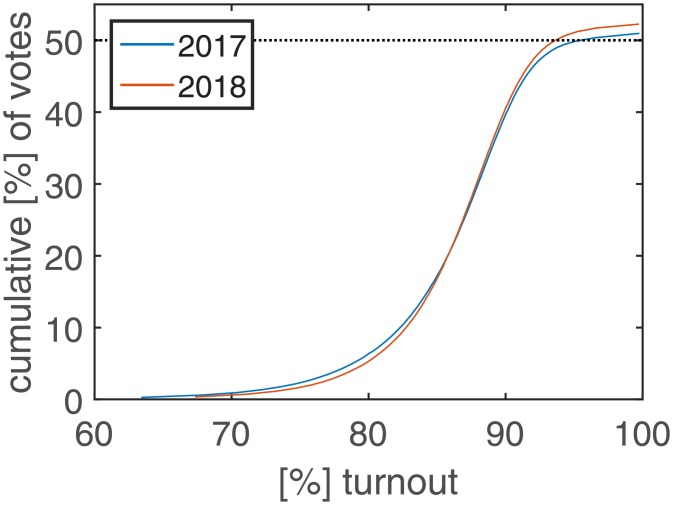
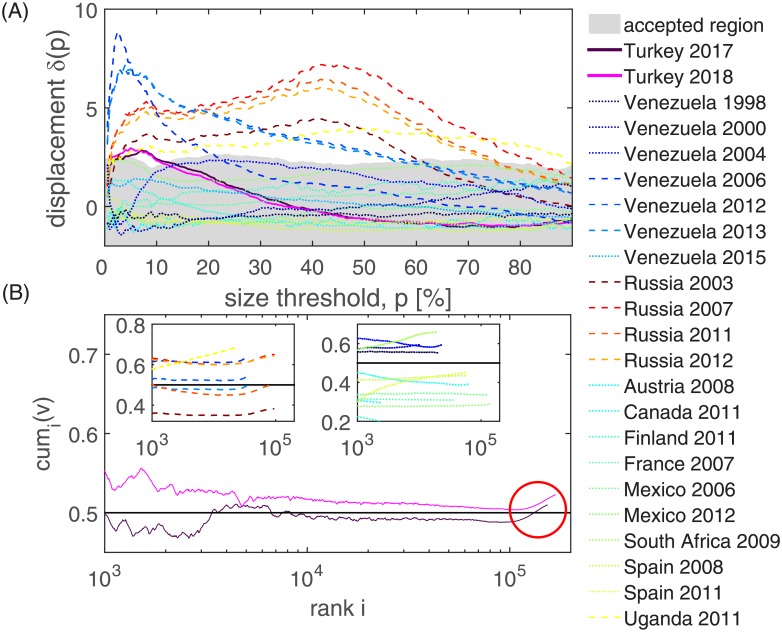
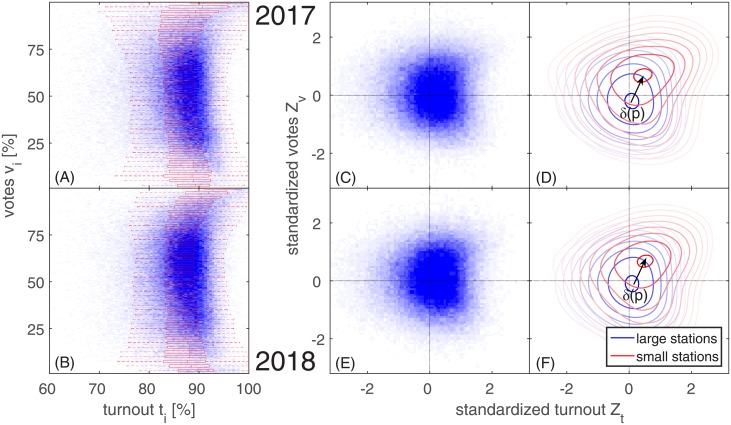
With a majority of 'Yes' votes in the Constitutional Referendum of 2017, Turkey continued its drift towards an autocracy. By the will of the Turkish people, this referendum transferred practically all executive power to president Erdoğan. However, the referendum was confronted with a substantial number of allegations of electoral misconducts and irregularities, ranging from state coercion of 'No' supporters to the controversial validity of unstamped ballots. Here we report the results of an election forensic analysis of recent Turkish elections to clarify to what extent it is plausible that these voting irregularities were present and able to influence the outcome of the referendum. We apply statistical forensics tests to identify the specific nature of the alleged electoral malpractices. In particular, we test whether the data contains fingerprints for ballot stuffing (submission of multiple ballots per person during the vote) and voter rigging (coercion and intimidation of voters). Additionally, we perform tests to identify numerical anomalies in the election results. For the 2017 Constitutional Referendum we find systematic and highly significant statistical support for the presence of both ballot stuffing and voter rigging. In 11% of stations we find signs for ballot stuffing with a standard deviation (uncertainty of ballot stuffing probability) of 2.7% (4 sigma event). Removing such ballot-stuffing-characteristic anomalies from the data would tip the overall balance from 'No' to a majority of 'Yes' votes. The 2017 election was followed by early elections in 2018 to directly vote for a new president who would now be head of state and government. We find statistical irregularities in the 2018 presidential and parliamentary elections similar in size and direction to those in 2017. These findings validate that our results unveil systematic and potentially even fraudulent biases that require further attention in order to combat electoral malpractices.
在 2017 年的宪法公投中,土耳其以多数票赞成继续向独裁统治倾斜。根据土耳其人民的意愿,这次公投将几乎所有行政权力都移交给了总统埃尔多安。然而,这次公投面临着大量选举不当和违规行为的指控,从国家对“反对”派的强制到有争议的无印章选票的有效性。在这里,我们报告了对最近土耳其选举的选举法医分析结果,以澄清这些投票违规行为存在的程度,以及它们是否能够影响公投结果。我们应用统计法医检验来识别所谓选举不当行为的具体性质。特别是,我们测试数据是否包含选票填充(投票期间每人提交多张选票)和选民操纵(选民的胁迫和恐吓)的指纹。此外,我们还进行了测试,以识别选举结果中的数值异常。对于 2017 年的宪法公投,我们发现存在选票填充和选民操纵的系统且高度显著的统计支持。在 11%的投票站,我们发现有选票填充的迹象,其标准偏差(选票填充概率的不确定性)为 2.7%(4 西格玛事件)。从数据中删除这种选票填充特征异常将使总体平衡从“反对”变为多数赞成票。2017 年的选举之后,2018 年提前举行了选举,直接选举一位新总统,他现在将成为国家元首和政府首脑。我们发现 2018 年总统和议会选举中的统计异常与 2017 年的选举相似,规模和方向相同。这些发现验证了我们的结果揭示了系统的、甚至可能是欺诈性的偏见,需要进一步关注,以打击选举不当行为。