Warren Alpert Medical School of Brown University, Providence, Rhode Island.
Warren Alpert Medical School of Brown University, Department of Emergency Medicine, Providence, Rhode Island.
West J Emerg Med. 2021 Jul 15;22(4):1000-1009. doi: 10.5811/westjem.2021.4.50884.
Voters facing illness or disability are disproportionately under-represented in terms of voter turnout. Earlier research has indicated that enfranchisement of these populations may reinforce the implementation of policies improving health outcomes and equity. Due to the confluence of the coronavirus 2019 (COVID-19) pandemic and the 2020 election, we aimed to assess emergency absentee voting processes, which allow voters hospitalized after regular absentee deadlines to still obtain an absentee ballot, and election changes due to COVID-19 in all 50 states.
We performed a cross-sectional study collecting 34 variables pertaining to emergency voting processes and COVID-19-related election changes, including deadlines, methods of submission for applications and ballots, and specialized services for patients. Data were obtained from, in order of priority, state boards of elections websites, poll worker manuals, application forms, and state legislation. We verified all data through direct correspondence with state boards of elections.
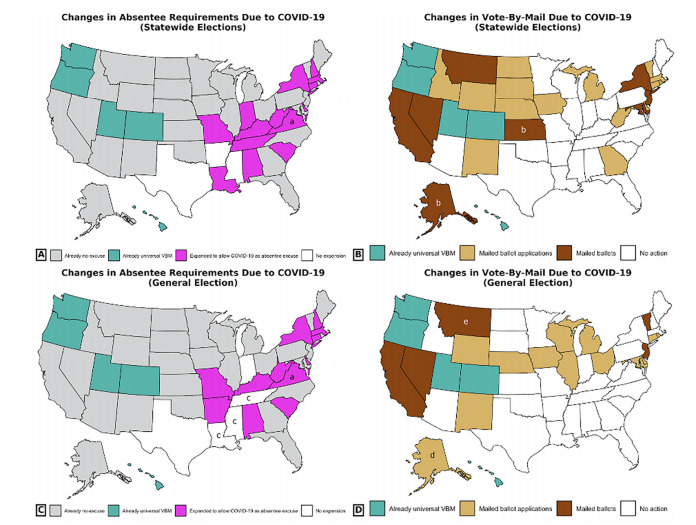
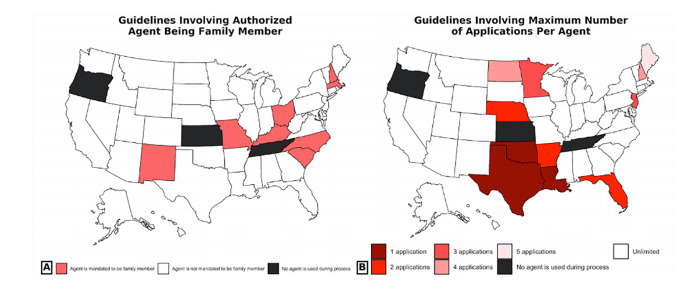
Emergency absentee voting processes are in place in 39 states, with the remaining states having universal vote-by-mail (n = 5) or extended regular absentee voting deadlines (n = 6). The emergency absentee period most commonly began within 24 hours following the normal absentee application deadline, which was often seven days before an election (n = 11). Unique aspects of emergency voting processes included patients designating an "authorized agent" to deliver their applications and ballots (n = 38), electronic ballot delivery (n = 5), and in-person teams that deliver ballots directly to patients (n = 18). Documented barriers in these processes nationwide include unavailable online information (n = 11), restrictions mandating agents to be family members (n = 7), physician affidavits or signatures (n = 9), and notary or witness signature requirements (n = 15). For the November 2020 presidential election, 12 states expanded absentee eligibility to allow COVID-19 as a reason to request an absentee ballot, and 18 states mailed absentee ballot applications or absentee ballots to all registered voters.
While 39 states operate emergency absentee voting processes for hospitalized voters, there are considerable areas for improvement and heterogeneity in guidelines for these protocols. For future election cycles, information on emergency voting and broader election reforms due to COVID-19 may be useful for emergency providers and patients alike to improve the democratic participation of voters experiencing illness.
在选民投票率方面,面临疾病或残疾的选民比例不成比例地偏低。早期的研究表明,赋予这些人群选举权可能会加强实施改善健康结果和公平性的政策。由于 2019 年冠状病毒病(COVID-19)大流行和 2020 年选举的同时发生,我们旨在评估紧急缺席投票程序,该程序允许在常规缺席截止日期后住院的选民仍能获得缺席选票,并评估由于 COVID-19 而在所有 50 个州进行的选举变更。
我们进行了一项横断面研究,收集了 34 个与紧急投票程序和 COVID-19 相关选举变更相关的变量,包括截止日期、申请和选票提交的方法以及患者的专门服务。数据按优先顺序从州选举委员会网站、投票工作人员手册、申请表和州立法中获取。我们通过与州选举委员会的直接通信来验证所有数据。
在 39 个州实施了紧急缺席投票程序,其余的州则实行普遍的邮寄选票(n = 5)或延长常规缺席投票截止日期(n = 6)。紧急缺席投票期通常在正常缺席申请截止日期后的 24 小时内开始,该截止日期通常是选举前七天(n = 11)。紧急投票程序的独特方面包括患者指定“授权代理人”来提交他们的申请和选票(n = 38)、电子选票交付(n = 5)以及直接向患者投递选票的现场团队(n = 18)。全国范围内这些程序存在的记录障碍包括无法在线获取信息(n = 11)、限制授权代理人必须是家庭成员的规定(n = 7)、医生宣誓书或签名(n = 9)以及需要公证人或证人签名的要求(n = 15)。在 2020 年 11 月总统选举中,有 12 个州扩大了缺席投票资格,允许将 COVID-19 作为申请缺席选票的理由,有 18 个州向所有登记选民邮寄缺席选票申请或缺席选票。
虽然 39 个州为住院选民实施了紧急缺席投票程序,但在这些协议的指导方针方面仍有相当大的改进和异质性的空间。对于未来的选举周期,有关紧急投票和由于 COVID-19 而进行的更广泛选举改革的信息可能对急诊提供者和患者都有用,以提高患病选民的民主参与度。