Department of Clinical Medicine, Aarhus University, Aarhus, Denmark.
Department of Hematology and.
Blood Adv. 2018 Oct 9;2(19):2533-2542. doi: 10.1182/bloodadvances.2018019893.
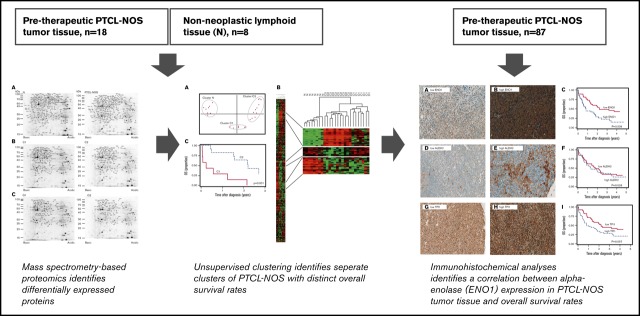
Peripheral T-cell lymphoma, not otherwise specified (PTCL-NOS) constitutes a heterogeneous category of lymphomas, which do not fit into any of the specifically defined T-cell lymphoma entities. Both the pathogenesis and tumor biology in PTCL-NOS are poorly understood. Protein expression in pretherapeutic PTCL-NOS tumors was analyzed by proteomics. Differentially expressed proteins were compared in 3 distinct scenarios: (A) PTCL-NOS tumor tissue (n = 18) vs benign lymphoid tissue (n = 8), (B) clusters defined by principal component analysis (PCA), and (C) tumors from patients with chemosensitive vs refractory PTCL-NOS. Selected differentially expressed proteins identified by proteomics were correlated with clinico-pathological features and outcome in a larger cohort of patients with PTCL-NOS (n = 87) by immunohistochemistry (IHC). Most proteins with altered expression were identified comparing PTCL-NOS vs benign lymphoid tissue. PCA of the protein profile defined 3 distinct clusters. All benign samples clustered together, whereas PTCL-NOS tumors separated into 2 clusters with different patient overall survival rates ( = .001). Differentially expressed proteins reflected large biological diversity among PTCL-NOS, particularly associated with alterations of "immunological" pathways. The 2 PTCL-NOS subclusters defined by PCA showed disturbance of "stress-related" and "protein metabolic" pathways. α-Enolase 1 (ENO1) was found differentially expressed in all 3 analyses, and high intratumoral ENO1 expression evaluated by IHC correlated with poor outcome (hazard ratio, 2.09; 95% confidence interval, 1.17-3.73; = .013). High expression of triosephosphate isomerase (TPI1) also showed a tendency to correlate with poor survival ( = .057). In conclusion, proteomic profiling of PTCL-NOS provided evidence of markedly altered protein expression and identified ENO1 as a novel potential prognostic marker.
外周 T 细胞淋巴瘤,非特指型(PTCL-NOS)是一组异质性的淋巴瘤,无法归入任何特定定义的 T 细胞淋巴瘤实体中。PTCL-NOS 的发病机制和肿瘤生物学都知之甚少。通过蛋白质组学分析了治疗前 PTCL-NOS 肿瘤中的蛋白表达情况。将差异表达蛋白在 3 种不同的情况下进行比较:(A)PTCL-NOS 肿瘤组织(n=18)与良性淋巴组织(n=8),(B)主成分分析(PCA)定义的聚类,以及(C)来自化疗敏感和耐药性 PTCL-NOS 患者的肿瘤。通过免疫组织化学(IHC)在更大的 PTCL-NOS 患者队列(n=87)中对蛋白质组学鉴定的选定差异表达蛋白与临床病理特征和结局进行了相关性分析。通过比较 PTCL-NOS 与良性淋巴组织,确定了大多数具有改变表达的蛋白。蛋白质图谱的 PCA 定义了 3 个不同的聚类。所有良性样本聚集在一起,而 PTCL-NOS 肿瘤分为 2 个具有不同患者总生存率的聚类( =.001)。差异表达的蛋白反映了 PTCL-NOS 之间的巨大生物学多样性,特别是与“免疫”途径的改变有关。PCA 定义的 2 个 PTCL-NOS 亚聚类显示“应激相关”和“蛋白质代谢”途径的紊乱。α-烯醇化酶 1(ENO1)在所有 3 种分析中均发现差异表达,并且通过 IHC 评估的肿瘤内 ENO1 高表达与不良结局相关(危险比,2.09;95%置信区间,1.17-3.73; =.013)。三磷酸甘油醛异构酶(TPI1)的高表达也显示出与不良生存相关的趋势( =.057)。总之,PTCL-NOS 的蛋白质组学分析提供了明显改变蛋白表达的证据,并确定 ENO1 为一种新的潜在预后标志物。