Borragán Guillermo, Gilson Médhi, Atas Anne, Slama Hichem, Lysandropoulos Andreas, De Schepper Melanie, Peigneux Philippe
Neuropsychology and Functional Neuroimaging Research Unit, Université Libre de Bruxelles, Brussels, Belgium.
Centre de Recherches en Cognition et Neurosciences and ULB Neurosciences Institute, Université Libre de Bruxelles, Brussels, Belgium.
Front Hum Neurosci. 2018 Sep 20;12:378. doi: 10.3389/fnhum.2018.00378. eCollection 2018.
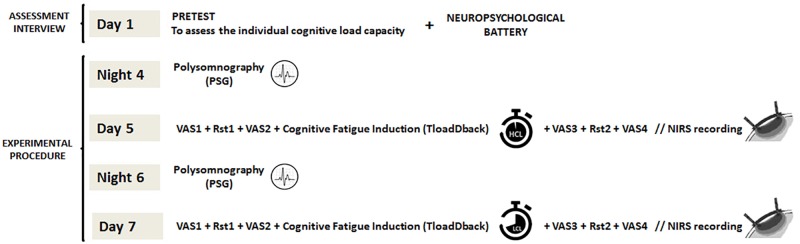
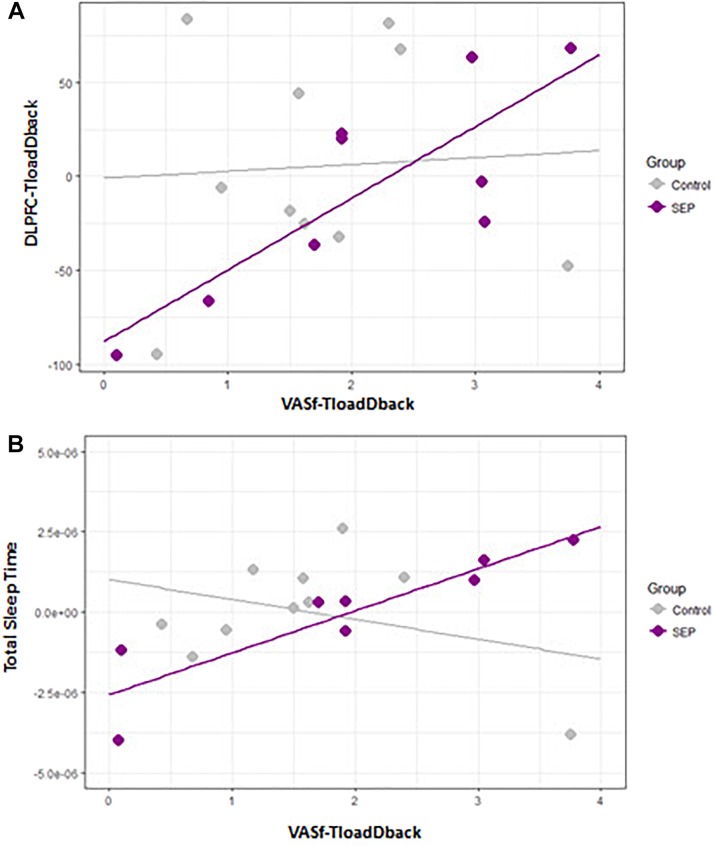
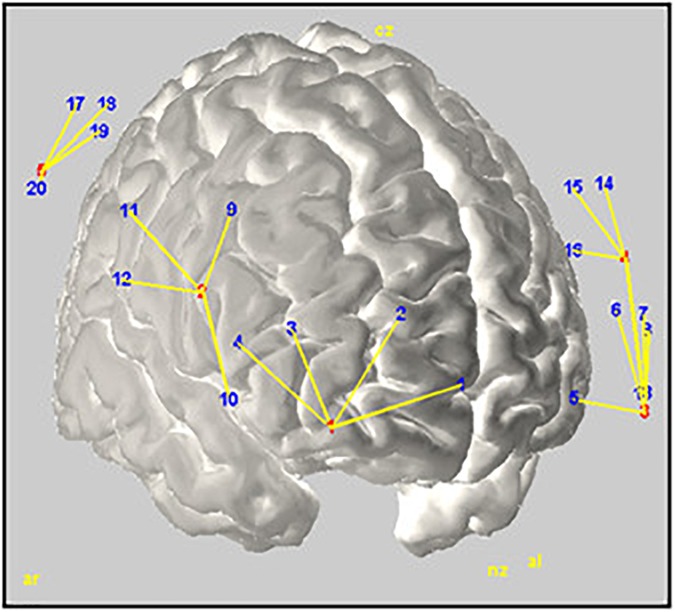
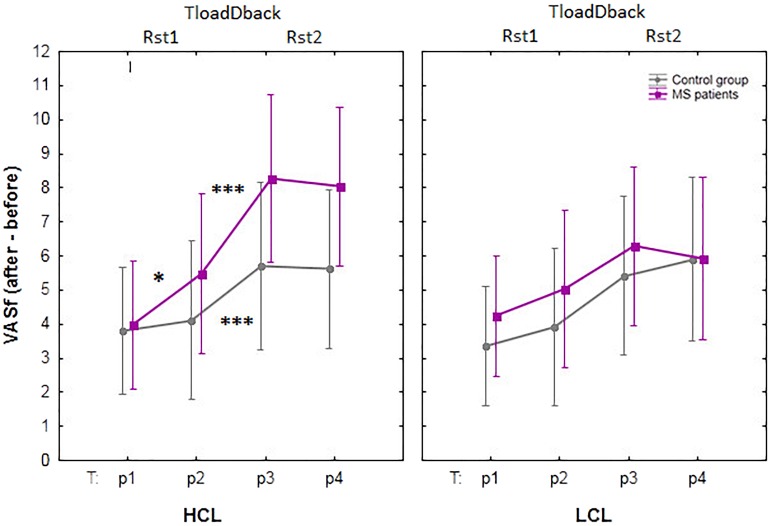
Patients with multiple sclerosis (MS) disease frequently experience fatigue as their most debilitating symptom. Fatigue in MS partially refers to a cognitive component, cognitive fatigue (CF), characterized by a faster and stronger than usual development of the subjective feeling of exhaustion that follows sustained cognitive demands. The feeling of CF might result from supplementary task-related brain activity following MS-related demyelination and neurodegeneration. Besides, CF in MS disease might also stem from disrupted sleep. The present study investigated the association between the triggering of CF, task-related brain activity and sleep features. In a counterbalance mixed design, 10 patients with MS and 11 healthy controls were exposed twice for 16 min to a CF-inducing dual working memory updating task (TloadDback) under low or high cognitive demands conditions, counterbalanced. Considering known inter-individual differences and potential cognitive deficits in MS, the maximal cognitive load of the task was individually adapted to each participant's own upper limits. During the experimental sessions, cortical brain activity was measured using near-infrared spectroscopy (NIRS) during the CF-induction task, and in a resting state immediately before and after. Ambulatory polysomnography recordings were obtained on the nights preceding experimental sessions. When cognitive load was individually adapted to their processing capabilities, patients with MS exhibited similar than healthy controls levels of subjectively perceived CF, evolution of performance during the task, and brain activity patterns. Linear mixed models indicate a negative association between oxygenation level changes in the dorsolateral prefrontal cortex (DLPFC) and the triggering of subjective CF in patients with MS only. Longer total sleep time was also associated with higher CF in MS patients. These results suggest that controlling for cognitive load between individuals with and without MS results in a similar task-related development of subjective CF. Besides comparable performance and cortical brain activity between groups, mixed model analyses suggest a possible association between CF, DLPFC activity and sleep duration in MS disease.
多发性硬化症(MS)患者经常经历疲劳,这是他们最使人衰弱的症状。MS中的疲劳部分涉及认知成分,即认知疲劳(CF),其特征是在持续的认知需求后,主观疲劳感的发展比平时更快、更强。CF的感觉可能源于MS相关脱髓鞘和神经变性后与任务相关的额外大脑活动。此外,MS疾病中的CF也可能源于睡眠中断。本研究调查了CF的触发、与任务相关的大脑活动和睡眠特征之间的关联。在一种平衡的混合设计中,10名MS患者和11名健康对照者在低或高认知需求条件下,以平衡的方式两次暴露于诱导CF的双重工作记忆更新任务(TloadDback)中,每次16分钟。考虑到MS中已知的个体差异和潜在的认知缺陷,任务的最大认知负荷根据每个参与者自己的上限进行了个性化调整。在实验过程中,在CF诱导任务期间以及前后的静息状态下,使用近红外光谱(NIRS)测量了大脑皮层活动。在实验前的晚上进行了动态多导睡眠图记录。当认知负荷根据他们的处理能力进行个性化调整时,MS患者表现出与健康对照者相似的主观感知CF水平、任务期间的表现演变和大脑活动模式。线性混合模型表明,仅在MS患者中,背外侧前额叶皮层(DLPFC)的氧合水平变化与主观CF的触发之间存在负相关。总睡眠时间较长也与MS患者较高的CF相关。这些结果表明,控制有MS和无MS个体之间的认知负荷会导致主观CF在与任务相关的发展上相似。除了两组之间可比的表现和大脑皮层活动外,混合模型分析表明,MS疾病中CF、DLPFC活动和睡眠时间之间可能存在关联。