Iwamoto Kazuko, Kamo Shuichi, Takada Yuichi, Ieda Ayana, Yamashita Takatoshi, Sato Toshiro, Zaima Nobuhiro, Moriyama Tatsuya
School of Agriculture, Kindai University, Naka-machi, Nara, Nara 631-8505, Japan.
Product Development Laboratory, J-OIL MILLS, Inc., 7-41, Daikoku-cho, Tsurumi-ku, Yokohama-city, Kanagawa 230-0053, Japan.
Biochem Biophys Rep. 2018 Sep 27;16:44-49. doi: 10.1016/j.bbrep.2018.09.006. eCollection 2018 Dec.
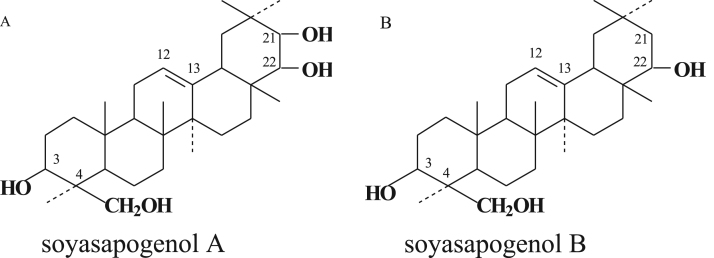
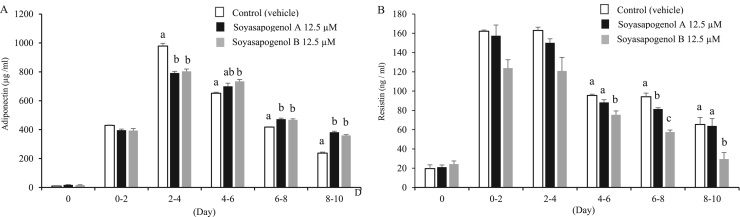
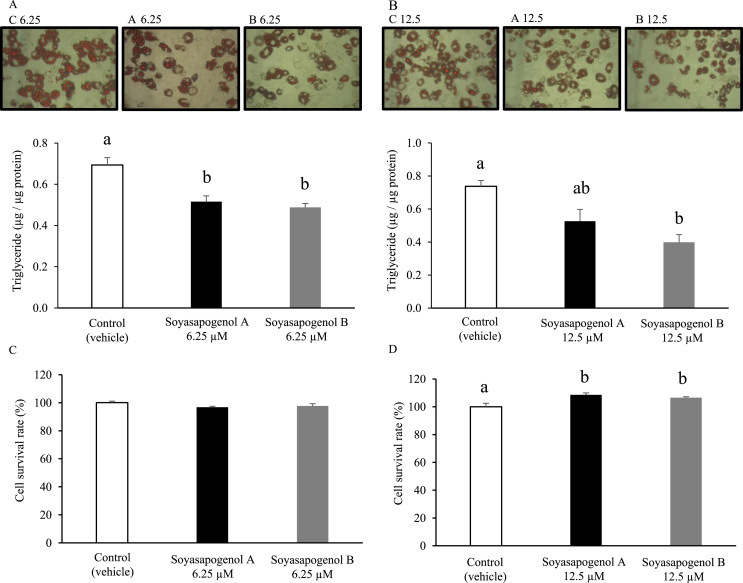
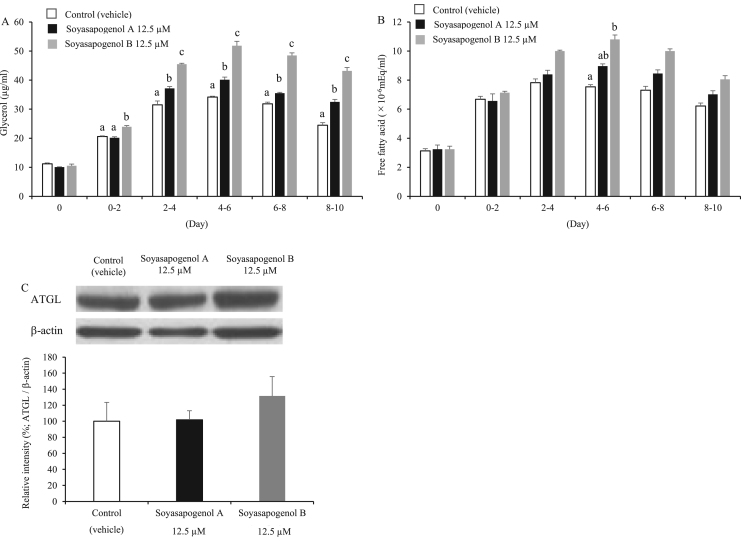
Soyasapogenol is a soyasaponin aglycone, which has been suggested to exert a more potent function than the glycoside form. In this study, the effect of soyasapogenol A and B on cultured adipocyte cell function was investigated using mouse 3T3-L1 adipocyte cells. 3T3-L1 cells were treated with insulin, dexamethasone, and 3-isobutyl-1-methylxanthine for differentiation to adipocytes, and the cells were then cultured in the presence of soyasapogenol A or B (6.25 or 12.5 µM). The media were harvested and refreshed every 2 d. After a 10 d culture, the cells were harvested and the triglyceride content of the cells was determined. The triglyceride content of soyasapogenol B-treated cells was significantly lower than those of vehicle-treated cells. Glycerol and free fatty acid levels in the soyasapogenol-treated cell media were higher than those in vehicle cells. However, there was no difference in the level of adipose triglyceride lipase among soyasapogenol A-, soyasapogenol B-, and vehicle-treated cells. The secreted adiponectin and resistin levels of soyasapogenol-treated cell media were also different compared with those of vehicle-treated cells. Especially, the secreted resistin level in soyasapogenol B-treated cell media was obviously reduced compared with that of vehicle-treated cells. Taken together, these results suggest that soyasapogenol B exerted an anti-obesity and anti-diabetic effect on adipocytes by lowering the cellular triglyceride level by accelerating triglyceride lipolysis with reduced resistin secretion.
大豆皂醇是一种大豆皂苷苷元,有人认为它比糖苷形式具有更强的功能。在本研究中,使用小鼠3T3-L1脂肪细胞研究了大豆皂醇A和B对培养的脂肪细胞功能的影响。将3T3-L1细胞用胰岛素、地塞米松和3-异丁基-1-甲基黄嘌呤处理以分化为脂肪细胞,然后在大豆皂醇A或B(6.25或12.5 μM)存在的情况下培养细胞。每2天收集并更换培养基。培养10天后,收获细胞并测定细胞内甘油三酯含量。大豆皂醇B处理的细胞中甘油三酯含量显著低于载体处理的细胞。大豆皂醇处理的细胞培养基中的甘油和游离脂肪酸水平高于载体处理的细胞。然而,大豆皂醇A、大豆皂醇B和载体处理的细胞之间的脂肪甘油三酯脂肪酶水平没有差异。大豆皂醇处理的细胞培养基中分泌的脂联素和抵抗素水平与载体处理的细胞也不同。特别是,大豆皂醇B处理的细胞培养基中分泌的抵抗素水平与载体处理的细胞相比明显降低。综上所述,这些结果表明大豆皂醇B通过加速甘油三酯脂解并减少抵抗素分泌来降低细胞内甘油三酯水平,从而对脂肪细胞发挥抗肥胖和抗糖尿病作用。