Rider Ashley C, Frazee Bradley W
Department of Emergency Physician, Alameda Health System - Highland Hospital, 1411 East 31st Street, Oakland, CA 94602, USA; UCSF, San Francisco, CA, USA.
Department of Emergency Medicine, Alameda Health System - Highland Hospital, 1411 East 31st Street, Oakland, CA 94602, USA.
Emerg Med Clin North Am. 2018 Nov;36(4):665-683. doi: 10.1016/j.emc.2018.07.001. Epub 2018 Sep 6.
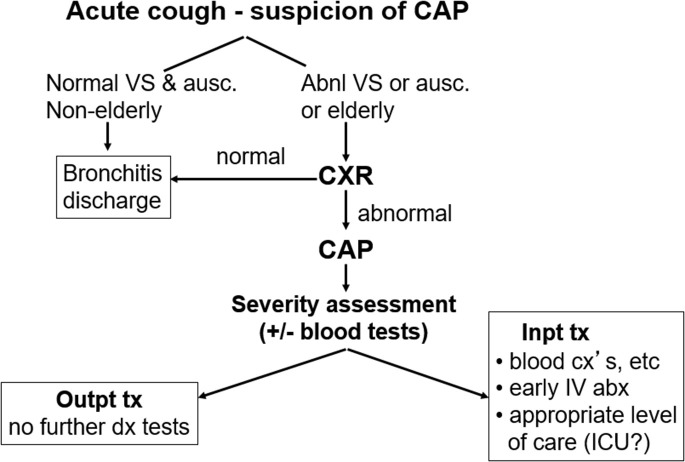
Community-acquired pneumonia is one of the most common infections seen in emergency department patients. There is a wide spectrum of disease severity and viral pathogens are common. After a careful history and physical examination, chest radiographs may be the only diagnostic test required. The first step in management is risk stratification, using a validated clinical decision rule and serum lactate, followed by early antibiotics and fluid resuscitation when indicated. Antibiotics should be selected with attention to risk factors for multidrug-resistant respiratory pathogens. Broad use of pneumococcal vaccine in adults and children can prevent severe community-acquired pneumonia.
社区获得性肺炎是急诊科患者中最常见的感染之一。疾病严重程度范围广泛,病毒病原体很常见。经过详细的病史询问和体格检查后,胸部X光片可能是唯一需要的诊断检查。管理的第一步是风险分层,使用经过验证的临床决策规则和血清乳酸,然后在有指征时尽早使用抗生素和进行液体复苏。选择抗生素时应注意耐多药呼吸道病原体的危险因素。在成人和儿童中广泛使用肺炎球菌疫苗可预防严重的社区获得性肺炎。