Department of Molecular Cell Biology and Immunology, VU University Medical Center, Amsterdam, Netherlands.
Department of Medical Oncology, VU University Medical Center, Amsterdam, Netherlands.
Front Immunol. 2018 Sep 21;9:1990. doi: 10.3389/fimmu.2018.01990. eCollection 2018.
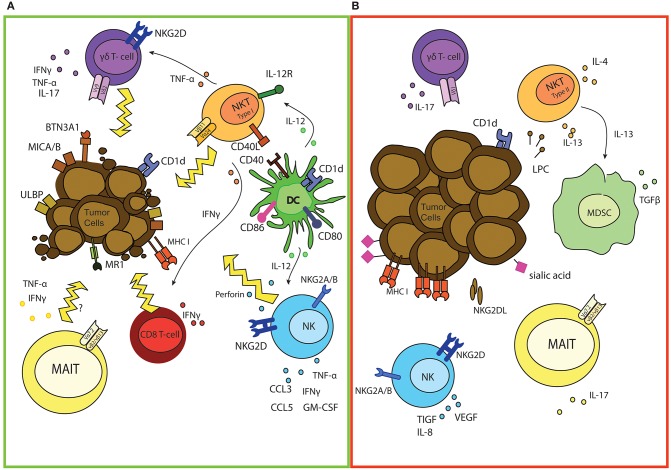
Innate immune cells are active at the front line of host defense against pathogens and now appear to play a range of roles under non-infectious conditions as well, most notably in cancer. Establishing the balance of innate immune responses is critical for the "flavor" of these responses and subsequent adaptive immunity and can be either "good or bad" in controlling cancer progression. The importance of innate NK cells in tumor immune responses has already been extensively studied over the last few decades, but more recently several relatively mono- or oligo-clonal [i.e., (semi-) invariant] innate T cell subsets received substantial interest in tumor immunology including invariant natural killer T (iNKT), γδ-T and mucosal associated invariant T (MAIT) cells. These subsets produce high levels of various pro- and/or anti-inflammatory cytokines/chemokines reflecting their capacity to suppress or stimulate immune responses. Survival of patients with cancer has been linked to the frequencies and activation status of NK, iNKT, and γδ-T cells. It has become clear that NK, iNKT, γδ-T as well as MAIT cells all have physiological roles in anti-tumor responses, which emphasize their possible relevance for tumor immunotherapy. A variety of clinical trials has focused on manipulating NK, iNKT, and γδ-T cell functions as a cancer immunotherapeutic approach demonstrating their safety and potential for achieving beneficial therapeutic effects, while the exploration of MAIT cell related therapies is still in its infancy. Current issues limiting the full therapeutic potential of these innate cell subsets appear to be related to defects and suppressive properties of these subsets that, with the right stimulus, might be reversed. In general, how innate lymphocytes are activated appears to control their subsequent abilities and consequent impact on adaptive immunity. Controlling these potent regulators and mediators of the immune system should enable their protective roles to dominate and their deleterious potential (in the specific context of cancer) to be mitigated.
固有免疫细胞活跃于宿主防御病原体的第一线,现在似乎在非传染性条件下也发挥着一系列作用,尤其是在癌症中。建立固有免疫反应的平衡对于这些反应的“性质”以及随后的适应性免疫至关重要,并且在控制癌症进展方面可以是“好”或“坏”。固有 NK 细胞在肿瘤免疫反应中的重要性在过去几十年中已经得到了广泛研究,但最近,一些相对单克隆或寡克隆(即,(半)不变)固有 T 细胞亚群在肿瘤免疫学中引起了广泛关注,包括不变自然杀伤 T(iNKT)、γδ-T 和黏膜相关不变 T(MAIT)细胞。这些亚群产生高水平的各种促炎和/或抗炎细胞因子/趋化因子,反映了它们抑制或刺激免疫反应的能力。癌症患者的存活率与 NK、iNKT 和 γδ-T 细胞的频率和激活状态有关。很明显,NK、iNKT、γδ-T 以及 MAIT 细胞在抗肿瘤反应中都具有生理作用,这强调了它们在肿瘤免疫治疗中的可能相关性。各种临床试验都集中在操纵 NK、iNKT 和 γδ-T 细胞功能作为癌症免疫治疗方法上,证明了它们的安全性和实现有益治疗效果的潜力,而 MAIT 细胞相关治疗的探索仍处于起步阶段。目前限制这些固有细胞亚群充分治疗潜力的问题似乎与这些亚群的缺陷和抑制特性有关,通过适当的刺激,这些缺陷和抑制特性可能会被逆转。一般来说,固有淋巴细胞的激活方式似乎控制着它们随后的能力以及对适应性免疫的影响。控制这些免疫系统的有效调节剂和介质应该使它们的保护作用占主导地位,并减轻它们的有害潜力(在癌症的特定背景下)。