Department of Periodontics, School of Stomatology, China Medical University, Shenyang 110002, China.
Department of Periodontics, Suzhou Stomatological Hospital, Stomatological Hospital Affiliated to Soochow University, Suzhou 215008, China.
Biomed Res Int. 2018 Sep 12;2018:7349351. doi: 10.1155/2018/7349351. eCollection 2018.
The primary purpose of this study was to evaluate the reparative efficacy of a novel antimicrobial peptide, Nal-P-113, in shortening the healing time of oral mucosal ulcers by promoting cell proliferation and migration and accelerating the cell cycle.
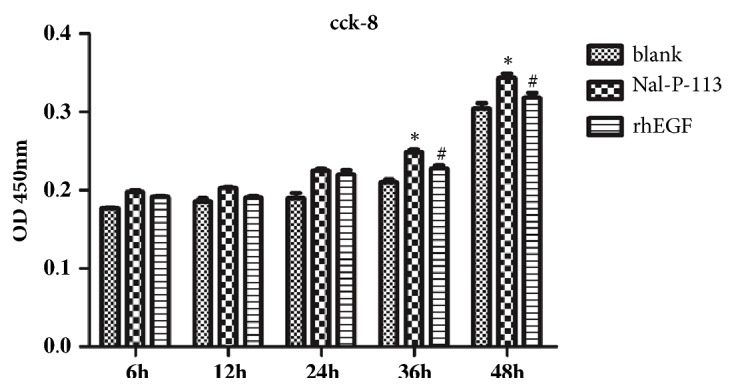
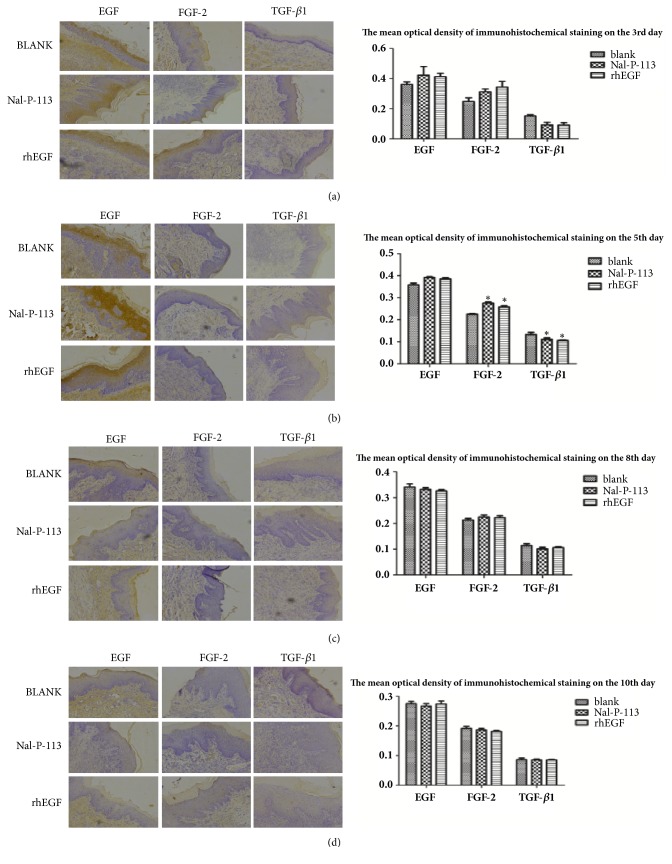
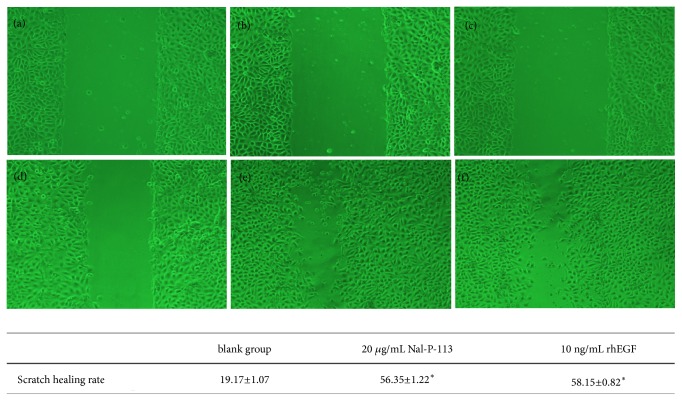
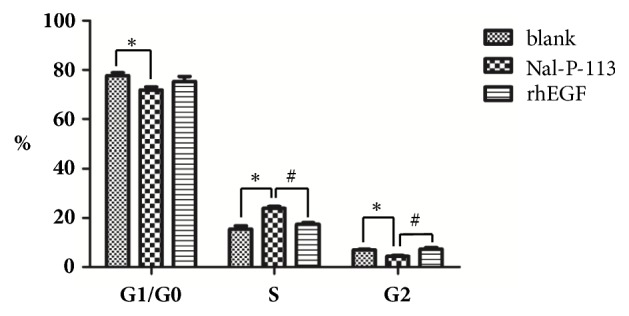
Cell counting kit-8 (CCK-8) and wound-healing assays were used to evaluate the proliferation and migration of human immortalized oral epithelial cells (HIOECs). The cell cycle distribution of HIOECs was analyzed by flow cytometry. Additionally, the RNA levels of EGF, FGF-2, and TGF-1 of HIOECs were assessed by real-time PCR. Rats were divided into three groups randomly: (a) blank control group; (b) 20 g/mL Nal-P-113; and (c) 10 ng/mL rhEGF. An oral mucosal ulcer was induced in every rat by the application of 30% acetic acid. An immunohistochemical assay was used to assess the expression of EGF, FGF-2, and TGF-1 in the rat oral mucosa.
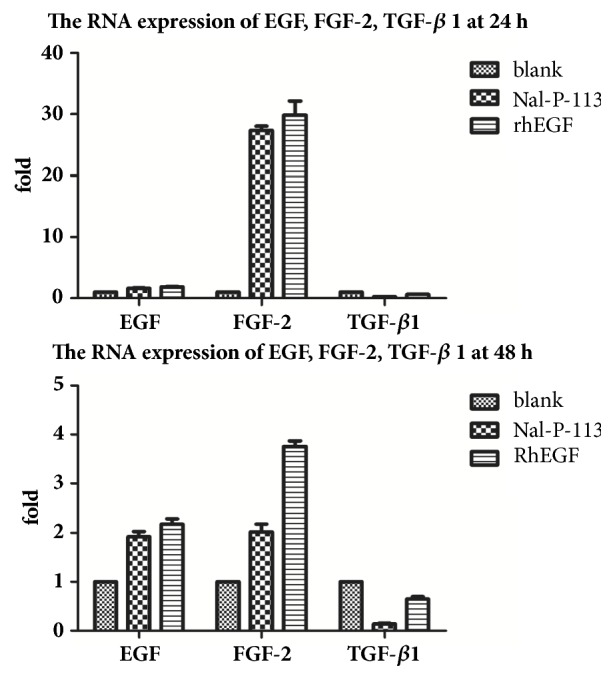
In the CCK-8 assay, the optical density values in the Nal-P-113 and rhEGF groups were found to be significantly higher than that in the blank control group. In addition, the scratch areas in the Nal-P-113 and rhEGF groups were found to be significantly smaller (<0.05). Cell cycle analysis showed that Nal-P-113 accelerated the entry of HIOECs into the S phase and expedited their cell cycles. The RT-PCR results suggested that Nal-P-113 upregulated the RNA levels of EGF and FGF-2 but downregulated that of TGF-1 at 24 h and 48 h. Lastly, the immunohistochemical assay verified that Nal-P-113 changed the expression of the above cytokines in rat mucosal ulcers.
Nal-P-113 promoted the repair of oral mucosal ulcers by increasing the EGF and FGF-2 expression and decreasing that of TGF-1 in HIOECs, accelerating their proliferation and cell cycle progression. The application of Nal-P-113 might serve as an effective therapeutic approach for recurrent aphthous stomatitis.
本研究的主要目的是评估一种新型抗菌肽 Nal-P-113 通过促进细胞增殖和迁移以及加速细胞周期来缩短口腔黏膜溃疡愈合时间的修复效果。
使用细胞计数试剂盒-8(CCK-8)和划痕愈合实验评估人永生化口腔上皮细胞(HIOEC)的增殖和迁移。通过流式细胞术分析 HIOEC 的细胞周期分布。此外,通过实时 PCR 评估 HIOEC 中表皮生长因子(EGF)、成纤维细胞生长因子-2(FGF-2)和转化生长因子-β1(TGF-β1)的 RNA 水平。将大鼠随机分为三组:(a)空白对照组;(b)20 g/mL Nal-P-113 组;和(c)10 ng/mL rhEGF 组。通过涂抹 30%醋酸诱导每只大鼠口腔黏膜溃疡。使用免疫组织化学检测大鼠口腔黏膜中 EGF、FGF-2 和 TGF-1 的表达。
在 CCK-8 检测中,Nal-P-113 和 rhEGF 组的光密度值明显高于空白对照组。此外,Nal-P-113 和 rhEGF 组的划痕面积明显较小(<0.05)。细胞周期分析表明,Nal-P-113 加速了 HIOEC 进入 S 期并加快了它们的细胞周期。RT-PCR 结果表明,Nal-P-113 在 24 小时和 48 小时时上调了 EGF 和 FGF-2 的 RNA 水平,但下调了 TGF-1 的 RNA 水平。最后,免疫组织化学检测证实,Nal-P-113 改变了大鼠黏膜溃疡中上述细胞因子的表达。
Nal-P-113 通过增加 HIOEC 中 EGF 和 FGF-2 的表达并降低 TGF-1 的表达来促进口腔黏膜溃疡的修复,从而加速其增殖和细胞周期进程。Nal-P-113 的应用可能成为复发性阿弗他口炎的有效治疗方法。