Department of Rehabilitation Medicine.
Multiple Sclerosis Center of Excellence-West, Veteran Affairs Puget Sound Health Care System.
Rehabil Psychol. 2018 Nov;63(4):612-620. doi: 10.1037/rep0000242. Epub 2018 Oct 8.
Much is known about the associations between negative factors and adjustment to chronic pain. However, less is known about how positive factors (e.g., positive affect [PA], resilience) function in relation to disability and mood in individuals with multiple sclerosis (MS). To better understand how positive factors contribute to function we sought to determine if (a) PA and/or trait resilience moderate the associations between pain intensity and function (pain interference, depressive symptoms), and (b) trait resilience concurrently mediates the association between PA and function in a sample of individuals with MS.
There were 455 adults with MS who provided data via an ongoing survey.
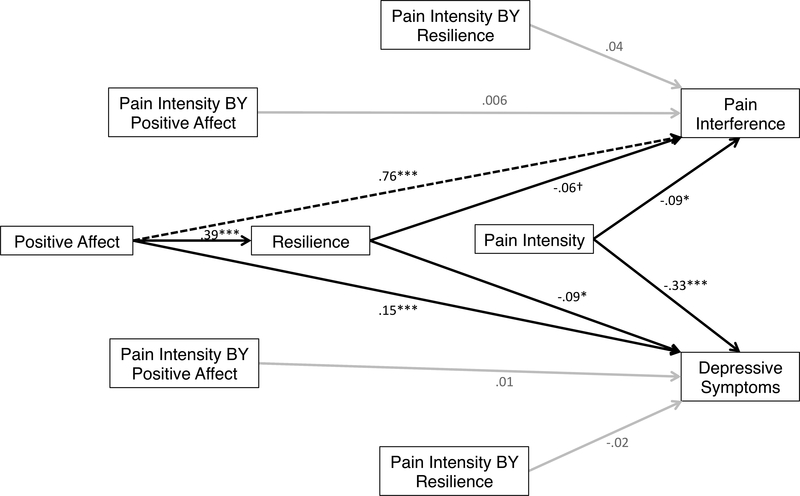
Controlling for negative affect, demographic, and disease-related variables, cross-sectional path analysis revealed the following: PA and trait resilience did not moderate the associations between pain intensity and pain interference (βPA = 0.01, p = .86; βRESILIENCE = 0.04, p = .33), and pain intensity and depression (βPA = 0.01, p = .79; βRESILIENCE = -0.02, p = .60). However, trait resilience significantly mediated the associations between PA and both criterion variables (abINTERFERENCE = -0.03, p = .03; abDEPRESSION = -0.13, p < .001).
The findings provide preliminary support for the conclusion that PA is indirectly related to pain interference and depression via resilience, rather than serves as a protective function. The findings are consistent with theoretical models suggesting that increases in PA build personal resources. Research examining the potential benefits of increasing PA and resilience to improve pain outcomes in individuals with MS is warranted. (PsycINFO Database Record (c) 2018 APA, all rights reserved).
人们对负面因素与慢性疼痛适应之间的关系了解较多。然而,对于积极因素(例如积极情绪[PA]、适应力)如何与多发性硬化症(MS)患者的残疾和情绪相关,人们的了解较少。为了更好地理解积极因素如何发挥作用,我们试图确定(a)PA 和/或特质适应力是否调节疼痛强度与功能(疼痛干扰、抑郁症状)之间的关系,以及(b)特质适应力是否同时在 MS 患者样本中调节 PA 与功能之间的关系。
共有 455 名 MS 成年人通过正在进行的调查提供了数据。
在控制了消极情绪、人口统计学和疾病相关变量后,横断面路径分析显示:PA 和特质适应力并没有调节疼痛强度与疼痛干扰之间的关系(βPA=0.01,p=.86;βRESILIENCE=0.04,p=.33),以及疼痛强度与抑郁之间的关系(βPA=0.01,p=.79;βRESILIENCE=-0.02,p=.60)。然而,特质适应力显著调节了 PA 与两个标准变量之间的关系(abINTERFERENCE=-0.03,p=.03;abDEPRESSION=-0.13,p<.001)。
这些发现初步支持了这样的结论,即 PA 通过适应力与疼痛干扰和抑郁间接相关,而不是作为一种保护功能。这些发现与理论模型一致,即增加 PA 可以建立个人资源。有必要研究增加 PA 和适应力以改善 MS 患者疼痛结果的潜在益处。(APA,所有权利保留)。