Department of Operative and Preventive Dentistry, Charité - Universitätsmedizin Berlin, Berlin, Germany.
Department of Restorative Dentistry, Periodontology, Endodontology, and Preventive and Pediatric Dentistry, University Medicine Greifswald, Greifswald, Germany.
J Clin Periodontol. 2018 Dec;45(12):1400-1407. doi: 10.1111/jcpe.13020. Epub 2018 Nov 20.
With more teeth retained for longer in an ageing population, population-wide periodontal treatment needs may increase. We assessed and projected periodontal treatment needs from 1997 to 2030 in Germany.
Partial-mouth probing-pocket depths (PPDs) from repeated waves (1997, 2005, 2014) of the nationally representative German Oral Health Studies were transformed into full-mouth PPDs via decision-tree-based ensemble-modelling. In line with German healthcare-regulations, teeth with PPD ≥ 4 mm were regarded as needing periodontal treatment. Weighted means were interpolated cross-sectionally by fitting spline-curves and then regressed longitudinally 1997-2030.
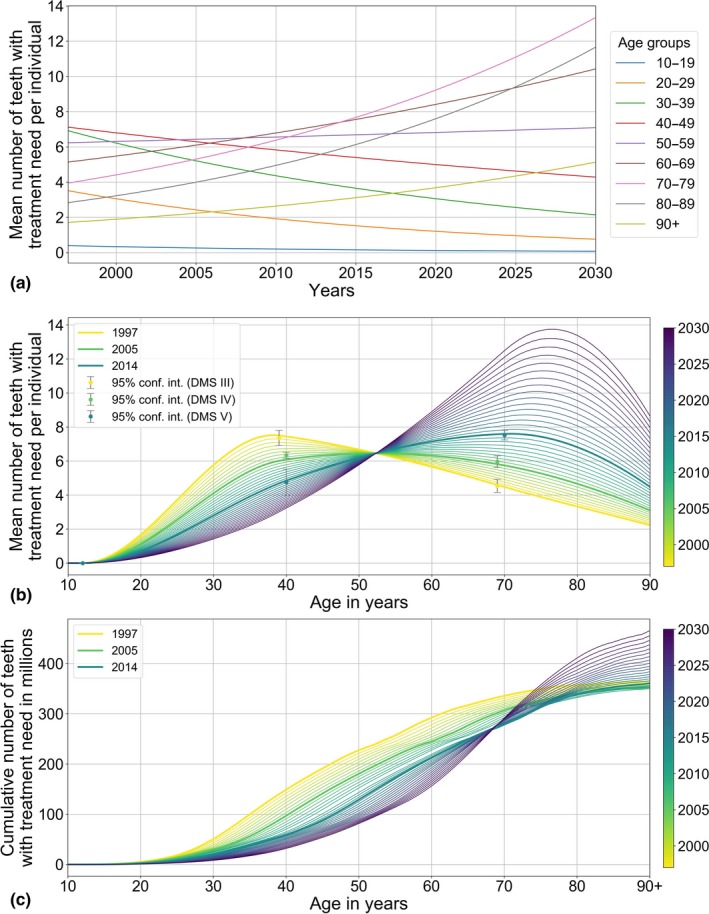
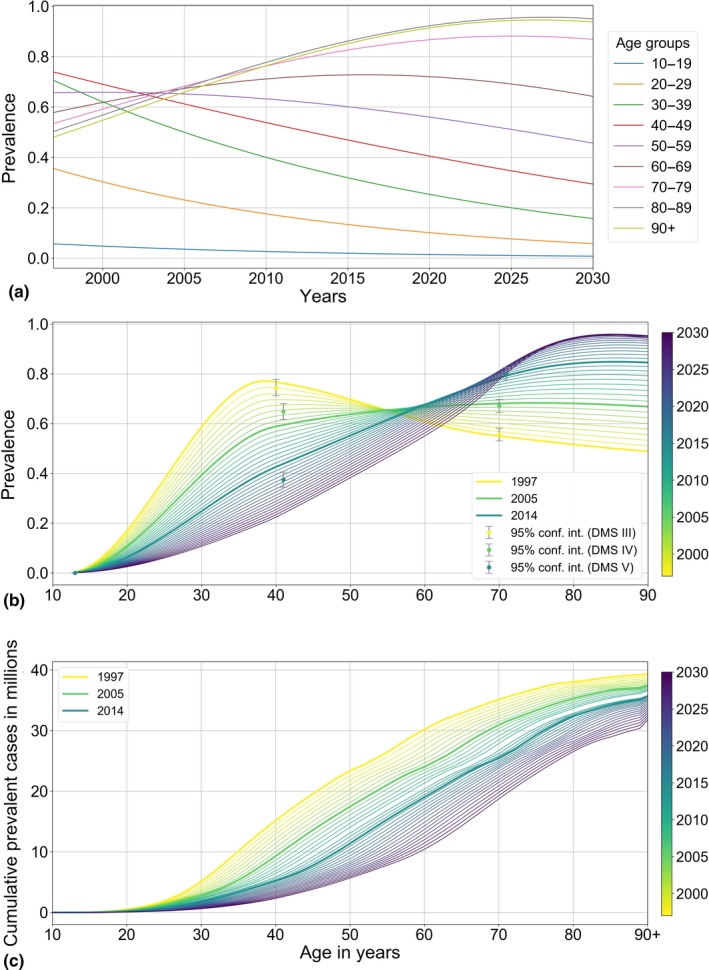
In 1997, younger adults (35-44 years old) had a mean of 7.4 teeth needing treatment (overall 93.8 million teeth); this decreased to 4.8 teeth (47.3 million teeth) in 2014. For 2030, we project 3.2 teeth (33.7 million teeth). In seniors, an increase was recorded (1997: 4.5 teeth, 33.5 million teeth; 2014: 7.5 teeth, 63.4 million teeth); this is expected to continue until 2030 (to 12.2 teeth, 140.8 million teeth). The cumulative number of teeth needing treatment increased from 2000 (355 million) to 2015 (365 million), and will increase further to 2030 (464 million).
Population-wide periodontal treatment needs may increase until 2030, mainly in the elderly. Concepts for addressing, these growing needs are required.
随着人口老龄化,越来越多的人保留更多的牙齿,因此,全人群牙周治疗需求可能会增加。我们评估并预测了德国从 1997 年至 2030 年的牙周治疗需求。
利用全国代表性的德国口腔健康研究(1997 年、2005 年、2014 年)中重复的牙周袋深度(PPD)的部分口腔探测数据,通过基于决策树的集成模型转化为全口 PPD。根据德国医疗保健法规,将 PPD≥4mm 的牙齿视为需要牙周治疗的牙齿。通过拟合样条曲线对加权均值进行横截面插值,然后对 1997-2030 年的数据进行纵向回归。
1997 年,年轻成年人(35-44 岁)平均有 7.4 颗需要治疗的牙齿(总计 9380 万颗牙齿);这一数字在 2014 年减少到 4.8 颗(4730 万颗牙齿)。到 2030 年,我们预计有 3.2 颗牙齿(3370 万颗牙齿)需要治疗。在老年人中,记录到的牙齿数量增加(1997 年:4.5 颗,3350 万颗牙齿;2014 年:7.5 颗,6340 万颗牙齿);预计这一数字将持续到 2030 年(12.2 颗,14080 万颗牙齿)。需要治疗的牙齿总数从 2000 年(3.55 亿颗)增加到 2015 年(3.65 亿颗),并将进一步增加到 2030 年(4.64 亿颗)。
全人群牙周治疗需求可能会持续增加到 2030 年,主要是在老年人中。需要有概念来应对这些不断增长的需求。