Samietz Stefanie, Borof Katrin, Hertrampf Katrin, Aarabi Ghazal, Ciardo Antonio, Finke Hannah, Hagenfeld Daniel, Kühnisch Jan, Rütters Maurice, Baumeister Sebastian-Edgar, Reckelkamm Stefan Lars, Kim Ti-Sun, Kocher Thomas, Ahrens Wolfgang, Brenner Hermann, Emmel Carina, Fischer Beate, Führer Amand, Greiser Karin Halina, Grischke Jasmin, Günther Kathrin, Harth Volker, Jaskulski Stefanie, Karch André, Keil Thomas, Kemmling Yvonne, Kluttig Alexander, Krist Lilian, Kuss Oliver, Leitzmann Michael, Meinke-Franze Claudia, Michels Karin B, Obi Nadia, Peters Anette, Pischon Nicole, Pischon Tobias, Schipf Sabine, Schmidt Börge, Teismann Henning, Rupf Stefan, Holtfreter Birte
Department of Prosthetic Dentistry, Gerodontology and Biomaterials, University Medicine Greifswald, Greifswald, Germany.
Department of Periodontics, Preventive and Restorative Dentistry, Centre for Dental and Oral Medicine, University Medical Centre Hamburg-Eppendorf, Hamburg, Germany.
BMC Oral Health. 2025 Jan 28;25(1):149. doi: 10.1186/s12903-025-05454-z.
Despite considerable improvements in oral health in recent decades, caries and periodontitis are still widespread, ranking among the most prevalent diseases worldwide and requiring future research. The German National Cohort (NAKO Gesundheitsstudie, NAKO) is a large-scaled, multidisciplinary, nationwide, multi-centre, population-based, prospective cohort study with oral examinations that aims to provide a resource to study risk factors for major diseases. The aim of the present article is to provide the methodological background, to report on the data quality, and to present initial results of the oral examinations.
During baseline examinations (2014-2019), a total of 205,184 persons aged 19-74 years has been examined in 18 study centres, including, among others, a dental interview, stimulated saliva sampling, and recording of the numbers of present teeth and prostheses (standard Level 1 program). As part of the Level 2 program that was offered to 20% randomly selected participants, each study centre selected one of three modules, one of them being the Level 2 oral examination. This extended program was carried out in a subgroup of 20,828 participants, including collection of detailed information on the dental and prosthetic status as well as on periodontal, cariological and functional aspects. To ensure reliability and reproducibility, study nurses were trained and calibrated by dental experts. In addition, a reliability study was conducted among 794 Level 1 and 359 Level 2 participants, reporting intra class correlation and kappa coefficients.
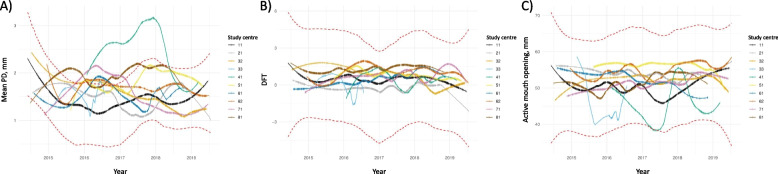
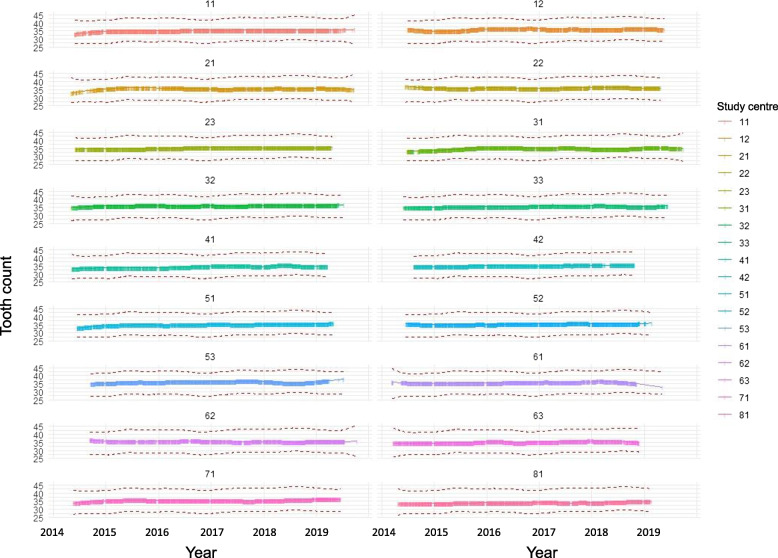
Intra class correlation and kappa coefficients for observer agreement and reliability were consistently above 0.7, indicating good to excellent reliability of all dental measurements. For example, intra class correlation was 0.937 for the number of present teeth (Level 1), 0.740 for mean probing depth (PD) and 0.797 for active mouth opening. An initial inspection of the data showed that the median number of present teeth was 27, of which on average 6.9 teeth were healthy and caries-free. Average mean PD was 1.92 mm. An orthodontic treatment was reported by 35.5% of participants.
Overall, the dental study protocol was feasible and successfully integrated into the NAKO's overall assessment program. However, rigorous support of the study centres by dental professionals was required to ensure high quality data. In summary, high-quality data collection within the NAKO pave the way for future investigation of potential risk factors for oral diseases and links between oral and systemic diseases and conditions.
尽管近几十年来口腔健康状况有了显著改善,但龋齿和牙周炎仍然普遍存在,是全球最常见的疾病之一,需要未来开展研究。德国国民队列研究(NAKO健康研究,NAKO)是一项大规模、多学科、全国性、多中心、基于人群的前瞻性队列研究,包含口腔检查,旨在为研究重大疾病的风险因素提供资源。本文旨在提供方法学背景,报告数据质量,并展示口腔检查的初步结果。
在基线检查期间(2014 - 2019年),18个研究中心对总共205,184名年龄在19 - 74岁的人进行了检查,其中包括牙科访谈、刺激性唾液采样以及现存牙齿和假牙数量的记录(标准1级程序)。作为提供给20%随机选择参与者的2级程序的一部分,每个研究中心从三个模块中选择一个,其中之一是2级口腔检查。这个扩展程序在20,828名参与者的子组中进行,包括收集关于牙齿和假牙状况以及牙周、龋病和功能方面的详细信息。为确保可靠性和可重复性,研究护士由牙科专家进行培训和校准。此外,在794名1级参与者和359名2级参与者中进行了可靠性研究,报告了组内相关系数和kappa系数。
观察者一致性和可靠性的组内相关系数和kappa系数始终高于0.7,表明所有牙科测量的可靠性良好至优秀。例如,现存牙齿数量(1级)的组内相关系数为0.937,平均探诊深度(PD)为0.740,主动开口度为0.797。对数据的初步检查显示,现存牙齿的中位数为27颗,其中平均6.9颗牙齿健康且无龋齿。平均平均PD为1.92毫米。35.5%的参与者报告接受过正畸治疗。
总体而言,牙科研究方案是可行的,并成功纳入了NAKO的整体评估计划。然而,需要牙科专业人员对研究中心进行严格支持,以确保高质量数据。总之,NAKO内的高质量数据收集为未来研究口腔疾病的潜在风险因素以及口腔与全身疾病和状况之间的联系铺平了道路。