Yoshimizu Shoichi, Hirasawa Toshiaki, Horiuchi Yusuke, Omae Masami, Ishiyama Akiyoshi, Yoshio Toshiyuki, Tsuchida Tomohiro, Fujisaki Junko
Division of Gastroenterology, Cancer Institute Hospital, Tokyo, Japan.
Endosc Int Open. 2018 Oct;6(10):E1190-E1197. doi: 10.1055/a-0655-7382. Epub 2018 Oct 8.
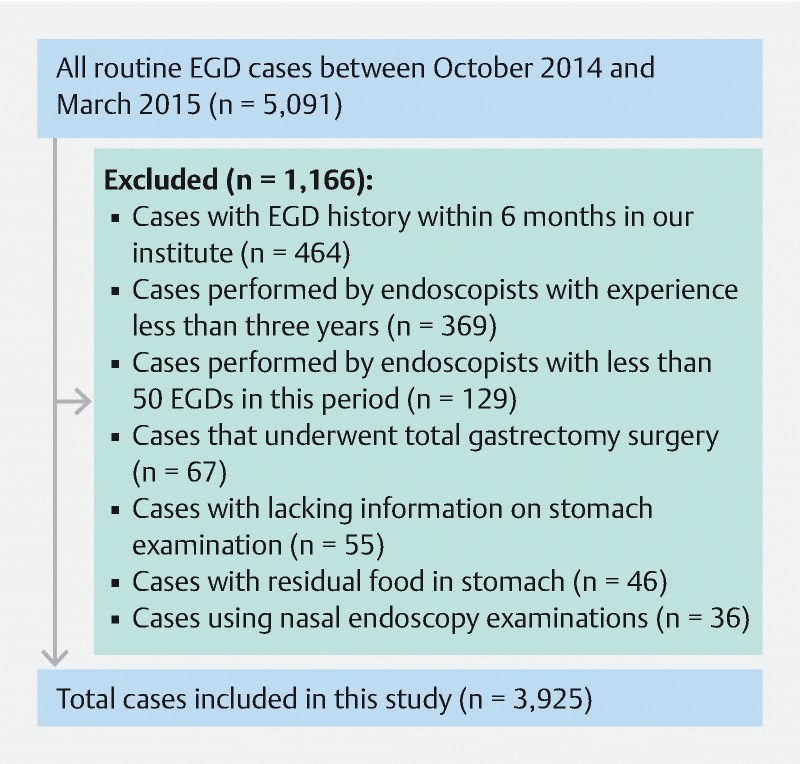
Esophagogastroduodenoscopy (EGD) has utility in early detection of upper gastrointestinal (UGI) neoplasms. However, previous studies report shorter inspection times and inexperienced endoscopists contribute to overlooking gastric neoplasms. We investigated neoplasm detection rates according to inspection time and extent of EGD training. In this retrospective observational study, we reviewed routine EGDs for 3,925 consecutive cases between October 2014 and March 2015. We divided the endoscopists into three groups based on median inspection time during EGD without undergoing biopsy. Using cut-off median inspection times of 7 and 10 minutes, three, five, and eight endoscopists were classified into the fast, moderate, and slow groups, respectively. We compared detection rates according to inspection time and the extent of EGD training. The median inspection time among all endoscopists was 9.3 minutes (range, 6.6 - 12.0 min). The detection rate for UGI neoplasms was as follows: fast group, 3.6%; moderate group, 3.3 %; and slow group, 3.1 % ( = 0.807). The median inspection time was significantly shorter among the intensive training ≥ 1-year group than among the < 1-year group (< 1-year: median 6.3 min; range 8.2 - 13.9 min, ≥ 1-year: median 8.9 min; range 6.4 - 11.4 min, < 0.001). The detection rate for UGI neoplasms was significantly higher among the intensive training ≥ 1-year group than among the < 1-year group (< 1-year: 2.2 %; ≥ 1-year: 3.7 %, OR = 1.65, 95 % CI: 1.02 - 2.68, = 0.041). There was no association between inspection times and neoplasm detection rates. The quality of EGD, as measured by neoplasm detection rates, may be improved by ≥ 1-year of intensive training.
食管胃十二指肠镜检查(EGD)在早期发现上消化道(UGI)肿瘤方面具有实用价值。然而,以往研究报告称,检查时间较短以及内镜医师经验不足会导致胃肿瘤被漏诊。我们根据检查时间和EGD培训程度调查了肿瘤检出率。在这项回顾性观察研究中,我们回顾了2014年10月至2015年3月期间连续3925例常规EGD检查病例。我们根据EGD期间未进行活检时的中位检查时间将内镜医师分为三组。使用7分钟和10分钟的中位检查时间临界值,分别有3名、5名和8名内镜医师被归类为快速组、中等组和慢速组。我们比较了根据检查时间和EGD培训程度的检出率。所有内镜医师的中位检查时间为9.3分钟(范围6.6 - 12.0分钟)。UGI肿瘤的检出率如下:快速组为3.6%;中等组为3.3%;慢速组为3.1%(P = 0.807)。强化培训≥1年组的中位检查时间明显短于<1年组(<1年组:中位6.3分钟;范围8.2 - 13.9分钟,≥1年组:中位8.9分钟;范围6.4 - 11.4分钟,P < 0.001)。强化培训≥1年组的UGI肿瘤检出率明显高于<1年组(<1年组:2.2%;≥1年组:3.7%,OR = 1.65,95% CI:1.02 - 2.68,P = 0.041)。检查时间与肿瘤检出率之间没有关联。通过≥1年的强化培训,以肿瘤检出率衡量的EGD质量可能会得到提高。