National Central Cancer Registry, National Cancer Center/National Clinical Research Center for Cancer/Cancer Hospital, Chinese Academy of Medical Sciences and Peking Union Medical College, Beijing, China.
Office for Cancer Screening, National Cancer Center/National Clinical Research Center for Cancer/Cancer Hospital, Chinese Academy of Medical Sciences and Peking Union Medical College, 17 South Lane, Panjiayuan, Chaoyang District, Beijing, 100021, China.
BMC Gastroenterol. 2020 Nov 24;20(1):398. doi: 10.1186/s12876-020-01517-3.
We initiated the first multi-center cluster randomized trial of endoscopic screening for esophageal cancer and gastric cancer in China. The objective of the study was to report the baseline screening findings in this trial.
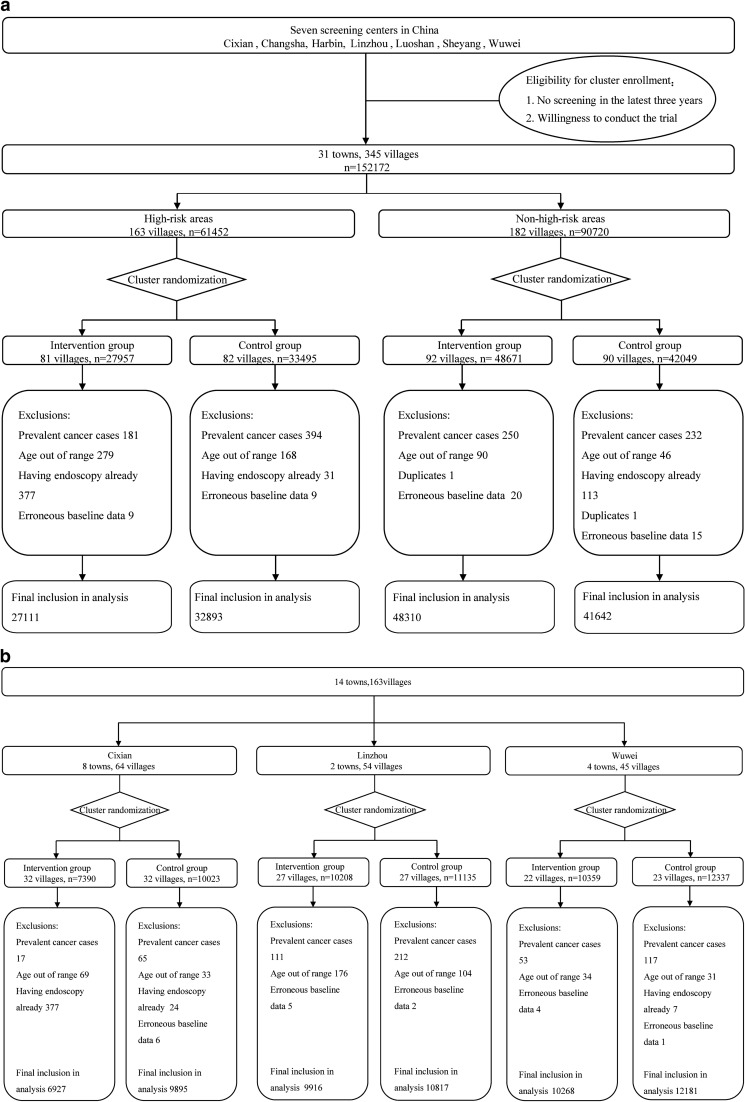
We recruited a total of 345 eligible clusters from seven screening centers. In the intervention group, participants from high-risk areas were screened by endoscopy; in non-high-risk areas, high-risk individuals were identified using a questionnaire and advised for endoscopy. Lugol's iodine staining in esophagus and indigo carmine dye in stomach were performed to aid in the diagnosis of suspicious lesions. The primary outcomes of this study were the detection rate (proportion of positive cases among individuals who underwent endoscopic screening) and early detection rate (the proportion of positive cases with stage 0/I among all positive cases).
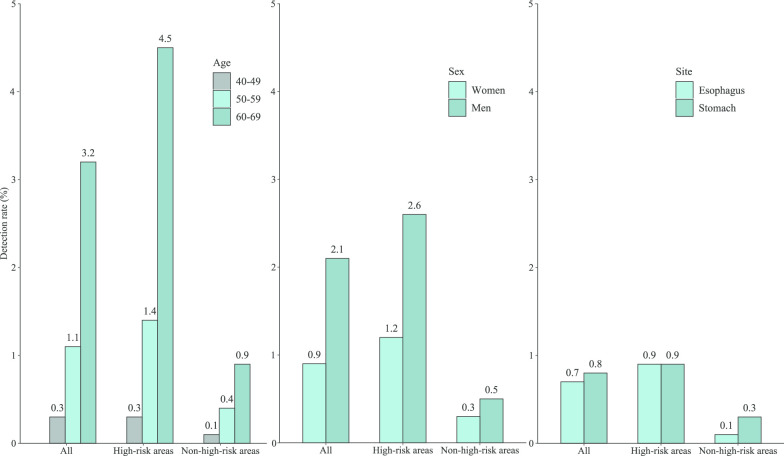
A total of 149,956 eligible subjects were included. The detection rate was 0.7% in esophagus and 0.8% in stomach, respectively. Compared with non-high-risk areas, the detection rates in high-risk areas were higher, both in esophagus (0.9% vs. 0.1%) and in stomach (0.9% vs. 0.3%). The same difference was found for early-detection rate (esophagus: 92.9% vs. 53.3%; stomach: 81.5% vs. 33.3%).
The diagnostic yield of both esophagus and stomach were higher in high-risk areas than in non-high-risk areas, even though in non-high-risk areas, only high-risk individuals were screened. Our study may provide important clues for evaluating and improving the effectiveness of upper-endoscopic screening in China.
Protocol Registration System in Chinese Clinical Trial Registry, ChiCTR-EOR-16008577. Registered 01 June 2016-Retrospectively registered, http://www.chictr.org.cn/showprojen.aspx?proj=14372.
我们在中国首次开展了多中心、集群、随机对照内镜筛查食管癌和胃癌的研究。本研究旨在报告该试验的基线筛查结果。
我们从 7 个筛查中心共招募了 345 个符合条件的集群。在干预组中,高危地区的参与者接受内镜筛查;在非高危地区,通过问卷识别高危个体,并建议其进行内镜检查。食管采用卢戈氏碘染色,胃采用靛胭脂染色,以辅助可疑病变的诊断。本研究的主要结局为检出率(接受内镜筛查者中阳性病例的比例)和早期检出率(所有阳性病例中 0 期/Ⅰ期阳性病例的比例)。
共纳入 149956 名符合条件的受试者。食管和胃的检出率分别为 0.7%和 0.8%。与非高危地区相比,高危地区的检出率在食管(0.9%比 0.1%)和胃(0.9%比 0.3%)中均更高。早期检出率也存在同样的差异(食管:92.9%比 53.3%;胃:81.5%比 33.3%)。
即使在非高危地区仅对高危个体进行筛查,高危地区食管和胃的诊断检出率也高于非高危地区。本研究为评估和提高中国内镜筛查的有效性提供了重要线索。
中国临床试验注册中心,ChiCTR-EOR-16008577。注册日期:2016 年 6 月 1 日-回顾性注册,http://www.chictr.org.cn/showprojen.aspx?proj=14372。