Inserm, Paris, France.
Institut Curie, Paris, France.
Int J Cancer. 2019 Apr 15;144(8):1962-1974. doi: 10.1002/ijc.31921. Epub 2018 Nov 13.
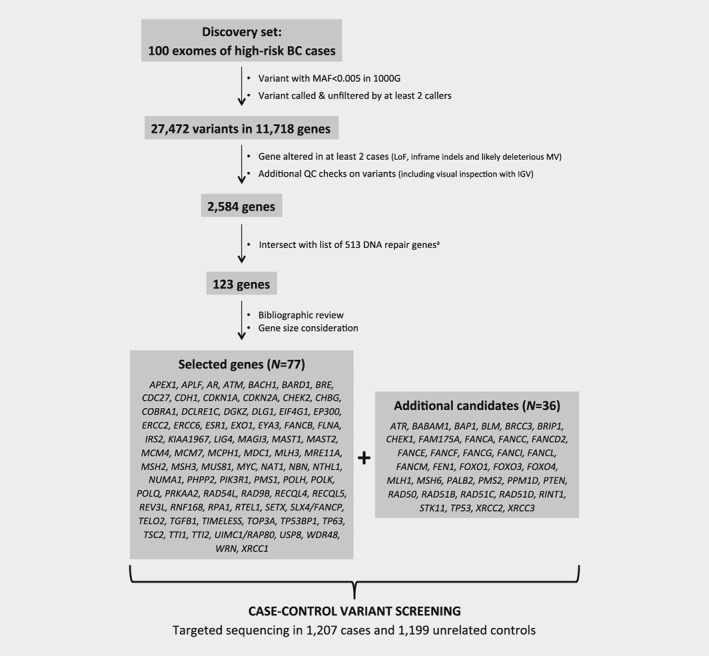
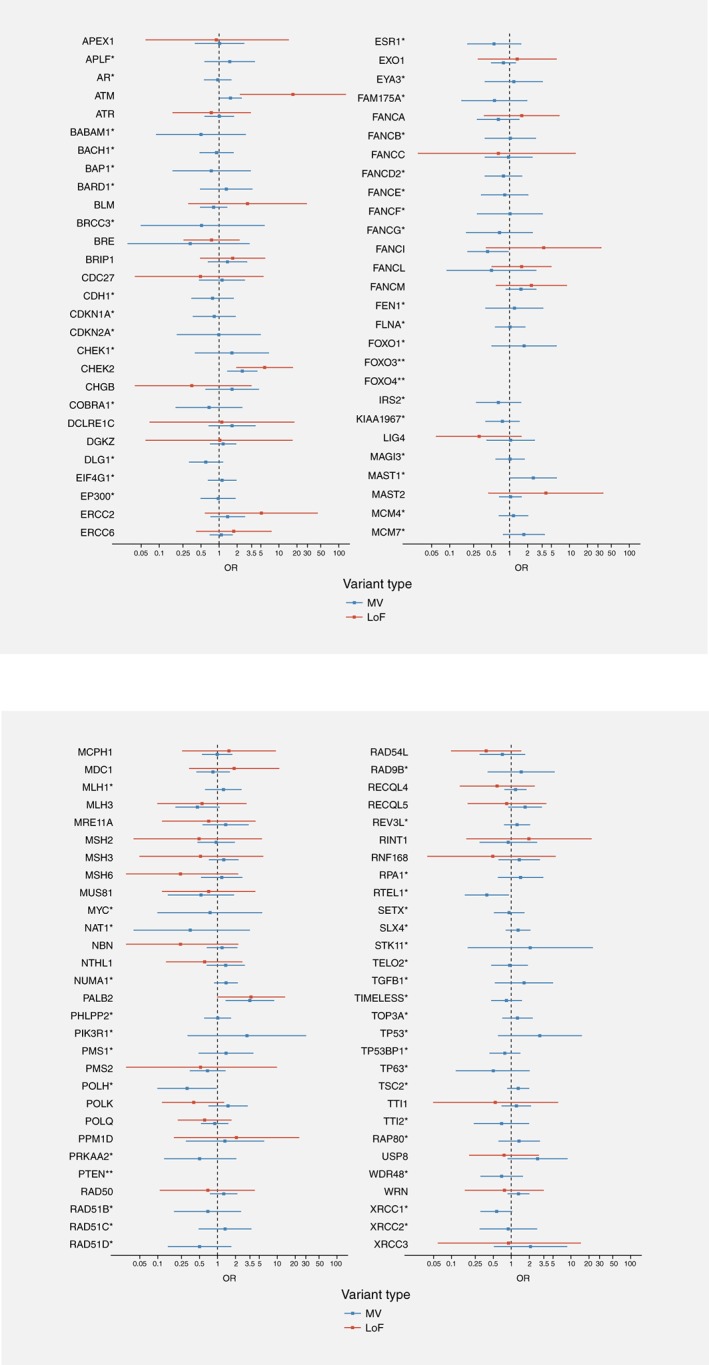
Pathogenic variants in BRCA1 and BRCA2 only explain the underlying genetic cause of about 10% of hereditary breast and ovarian cancer families. Because of cost-effectiveness, multigene panel testing is often performed even if the clinical utility of testing most of the genes remains questionable. The purpose of our study was to assess the contribution of rare, deleterious-predicted variants in DNA repair genes in familial breast cancer (BC) in a well-characterized and homogeneous population. We analyzed 113 DNA repair genes selected from either an exome sequencing or a candidate gene approach in the GENESIS study, which includes familial BC cases with no BRCA1 or BRCA2 mutation and having a sister with BC (N = 1,207), and general population controls (N = 1,199). Sequencing data were filtered for rare loss-of-function variants (LoF) and likely deleterious missense variants (MV). We confirmed associations between LoF and MV in PALB2, ATM and CHEK2 and BC occurrence. We also identified for the first time associations between FANCI, MAST1, POLH and RTEL1 and BC susceptibility. Unlike other associated genes, carriers of an ATM LoF had a significantly higher risk of developing BC than carriers of an ATM MV (OR = 17.4 vs. OR = 1.6; p = 0.002). Hence, our approach allowed us to specify BC relative risks associated with deleterious-predicted variants in PALB2, ATM and CHEK2 and to add MAST1, POLH, RTEL1 and FANCI to the list of DNA repair genes possibly involved in BC susceptibility. We also highlight that different types of variants within the same gene can lead to different risk estimates.
BRCA1 和 BRCA2 中的致病变体仅解释了约 10%的遗传性乳腺癌和卵巢癌家族的潜在遗传原因。由于成本效益,即使大多数基因的检测临床实用性仍存在疑问,多基因面板检测也经常进行。我们的研究目的是评估在一个特征明确且同质的人群中,DNA 修复基因中罕见的、预测有害的变体对家族性乳腺癌(BC)的贡献。我们分析了 GENESIS 研究中从外显子组测序或候选基因方法中选择的 113 个 DNA 修复基因,该研究包括无 BRCA1 或 BRCA2 突变且有姐妹患有 BC 的家族性 BC 病例(N=1,207),以及普通人群对照(N=1,199)。对测序数据进行了罕见的功能丧失变异(LoF)和可能有害的错义变异(MV)的过滤。我们证实了 LoF 和 MV 在 PALB2、ATM 和 CHEK2 与 BC 发生之间的关联。我们还首次发现了 FANCI、MAST1、POLH 和 RTEL1 与 BC 易感性之间的关联。与其他相关基因不同,ATM LoF 的携带者发生 BC 的风险明显高于 ATM MV 的携带者(OR=17.4 与 OR=1.6;p=0.002)。因此,我们的方法使我们能够确定 PALB2、ATM 和 CHEK2 中预测有害的变体与 BC 相对风险之间的关联,并将 MAST1、POLH、RTEL1 和 FANCI 添加到可能参与 BC 易感性的 DNA 修复基因列表中。我们还强调,同一基因中的不同类型的变体可能导致不同的风险估计。