Jalkh Nadine, Chouery Eliane, Haidar Zahraa, Khater Christina, Atallah David, Ali Hamad, Marafie Makia J, Al-Mulla Mohamed R, Al-Mulla Fahd, Megarbane Andre
Unité de Génétique Médicale, Pôle Technologie Santé, Faculty of Medicine, Saint Joseph University, Beirut, Lebanon.
Trad Hospital, Beirut, Lebanon.
BMC Med Genomics. 2017 Feb 15;10(1):8. doi: 10.1186/s12920-017-0244-7.
Familial breast cancer (BC) represents 5 to 10% of all BC cases. Mutations in two high susceptibility BRCA1 and BRCA2 genes explain 16-40% of familial BC, while other high, moderate and low susceptibility genes explain up to 20% more of BC families. The Lebanese reported prevalence of BRCA1 and BRCA2 deleterious mutations (5.6% and 12.5%) were lower than those reported in the literature.
In the presented study, 45 Lebanese patients with a reported family history of BC were tested using Whole Exome Sequencing (WES) technique followed by Sanger sequencing validation.
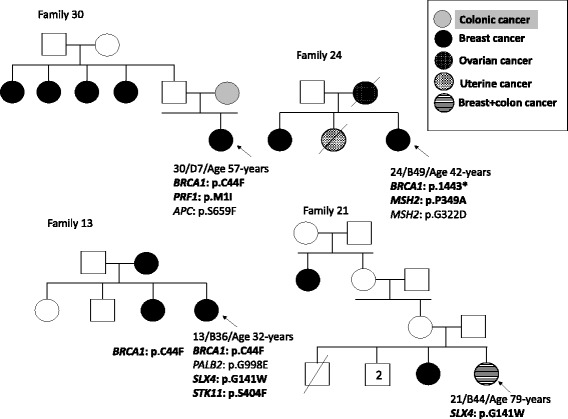
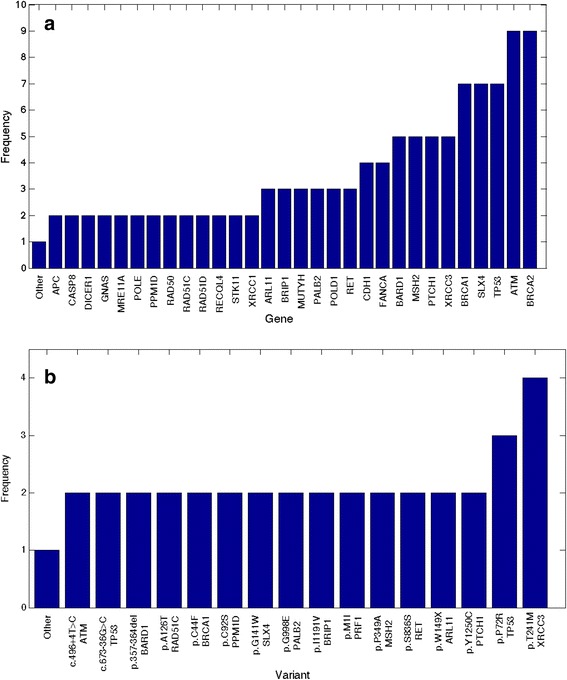
Nineteen pathogenic mutations were identified in this study. These 19 mutations were found in 13 different genes such as: ABCC12, APC, ATM, BRCA1, BRCA2, CDH1, ERCC6, MSH2, POLH, PRF1, SLX4, STK11 and TP53.
In this first application of WES on BC in Lebanon, we detected six BRCA1 and BRCA2 deleterious mutations in seven patients, with a total prevalence of 15.5%, a figure that is lower than those reported in the Western literature. The p.C44F mutation in the BRCA1 gene appeared twice in this study, suggesting a founder effect. Importantly, the overall mutation prevalence was equal to 40%, justifying the urgent need to deploy WES for the identification of genetic variants responsible for familial BC in the Lebanese population.
家族性乳腺癌(BC)占所有乳腺癌病例的5%至10%。两个高易感性基因BRCA1和BRCA2的突变解释了16%-40%的家族性乳腺癌,而其他高、中、低易感性基因又解释了多达20%的乳腺癌家族病例。黎巴嫩报告的BRCA1和BRCA2有害突变患病率(分别为5.6%和12.5%)低于文献报道。
在本研究中,对45名有乳腺癌家族史报告的黎巴嫩患者采用全外显子测序(WES)技术进行检测,随后进行桑格测序验证。
本研究共鉴定出19个致病突变。这些突变分布于13个不同基因,如:ABCC12、APC、ATM、BRCA1、BRCA2、CDH1、ERCC6、MSH2、POLH、PRF1、SLX4、STK11和TP53。
在黎巴嫩首次将WES应用于乳腺癌研究中,我们在7名患者中检测到6个BRCA1和BRCA2有害突变,总患病率为15.5%,这一数字低于西方文献报道。BRCA1基因中的p.C44F突变在本研究中出现了两次,提示存在奠基者效应。重要的是,总体突变患病率为40%,这证明迫切需要采用WES来鉴定黎巴嫩人群中导致家族性乳腺癌的基因变异。